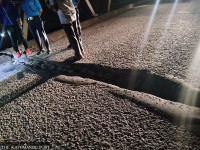
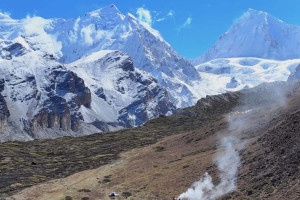
With the main gateway to China destroyed and alternatives vulnerable to floods, landslides and harsh weather, traders face another uncertain festival season. Rescuers carry out search and rescue operations at the mudslide-hit Gyirong Port in Gyirong County, southwest China’s Tibet on Saturday. Handout photo: Xinhua
The road to Rasuwagadhi was less a conventional highway than a narrow shelf cut into the steep walls of the Bhotekoshi gorge. In places, the asphalt clung directly to the mountainside above the river, with the milky-turquoise Bhotekoshi roaring far below. The road edge plunged almost vertically into the churning rapids, leaving barely enough room for two cargo trucks or containers to squeeze past each other.
At the end of this precarious corridor lies the Rasuwagadhi border point in Rasuwa district, Nepal’s main overland gateway to China. Across the frontier is Gyirong, known in Nepal as Kerung, a Chinese border town connected to Tibet’s road network.
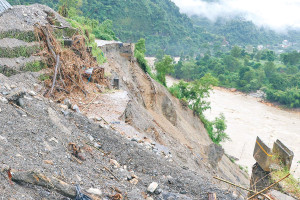
The floods that tore through the Bhotekoshi corridor on August 26 destroyed this vital crossing and left Nepal’s main overland trade gateway with China cut off. The disaster, which killed 788 people and left over 2,500 missing, according to the latest figures, has wiped out this all-weather international trade point without a trace.
The Rasuwagadhi-Kerung crossing opened in December 2014, but its strategic importance grew dramatically after the 2015 earthquake.
Nepal’s other major northern trade route, Tatopani on the Araniko Highway, was badly damaged by the earthquake and remained effectively closed for years. Although the crossing eventually resumed limited operations, it never regained its former prominence as Nepal’s principal overland link with Tibet.
That shift turned Rasuwagadhi into the country’s critical trade artery with China. Trucks carrying garments, electronics, vehicles, machinery and everyday consumer goods began flowing through the gorge towards Kathmandu. The road is therefore not merely a remote border route, it is a supply line connecting Chinese markets with Nepal’s largest consumer centre.
The stakes are particularly high in the weeks before Nepal’s major autumn festivals, when demand for vehicles, clothing, electronics and other consumer goods rises sharply. When the Rasuwagadhi corridor is cut, the impact is felt far beyond the gorge—it can ripple through Kathmandu’s markets, supply chains and prices.
After the April 2015 earthquake severely damaged the Araniko Highway in several sections, the Rasuwa-Kerung border point emerged as a lifeline for trade between Nepal and China.
In August 2017, the border point was upgraded to an international crossing, with the aim of developing it into a major trade junction linking China with South Asia. There was a geopolitical calculation behind the decision too.
Following the five-month-long border blockade imposed by India, from September 2015 to February 2016, Nepal sought to open new border crossings with China to ease shortages of fuel and other essentials. Beijing subsequently assured Nepal that it would upgrade the Kerung border point as part of its Belt and Road Initiative.
China was also looking at the longer-term potential of expanding trade to South Asia through the route, potentially connecting with the Indian states of Bihar and Uttar Pradesh, whose combined population is estimated at around 375 million, as well as Bangladesh, with a population of about 178 million.
When China and Nepal announced the upgrading of the crossing, Chinese officials said third-country trade would eventually be possible if China reached separate agreements with countries willing to use the route.
Kerung, the nearest Chinese town to Nepal, is about 35 km from the Rasuwa border point. The second-largest Tibetan city, Shigatse, lies about 540 km from Kerung, while Kathmandu is roughly 110 km from the Rasuwa district headquarters.
Nepal shares a 1,400-km border with Tibet along the Himalayan range. China allows bilateral trade and transit through six border points: Tatopani-Khasa, Rasuwa-Kerung, Yari (Humla)-Purang (Taklakot), Olangchung Gola-Riwu, Kimathanka-Riwu and Nechung (Mustang)-Lizi. All were closed during the Covid pandemic.
In 2023, after the pandemic, Beijing reopened several border points, including Rasuwa-Kerung.
The border crossing then began to regain momentum, driven largely by two developments: the growing import of Chinese electric vehicles and the emergence of the route as the shortest and cheapest gateway for the Kailash Manasarovar pilgrimage, particularly for Indian tourists. Tourism operators say the business could grow into a billion-dollar industry in the coming years if properly managed and marketed.
August and September are also peak business months at Nepal’s northern border points, coinciding with the country’s major festivals, Dashain and Tihar. Garments, footwear and consumer electronics account for a large share of imports from China during the period.
But those prospects have now been thrown into uncertainty after Wednesday’s devastating flash flood, which residents and analysts have described as a “Himalayan tsunami” of unprecedented scale. The disaster has brought bilateral trade with China and the region’s tourism potential to a crossroads.
For many, the Rasuwa-Kerung checkpoint was more than just a border crossing.
For Yamuna Shrestha, managing director of Cymex Inc., the authorised distributor of BYD electric vehicles in Nepal, Rasuwa-Kerung is closely tied to the company’s growth.
“Rasuwa is not only a border point for us, it is one of the important chapters connected with our journey. Our journey of BYD/Cymex moved ahead from Rasuwa and we are deeply saddened and worried by the huge devastation in the same area,” she wrote on Facebook on Friday.
According to Shrestha, around 8,000 of the roughly 11,000 BYD electric vehicles imported by the company so far entered Nepal through the Rasuwa border.
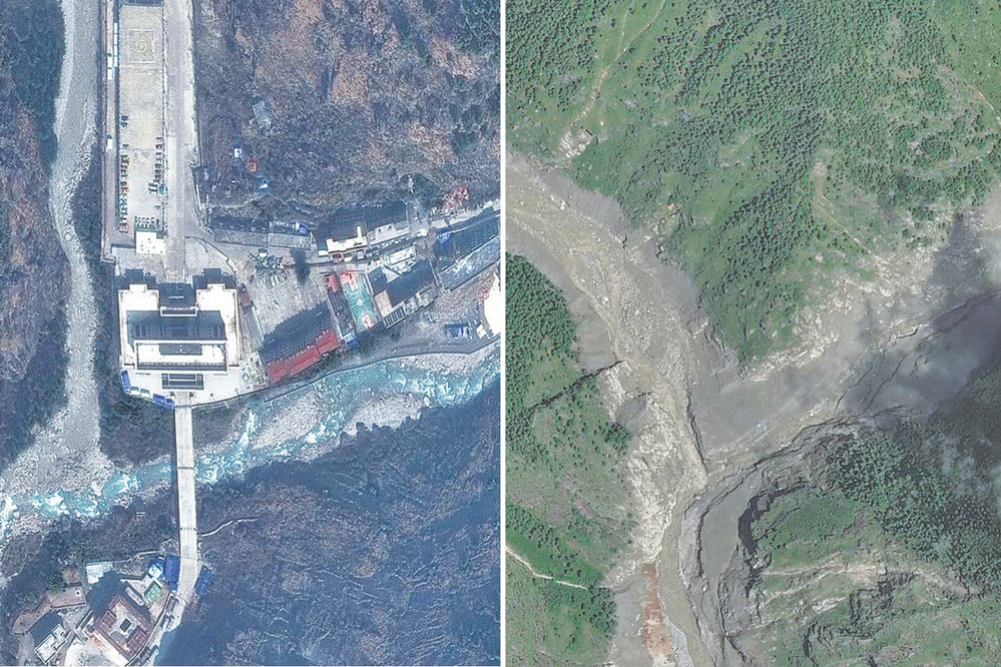
An aerial view of Rasuwagadhi border point before and after the disaster.
“We imported 10 BYDs first via Rasuwagadhi five years ago. We have been importing 1,500 to 2,000 EVs now. I wonder how the trade point will revive now,” Shrestha said.
The company estimates that around 1,000 electric vehicles and containers carrying spare parts were swept away by the flood. “We lost the people working for us in customs,” she said.
The flood, within minutes, destroyed the Rasuwagadhi border checkpoint and the Sino-Nepal Friendship Bridge, also known as the Miteri Bridge, which provides Nepal’s crossing into China.
It also swept through Timure, the border trading village, and tore apart the site of a dry port, a Chinese-funded facility that had been under construction for years at an estimated cost of Rs2.8 billion.
China is Nepal’s second-largest trading partner after India. It provides zero-tariff treatment to around 8,000 Nepali products under its duty-free market-access scheme for least-developed countries.
But Nepal’s trade relationship with China has repeatedly been disrupted by natural disasters and the Covid pandemic. According to the South Asia Watch on Trade, Economics and Environment (SAWTEE), a Kathmandu-based think tank, the 2015 earthquake was among the most significant shocks to cross-border trade between the two countries.
The latest disaster has once again exposed the vulnerability of Nepal’s northern trade routes.
On Thursday, a day after the flood, the Department of Customs issued a notice asking traders to use alternative routes. With customs officials, truck drivers and hundreds of others missing, however, the immediate priority remains search and rescue.
“Fifteen of our customs officials are missing in Rasuwagadhi and we are focused on search and rescue,” said Yam Lal Bhusal, director general of the Department of Customs.
The department has suggested rerouting containers originally destined for Rasuwagadhi through Tatopani and the Korala (Mustang) border points.
Rasuwagadhi suffered a similar disaster last year. On July 8, 2025, a flash flood in the Lhende River swept away the Miteri Bridge at Kerung. China took nearly six months to construct a temporary bridge. Nepal’s customs point at Rasuwagadhi lies about 24 km south of Kerung.
Traders say the most obvious alternative is Tatopani, but that route comes with its own problems. From Kerung, rerouting goods through Tatopani adds roughly 550 km to the journey.
Nepal had long relied on Tatopani as its principal northern trade gateway. Once a thriving international crossing where hundreds of Nepalis travelled each year for shopping, it was effectively shut after the 2015 earthquake.
The Tatopani border point was reopened for two-way cargo movement in May 2023, eight years after the earthquake. In September that year, Beijing also reopened the Tatopani-Khasa crossing for the movement of people.
But Tatopani has never operated smoothly. The route is considered highly vulnerable to floods and landslides.
“The Chinese side has alerted traders that Tatopani is also at a risk zone now. There is no traffic at Tatopani too,” said Ram Hari Karki, president of the Nepal Trans-Himalayan Border Commerce Association.
“It’s possible to reroute trucks to Tatopani, but challenges persist. Geographically, it has been challenging to import and export goods through Tatopani.”
Traders say the border has repeatedly opened and closed and remains out of service for more than half the year in some periods. “As we have no option left, we have written to the embassy of Nepal in Beijing and consulate of Nepal in Lhasa requesting permission to reroute goods to Tatopani,” Karki said.
Manoj Babu Shrestha, president of the Nepal National Traders' Federation, said traders were also struggling to locate missing truck drivers and helpers.
The disruption comes at the worst possible time for traders.
“Festivals used to be big business for many traders. Many struggle to meet the demand during festivals,” Shrestha said. “Traders were facing losses every year. This year too it’s another disappointing episode.”
Under normal conditions, around 60 to 70 cargo vehicles move through the Rasuwagadhi border point each day, traders said.
The government is also considering rerouting around 176 goods-laden containers stranded in Kerung through the Korala border point. But Korala has limited infrastructure on the Nepali side. It has no proper customs facilities, with officials operating from makeshift tents, and the crossing cannot accommodate heavy vehicles, traders said.
“If the government allows customs clearance facilities from Chobhar dry port in Kathmandu, allowing sealed containers in Korala border point to come directly, it would lessen the traffic congestion in different Chinese border points,” Karki said.
Customs officials, however, say clearing goods at Chobhar is not feasible because trucks carrying goods from Mustang take around two days to reach Kathmandu.
The Korala point, located at an altitude of 4,650 metres in upper Mustang, was opened for trade and travel in September last year. But it has its own limitations, including heavy snowfall in winter.
Nepal imported goods worth Rs425.24 billion from China in the last fiscal year ended mid-July, an increase of 24.66 percent from the previous year. Exports to China, meanwhile, fell 28.13 percent to Rs1.89 billion, leaving Nepal with a trade deficit of Rs423.35 billion.
Trade experts say facilitating the rerouting of goods will be crucial to maintaining supplies, particularly because Nepal imports significant quantities of intermediate and capital goods from China.
“Nepal imports one-fourth, or 25 percent, of its goods from China. And 25 percent of imports from China are via land border points, mainly Rasuwagadi, Tatopani and Koirala,” said Paras Kharel, executive director of SAWTEE.
So disruptions at the northern crossings are particularly consequential, he added.
“Korala does not have the capacity to operate fully due to a lack of customs infrastructure and climate conditions, as temperatures fall below zero for months,” Kharel said.
Facilitating rerouting, particularly during emergencies, by both the Nepali and Chinese governments would help ease the disruption, he said. Rerouting goods by sea through Indian ports increases transportation time and costs and can disrupt the wider supply chain.
Imports of Chinese goods through Indian seaports have increased significantly despite the longer transit time, which can range from a month and a half to as much as three months. Traders say the northern routes have become increasingly unreliable because of natural disasters, while losses caused by climatic factors have also risen.
China’s changing border policies have added another layer of uncertainty for Nepali traders.
The shift towards importing Chinese goods through seaports began after the 2015 earthquake and accelerated last fiscal year after the Miteri Bridge (friendship bridge) at Rasuwagadhi was swept away by a flash flood, said Shrestha of the Nepal National Traders' Federation.
“As per our data, Chinese goods imported via sea ports now cover 40 percent,” Shrestha said. “The shift is becoming visible as traders have been incurring losses every year while using the northern route.”
Sangam Prasain is Business Editor at The Kathmandu Post, covering tourism, agriculture, mountaineering, aviation, infrastructure and other economic affairs. He joined The Kathmandu Post in October 2009.
Krishana Prasain is a business reporter for The Kathmandu Post covering markets. Before joining The Kathmandu Post in 2018, she spent 3 years in New Business Age magazine covering business.




 15.55°C Kathmandu