Tribhuvan University to distribute question papers online, publish results within 60 days
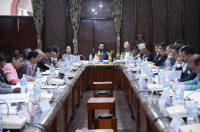
The university has at times taken over a year to publish results and these delays can force students to postpone further studies for an entire year or miss job opportunities.Education Minister and TU Co-Chancellor Sasmit Pokharel chaired the university’s Senate meeting on Thursday. Nepal Photo Library
Tribhuvan University has announced plans to send exam question papers electronically and publish results within 60 days, as the country’s largest university seeks to improve services and cut costs.
Presenting the university’s policy, programme and budget at its senate meeting on Thursday, Registrar Rabindra Siwakoti said question papers for examinations at all levels would be managed through an online system. Question papers are currently printed, transported, and distributed to examination centres, a process the university says is quite costly and time-consuming.
“Question papers for all examinations conducted by the university will be distributed through an online system,” said Siwakoti, adding that the move would reduce costs and use improved technology.
The country’s oldest university also plans to cut the time taken to publish results. Under its academic calendar, results are supposed to be published within 90 days of examinations. Siwakoti said that the target would now be reduced to 60 days.
The pledge comes after years of complaints over delays in publishing results. TU has at times taken more than a year to publish results and these delays can force students to postpone further studies for an entire year or miss job opportunities.
The university said it has also made the Office of the Controller of Examinations more technology-friendly so students can receive services online and more quickly.
Education Minister and TU Co-Chancellor Sasmit Pokharel, who chaired Thursday’s Senate meeting, directed the university to fully implement its academic calendar and provide faster services to students.
TU also plans to merge colleges with very low enrolment. Its policy for 2026-27 proposes merging colleges that have had fewer than 15 students for the past two academic years.
The Senate approved a budget of Rs30.87 billion for the current fiscal year, about two and a half months later than the normal deadline. Delays in appointing university officials had held up approval and forced TU to operate on an advance budget.
The university’s financial position remains a major concern. Its total audit irregularities have reached Rs32.98 billion, according to the latest annual report of the Office of the Auditor General—more than the university’s entire approved budget. The proposed budget itself has a deficit of Rs8.31 billion.
TU Senate member Reshu Aryal Dhungana, who is also a member of the National Planning Commission, called for stronger action to curb irregularities and punish those responsible.
The government has allocated Rs7.31 billion in grants to the university this year. The university says this falls short of the resources it needs. Professors and student representatives complained at the budget assembly that the allocation was lower than last year’s.
Responding to the grievances, Minister Pokharel said the government was discussing the shortfall with the Ministry of Finance and that the university would receive the additional resources required.
TU expects Rs15.24 billion, or 49.38 percent of total income, from internal sources and Rs15.62 billion, or 50.62 percent, from the government. About 86.14 percent of the budget is allocated for recurrent expenditure and 13.86 percent for capital expenditure. A large share goes towards salaries and benefits for teachers and staff, as well as pensions, gratuities and medical treatment.
Spending on pensions, gratuities and medical treatment is projected to rise to Rs5.2 billion this year from Rs4.04 billion in 2024-25. Only Rs433.55 million, or 1.41 percent of the total budget, has been set aside for research and development, while Rs80 million has been allocated for information technology and administrative systems.
To contain its deficit and audit irregularities, TU has proposed tighter financial discipline and cost-cutting measures, including virtual meetings, restrictions on unnecessary foreign travel, a ban on vehicle purchases, promotion of green energy, discouraging spending on credit, and online management of question papers.
The Senate also approved the graduation list of 95,540 students who completed their requirements and obtained transcripts between June 15, 2025 and June 30, 2026. They are expected to graduate at ceremonies planned for December-January.
For the first time, TU plans to hold convocation ceremonies in all seven provinces instead of requiring graduates from across the country to travel to Kathmandu.
Of the total, 72,404 are undergraduate students, 22,533 postgraduate students, 253 MPhil students, 184 postgraduate diploma students and 166 PhD students.




 15.17°C Kathmandu