Nepal’s gold-smuggling networks survive crackdown after crackdown
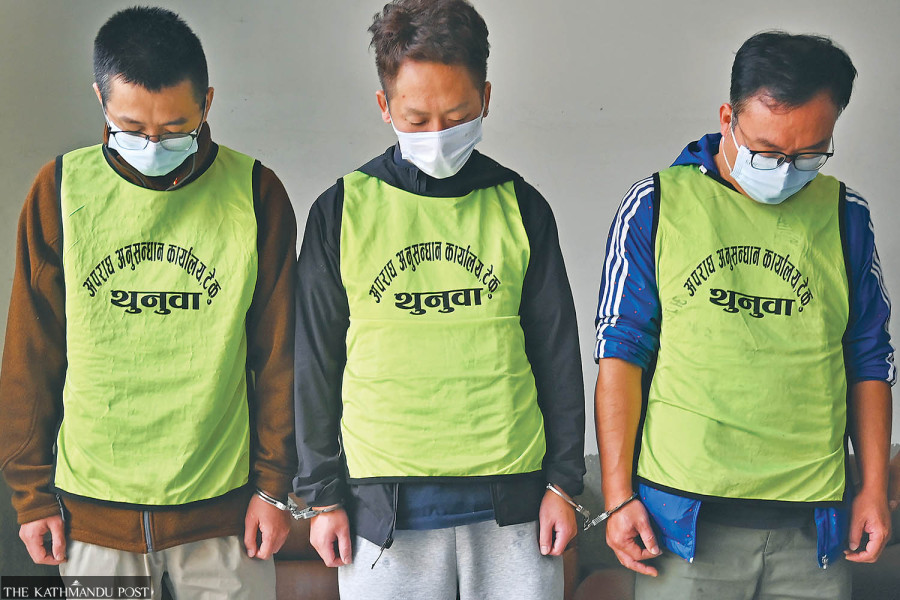
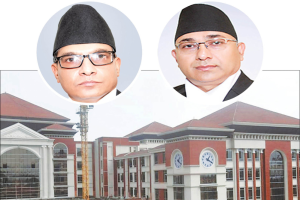
Investigations have exposed major syndicates and implicated police officers, yet high profits and gaps in the legal supply of gold continue to fuel the trade. Kathmandu police on Friday make public the three Chinese nationals (above) arrested Thursday along with 22kg of gold, bank cards, phones, and other documents. Angad Dhakal/TKP
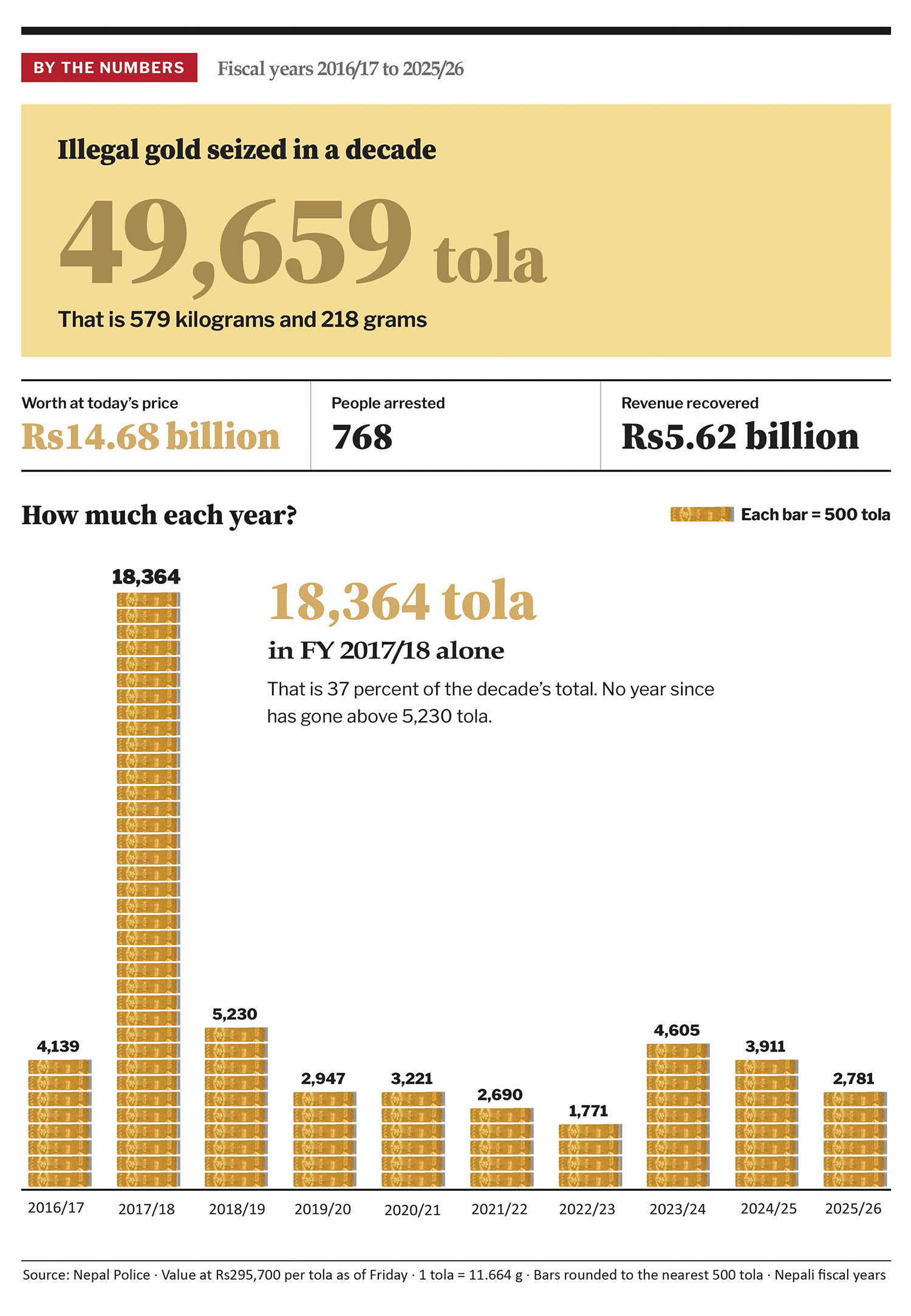
Over the past decade, authorities have seized 579kg and 219 grams of gold smuggled into Nepal by air and land, collected Rs5.62 billion in revenue and arrested 768 people.
Investigations have uncovered major smuggling networks, leading to cases against alleged kingpins and even police officers.
Yet the illicit trade continues.
The latest seizure came on Thursday, when police recovered 21.75kg of gold in a semi-solid form from a house in Budhanilkantha, on the northern edge of Kathmandu.
Officers from the Kathmandu Valley Crime Investigation Office in Teku found equipment for smelting and casting gold into bars, and weighing it. Three Chinese nationals were arrested.
According to Senior Superintendent of Police Santosh Khadka, head of the office, the suspects are Zhou Longqing, aged 47, Han Fei, 37, and Wang Jianzhen, 36.
The men had been using a house owned by a person now living in the United States as a gold-processing workshop. They were paying monthly rent of Rs330,000 and had apparently made an advance payment of Rs1.32 million for four months. The house had been rented on July 24.
“They appear to have set up a small factory inside the house,” Khadka said. “The Chinese nationals who rented the house are not in Nepal at present. The others appear to have been melting the gold and sending it out.”
Acting on specific intelligence, police had kept the house at Bhangal in Budhanilkantha Municipality under surveillance for more than ten days. During that period, officers noticed that only a limited number of people were visiting.
At around 5am on Thursday, a car left the house. Fearing that someone might flee, police stopped the vehicle while another team moved in to search the premises. The operation briefly turned tense as officers tried to enter the house.
“Questioning them has been difficult because of the language barrier. We are using interpreters now,” Khadka said. “When we searched the house, we found not just gold bars. We found an entire workshop.”
Police also found two gold bars inside the car as it was leaving the premises. The seized gold is worth an estimated Rs546 million at current market prices, Khadka said. Investigators have yet to establish whether it entered Nepal by air or land.
Residents living near the house said they had seen little activity by Chinese nationals there since the Bhotekoshi floods of August 26. Some had assumed the group had stopped coming because relatives might have gone missing in the disaster, an officer involved in the investigation said. “But they eventually returned, and people were surprised when we seized the gold yesterday [Thursday],” the officer said.
The most recent group of Chinese nationals had visited the house about 17 days before the seizure. Investigators believe the three arrested men processed the gold, which was in a semi-solid state, and prepared it for dispatch. They would then deliver it to designated locations according to instructions received online, an officer said. The person directing the operation is believed to be in China.
A familiar pattern
The latest case echoes a major seizure in July 2023, when authorities recovered 60kg of gold concealed inside motorcycle brake shoes after it had cleared customs at Tribhuvan International Airport. The gold was being smuggled overland into India. During that investigation, a team from the Department of Revenue Investigation raided a prefabricated house in Tokha, where it found a workshop used to melt gold, recast it and transform it into another form.
Investigators established that the consignment had come from Hong Kong and had passed through the airport disguised as motorcycle spare parts. Police also investigated a Belgian national in connection with the case. Investigators found links between him and Maoist leaders in Nepal. Daojin Wang, who was arrested in the case, was also reported to have associations with Maoist leaders.
In the latest case, however, investigators have yet to identify any Nepali accomplices. “We have yet to establish who the Chinese nationals’ local contacts are,” an officer involved in the investigation said. “That is also a focus of our inquiry.”
Gold smuggling has been a feature of Nepal’s underground economy since the Panchayat era (1960-1990), senior police officials say. At the time, clandestine networks linked to the royal establishment were involved. After 1990, leaders and figures associated with both the Nepali Congress and communist parties also became linked to gold-smuggling cases. One Rastriya Prajatantra Party (RPP) leader was widely known by the nickname “Sun Budha”—old gold man. After being caught with gold while carrying a diplomatic passport, he reportedly campaigned for election by promising to gift every villager a nose ring. During testimony before a high-level gold-smuggling investigation committee formed in 2018, RPP leader Bhujung Gurung also disclosed that he had been smuggling gold since 1983. He said he had stayed away from the trade for a long period before returning to it in 2012 after meeting Mohan Kumar Agrawal and Chudamani Upreti, known as Gore because of his fair complexion.
The scale of the trade became particularly clear in 2018, after the murder of Sanam Shakya, a carrier working for a gold-smuggling syndicate. Investigators discovered that a single group had smuggled 3.8 tonnes of gold over four years. The gold had arrived from the UAE through Kathmandu airport and was destined for India. Shakya was killed as members of the network tried to trace a missing 33 kg consignment. The home ministry subsequently formed a high-level investigation committee led by then joint secretary Ishwar Raj Paudel. The investigation resulted in court cases against 63 people, including police officers.
The scale of organised smuggling through the airport appeared to diminish after the investigation. Basanta Lama, a former additional inspector general of Nepal Police who served on the committee, said it had dismantled a major network. “That investigation destroyed one of the biggest syndicates smuggling gold through the [Kathmandu] airport,” Lama said. “Police officers, airport employees, carriers and the alleged kingpins were exposed.” Lama added, “I believe organised smuggling through the airport largely stopped for a long time afterwards. There were no major seizures either.”
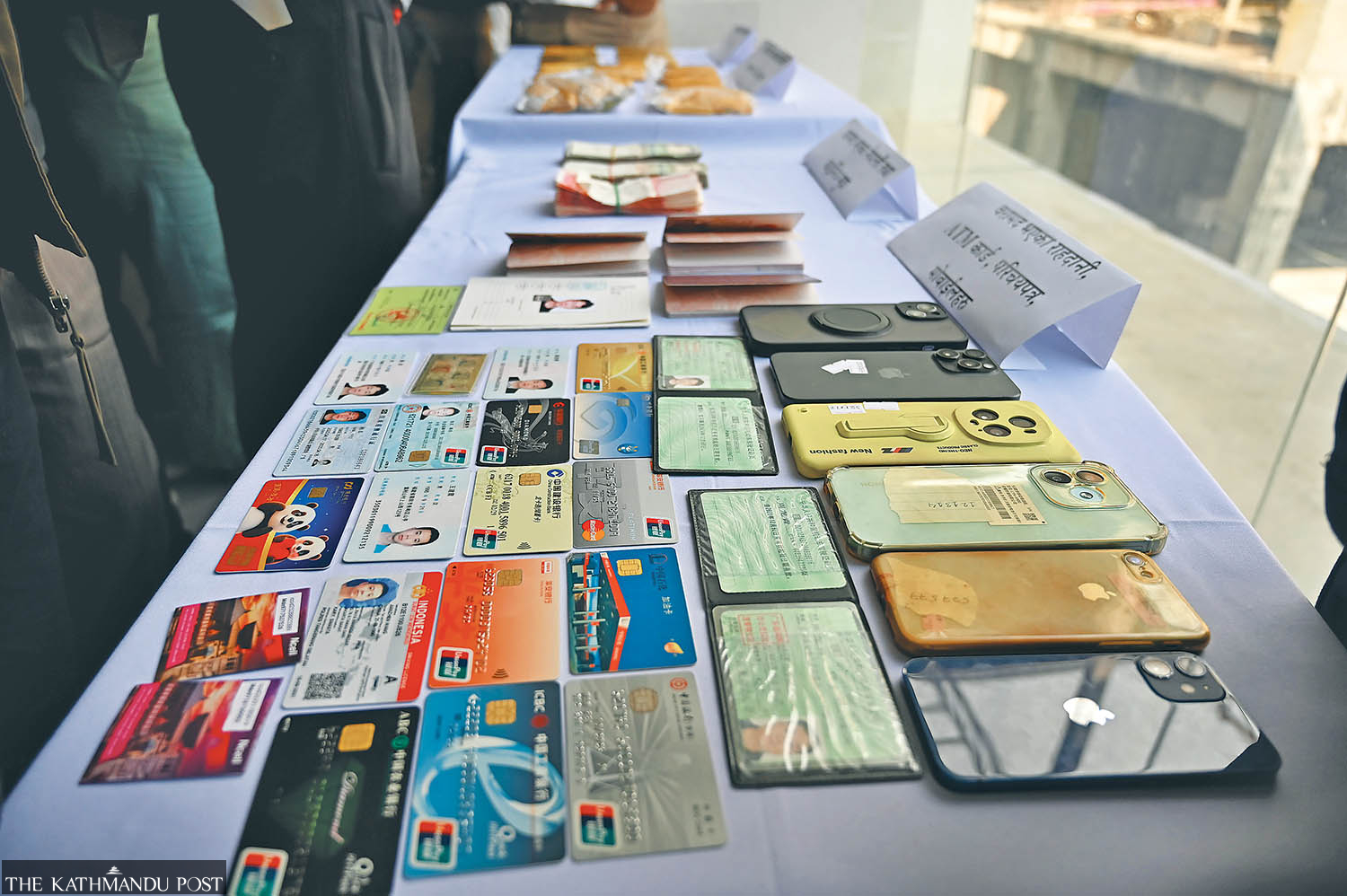
Gold weighing 22kg, bank cards, mobile phones and other documents seized by Kathmandu police from three Chinese nationals arrested on Thursday. Angad Dhakal/TKP
Fewer seizures do not mean less smuggling
Police figures show that gold seizures fell after the investigation, although they have fluctuated in recent years.
Authorities seized 48kg and 277 grams in fiscal year 2016-17, followed by 214kg and 194 grams in 2017-18. The haul then fell to 61kg and two grams in 2018-19; 34kg and 368 grams in 2019-20; and 37kg and 576 grams in 2020-21. Seizures amounted to 31kg and 378 grams in 2021-22, and 20kg and 659 grams in 2022-23. They rose to 53kg and 714 grams in 2023-24, before falling to 45kg and 619 grams in 2024-25, and 32kg and 432 grams in 2025-26. The figures suggest seizures have generally remained below the exceptional levels recorded before the 2017-18 crackdown. But that does not necessarily mean smuggling has stopped.
An officer at the Central Investigation Bureau said seizures depended heavily on tip-offs and information gleaned from feuds within smuggling networks. “Gold is seized when someone provides a tip-off or when a dispute within a group brings the operation to police attention,” the officer said. “The absence of seizures cannot be taken as proof that smuggling has stopped.” The flow of intelligence had also declined after rewards for informants were reduced, the officer said.
Customs regulations had provided for payments to informants whose information led to the seizure of smuggled gold, silver and precious stones. Rule 47 of the Customs Regulations 2007 stipulated that a person providing information or helping seize such goods would receive whichever was lower: 10 percent of the proceeds from their sale or auction, or Rs1 million.
The risk of providing information, combined with relatively small rewards, discouraged tip-offs, investigators say. Investigating officials themselves became embroiled in controversy in major seizures. This further diminished police interest in pursuing such cases, an officer said.
The new Customs Regulations 2026 now provide a reward of 15 percent of the proceeds from seized or auctioned goods for credible information about attempted or completed smuggling. “Some information has started coming in since the new provision was introduced,” the officer said.
A persistent gap in supply
Lama, the former police chief who served on the high-level investigation committee, believes smuggling will persist as long as there is a market for it and the returns outweigh the risks.
Tejratna Shakya, a former president of the Federation of Nepal Gold & Silver Dealers’ Association, estimates that the domestic market consumes about 30kg of gold a day. Nepal Rastra Bank, however, releases only 25kg a day through commercial banks. On paper, that leaves a daily supply gap of 5kg. Yet the market does not appear to suffer a corresponding shortage.
Banks previously supplied just 10kg of gold a day, but even then the market did not run short, Lama said.
“The shortfall was met entirely by smuggled gold,” he said. “Although most of the gold seized in Nepal is ultimately destined for India, the difference in customs duty rates between the two countries also encourages smuggling.”
The financial incentives remain powerful. Even when the risks are considerable, the profits can make the business attractive to those involved, Lama said.
The continued failure to implement recommendations made by successive high-level committees to address weaknesses at airports and land border crossings has also helped sustain the trade, he added.
Nearly 580kg of gold has been seized over the past decade. Yet the latest discovery of a clandestine processing workshop in Kathmandu underlines how smuggling networks continue to adapt.




 16.78°C Kathmandu