Government mulls covering childbirth-related lab test costs
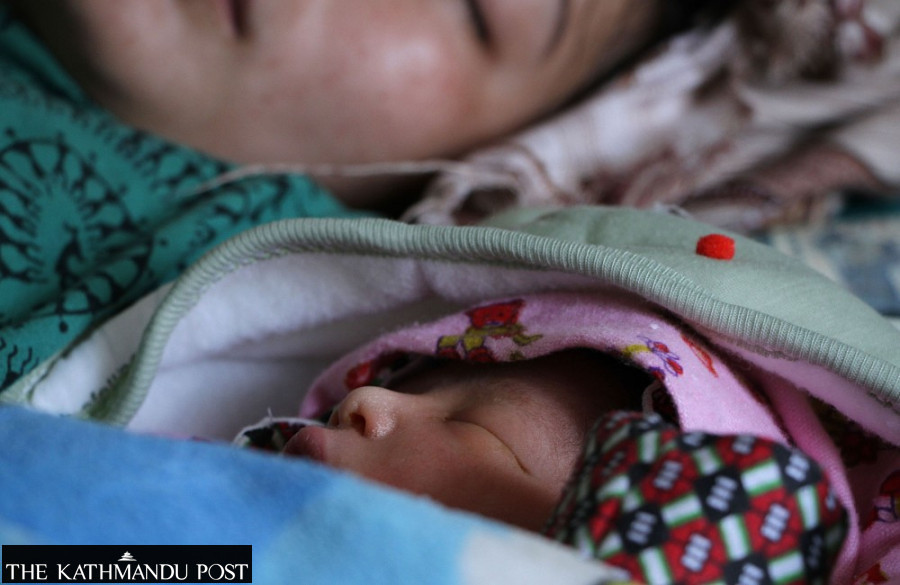
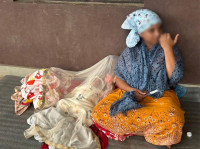
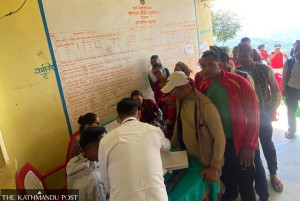
Proposal follows public outrage over a poor woman forced to give birth on a pavement outside Rajbiraj hospital after her husband could not afford blood tests.Post file photo
Amid criticism over an incident in which a poor woman in labour was forced to give birth outside a hospital in Rajbiraj last month, the Family Welfare Division under the Department of Health Services has proposed free lab services worth Rs1,845 for women delivering at hospitals under the safe motherhood programme.
The government has offered free institutional delivery services since 2009 at state-run hospitals, community hospitals, and select medical colleges. But women seeking hospital deliveries still have to pay thousands of rupees for lab tests.
“We have revised the guideline to propose free lab tests worth Rs1,845 at health facilities providing services under the Ama Programme [mother scheme, a component of the government’s broader Safe Motherhood Programme],” said Nisha Joshi, an official at the division. “That should cover basic tests, but it is only a proposal and has not yet been approved.”
Officials say that it costs over Rs8,000 to carry out all the required tests for pregnant women, and the division does not have the budget to provide all testing free of charge. They say the Rajbiraj incident happened due to confusion, as lab testing is not included in the free delivery services.
“Some hospitals cover the cost of all services themselves using their own funds,” said Joshi. “Others don’t provide these services for free because the government currently does not reimburse hospitals for lab services.”
Officials hope the new proposal will be approved, as criticism over the Rajbiraj incident remains fresh in people’s minds.
Babita Kumari Paswan, 30, of Parsahi in Rajbiraj, gave birth to a baby on a pavement outside the state-owned Gajendra Narayan Singh Hospital on September 9 after her husband could not afford the cost of blood tests.
The Health Ministry and Nepal Medical Council, the national regulatory body of medical doctors, launched separate investigations into the incident. Both teams submitted their reports to the Health Ministry, which also blamed government policy for not providing lab services for free. One of the reports also said that inhumane behaviour by some health workers and security guards was a serious problem at state-run health facilities.
Hospital workers at the time said they were simply following the process the hospital has used for years.
The government declared delivery services free at state-run health facilities years ago. The Ministry of Health and Population reimburses health facilities for the services they provide.
Under the Ama Programme, health facilities are reimbursed Rs2,500 for a normal delivery, Rs4,000 for a complicated delivery, and Rs10,000 for a cesarean section. Of this amount, the hospital must provide Rs300 to the nurses involved in each delivery.
In the mountain region, the government even provides helicopter services where the healthcare system is fragile and, in many places, where there is not even a basic health office. But women, who cannot afford the required tests can still be left without the tests, especially during emergencies.
Nepal’s constitution mandates health as a fundamental right of the people. The National Health Policy aims to implement this right by ensuring equitable access to high-quality healthcare services for all.
The government declared institutional delivery free in 2009 and started providing free medical treatment to mothers and their newborns.
The institutional delivery rate, which was around 16 percent at the time, has increased to more than 90 percent.
Along with free treatment, women receiving institutional delivery services also receive transportation allowances and cash incentives for antenatal checkups. These measures have helped bring women to health centres and hospitals.
The programme is credited with reducing the maternal mortality rate from 539 per 100,000 births in 1996 to 239 per 100,000 births in 2016. For this progress Nepal received the Millennium Development Goals award.
Since 2000, Nepal has reduced maternal deaths by more than 70 percent, according to a report by the World Health Organisation.
The report stated that currently 142 Nepali women die from maternity-related complications per 100,000 live births.
Health officials say neither the Safe Motherhood Programme nor the Basic Health Service Act addresses the cost of tests required before delivery.
Arjun Poudel is a health reporter for The Kathmandu Post. Before joining the Post, he worked for Sagarmatha Television, Naya Patrika, Republica and The Himalayan Times.




 19.74°C Kathmandu