Constitutional Bench caught in seniority, ‘pick and choose’ dispute
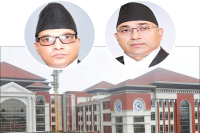
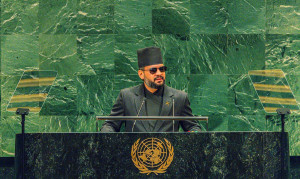
The bench boycott on Wednesday has exposed tensions at the Supreme Court since Sharma’s appointment over senior judges.The Supreme Court’s new building under construction, Chief Justice Manoj Kumar Sharma (top left) and Justice Hari Prasad Phuyal.
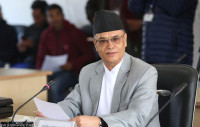
Chief Justice Manoj Kumar Sharma on Wednesday designated himself and Justices Sapana Pradhan Malla, Hari Prasad Phuyal, Nahakul Subedi and Abdul Aziz Musalman to form the five-member Constitutional Bench. The other judges were assigned to 11 benches through a lottery, and all went to sit on their respective benches.
A Supreme Court justice said that of the justices who had been designated to the Constitutional Bench, Malla, Subedi and Musalman gathered in Chief Justice Sharma’s chamber. Phuyal, however, said he could not sit on the bench.
“Since you became chief justice, you [Sharma] have not included me in the Constitutional Bench even once,” the justice quoted Phuyal as saying. “There was a practice of forming the Constitutional Bench on the basis of seniority. When one goes for ‘pick and choose’ in this way, it looks like there has been some setting.”
Phuyal’s objection was not limited to whether he had been included in the bench. He questioned the basis for forming the bench, the chief justice’s discretion and the role of seniority in the process.
“Phuyal said that the formation of the Constitutional Bench should be discussed by the full court and that a clear basis should be established,” the justice said. “In response, Chief Justice Sharma said the constitution gives him the authority to designate the four other judges for the Constitutional Bench and that there was no need for the matter to be discussed by the full court.”
After a brief argument, Sharma called a bench officer and asked him to inform those concerned that the Constitutional Bench could not sit that day. Thirty-eight cases had been listed for hearing before the bench, but none was heard.
The dispute has once again brought the method of forming the Constitutional Bench into focus. In Kathmandu’s legal circles, calls have grown for the full court to find a way out of the dispute between the chief justice’s constitutional authority and the need for an institutionally accepted method of exercising that authority.
Former justice Ananda Mohan Bhattarai said the chief justice’s constitutional authority could not be denied, but repeated controversy over how that authority is exercised was a sign of a problem.
“The constitution gives the chief justice this authority,” he said. “If that authority is denied, it raises a question about the provision in the constitution itself. But having authority shouldn’t mean exercising it incorrectly every time. The provision for forming the Constitutional Bench itself is flawed.”
The central question in the dispute is how the chief justice should exercise the power granted by the constitution. Article 137 provides for a Constitutional Bench at the Supreme Court comprising the chief justice and four other justices. The chief justice designates the four justices on the recommendation of the Judicial Council. But the constitution does not set out detailed criteria for selecting them, define the role of seniority or specify when judges can be replaced.
As a result, different practices have evolved over time, including selection based on seniority, a roster of eligible judges and the chief justice’s own discretion. The regular benches of the Supreme Court are now assigned through a lottery, but the constitution still gives the chief justice the authority to designate judges for the Constitutional Bench.
This is not the first time the issue has been a source of controversy. In 2022, during the tenure of then-chief justice Cholendra Shumsher Rana, questions arose over the formation of the Constitutional Bench during the hearing of cases related to the dissolution of the House of Representatives. Rana initially formed a bench comprising himself and Justices Hari Krishna Karki, Bishwambhar Prasad Shrestha, Anil Kumar Sinha and Tej Bahadur KC. Karki later recused himself after questions were raised over his participation, and Justice Sapana Pradhan Malla was included.
Questions were also raised over the participation of Justices KC and Bam Kumar Shrestha when the House was dissolved for a second time. As disagreements among the justices deepened, Supreme Court judges reached a point where they stopped hearing cases. The court subsequently decided to introduce a lottery system for assigning cases.
A motion of impeachment was filed against Rana on February 13, 2022, amid wider controversy over his conduct. The dispute over the Constitutional Bench was not the sole reason for the impeachment motion.
Debate over the method of forming the Constitutional Bench continued under subsequent chief justice Prakash Man Singh Raut. When the court delivered its ruling on 52 appointments to constitutional bodies on July 2, 2025, two of the five justices on the bench issued dissenting opinions.
Following the ruling, Raut proposed introducing a lottery system for the Constitutional Bench as well. The full court discussed the proposal after its annual review meeting on July 28, but there was no consensus, with nine judges supporting it and 10 opposing it. The court then returned to the practice of having the chief justice form the bench from the roster of eligible judges, taking seniority into consideration. That practice, too, did not become a norm.
Former justice Ishwar Prasad Khatiwada said the problem begins when there is a perception that judges are being selected with the outcome of a case in mind.
“When a bench is formed with the result in mind, it creates a problem,” Khatiwada said. “If the person forming the bench starts manipulating the process, what else can one expect but controversy?”
He said the process for forming the Constitutional Bench should appear transparent and impartial.
Questions over the role of seniority in forming the Constitutional Bench have also intensified since Sharma became chief justice. When Sharma was recommended for the post in May 2026, Justices Sapana Pradhan Malla, Kumar Regmi and Hari Phuyal were senior to him. That prompted debate over the seniority-based practice that had traditionally influenced the appointment of chief justices.
That does not, by itself, establish that Sharma’s appointment was unconstitutional. But the basis for forming the Constitutional Bench has again come under scrutiny under his leadership.
The first Constitutional Bench formed under Sharma in May did not include senior Justice Kumar Regmi, while Malla was on leave. Questions have also been raised over the fact that subsequent benches have not consistently followed seniority.
The issue resurfaced against that backdrop. At the Supreme Court’s most recent full-court meeting, judges had raised the formation of the Constitutional Bench and questioned why some senior judges had not been included. On Wednesday, the issue moved from the meeting room to the bench itself.
“We understand Justice Phuyal’s question about not being included in the Constitutional Bench earlier and then being included suddenly as a reflection of the intense upheaval within the Supreme Court,” a Supreme Court official said.
The Nepal Bar Association has also been calling for a clear method of forming the Constitutional Bench. The association’s president Vijay Kumar Mishra said the court should either automatically designate judges on the basis of seniority or adopt a lottery system.
“The Bar has been saying this repeatedly. There should now be a lottery system for the Constitutional Bench,” Mishra said. “Either judges should be designated automatically on the basis of seniority or there should be a lottery. It cannot be left to the discretion of the chief justice.”
Without a clear and predictable system for determining who sits on the Constitutional Bench, lawyers also face uncertainty, he said.
The Constitutional Bench is currently hearing cases including one concerning the abolition of trade unions for government employees. The Bar has also questioned why a case concerning a proposed commission to investigate assets was brought before the Constitutional Bench after an order had already been issued to send it to a full bench.
“Now we need to think about why the Constitutional Bench has repeatedly become controversial and find a way out,” Bhattarai said. “The chief justice should call a full court meeting so that everyone can work together to find a solution and alternatives.”




 16.38°C Kathmandu