Nepal’s growth to slow to 3.7 percent after devastating Rasuwa flood
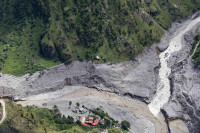
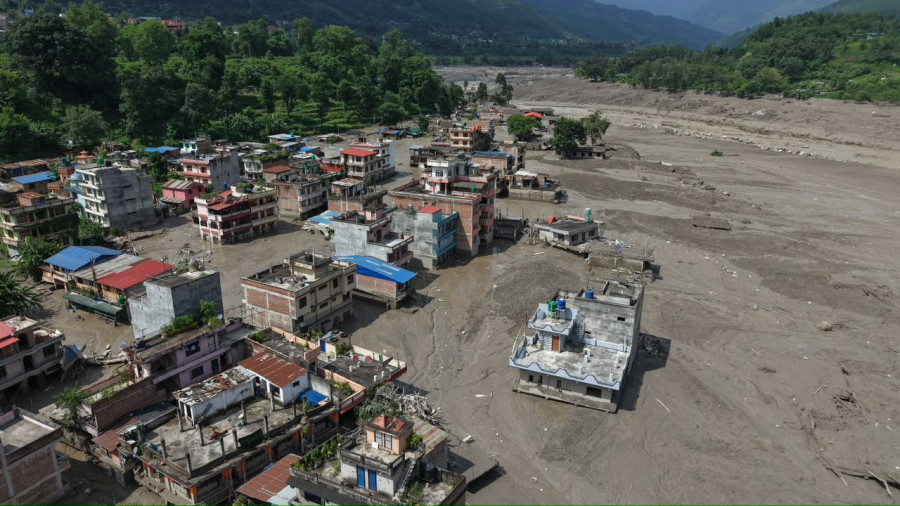
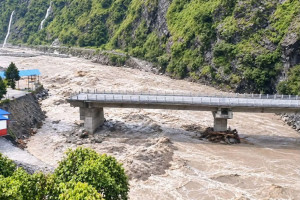
The World Bank estimates $1.66 billion in direct damage to physical assets, with infrastructure accounting for 83 percent of the losses. Energy, including hydropower and the electricity grid, was the most affected infrastructure subsector in the August floods, while economic activities and livelihoods accounted for the largest impacts within the productive sector. File Photo/Nepal Photo Library
Nepal’s economic growth is projected to slow to 3.7 percent in the current fiscal year ending mid-July 2027, largely due to disruptions to industry and services caused by the August 26 flood, the World Bank said on Tuesday.
The flood is expected to affect Nepal’s economy through four primary transmission channels: energy, transportation, trade and tourism.
According to the World Bank’s global rapid post-disaster damage estimation, total direct economic damage to physical assets amounted to $1.66 billion, with infrastructure accounting for 83 percent, followed by residential buildings at 11 percent and non-residential buildings at 6 percent. The impacts were concentrated largely in Rasuwa, Nuwakot and Dhading districts.
The government’s preliminary rapid damage and needs assessment estimates total physical damage at $1.81 billion and total disaster effects—including losses from disruptions to productive activities, livelihoods and essential services—at approximately $2.7 billion.
Nepal estimates total recovery and reconstruction needs at approximately $4.8 billion, of which 98.8 percent is required for longer-term recovery and reconstruction. Infrastructure accounts for 65.5 percent of the total needs.
The Asian Development Bank last month trimmed Nepal’s growth forecast by 0.4 percentage point to 4.1 percent for the current fiscal year. The government, which has set a 6 percent growth target, however, is yet to release its post-flood assessment.
According to the World Bank’s Nepal Development Update, Building Back Differently for the Future, industry is expected to be the primary drag on growth, reflecting extensive damage to hydropower, solar energy, electricity transmission and transport infrastructure.
The damage will constrain electricity generation and production, as well as the movement of goods.
Energy, including hydropower and the electricity grid, was the most affected infrastructure subsector, while economic activities and livelihoods accounted for the largest impacts within the productive sector.
The flood affected 12 hydropower projects, including seven operational projects with a combined capacity of 256 MW and five projects under construction with a combined capacity of 395 MW, as well as a 25 MW solar facility. Damage to transmission infrastructure disrupted an additional 149.6 MW, bringing total affected generation and transmission capacity to approximately 430.7 MW, equivalent to 10.6 percent of Nepal’s installed hydropower and solar capacity.
According to the World Bank report, more than 55 km of the 82-km Galchhi–Rasuwagadhi trade corridor was damaged, with 40 km completely washed away, along with 37 motorable bridges and 68 suspension bridges.
The Rasuwagadhi crossing is the main port for Nepal-China bilateral trade, accounting for 2.2 percent of Nepal’s total merchandise imports, 10.8 percent of merchandise imports from China and 47.3 percent of merchandise exports to China.
Damage to the Prithvi Highway at Krishnabhir further compounded the disruption by affecting a critical artery connecting Kathmandu with southern Nepal and the Indian border, with implications for both international trade and domestic supply chains.
To restore connectivity, authorities constructed a new track at Krishnabhir, and two-way traffic resumed on September 17. However, the route remains at considerable risk of additional closures during heavy rainfall. The new track and other damaged sections along the corridor also remain vulnerable to potential geohazards and climate-induced effects.
The World Bank said tourism is expected to face a potentially prolonged impact, reflecting both physical disruptions and heightened perceptions of travel risks. More than 200 hotels and restaurants were damaged across the affected districts, while access to major trekking and pilgrimage destinations—including Langtang, Gosaikunda and the Kailash Mansarovar corridor—has been disrupted.
The timing of the flood further compounds the impact, as the disruption occurred immediately before the main autumn tourism season from September to November, when tourist arrivals and trekking activity typically increase. The United Kingdom, Australia, Canada and the United States subsequently updated their travel advisories for Nepal.
The government’s preliminary rapid damage and needs assessment estimates total physical damage at $1.81 billion and total disaster effects at approximately $2.7 billion. File Photo/Nepal Photo Library
The report said inflation is projected to remain broadly contained and within the Nepal Rastra Bank’s medium-term target of around 5 percent. However, localised crop losses and transport disruptions could generate price pressures in the current fiscal year, disproportionately affecting poorer households.
Improved paddy production, easing global commodity prices and moderating inflation in India could help contain headline inflation during the next fiscal year, the World Bank said.
The current account surplus is expected to narrow in the current fiscal year and further in the next year, reflecting a wider merchandise trade deficit and weaker services exports in the near term, followed by a reconstruction-driven increase in import demand.
The World Bank said flood-related damage to hydropower and transmission infrastructure, including a loss of approximately 60 MW of export-oriented hydropower capacity, is expected to weigh on electricity exports this fiscal year, while heightened travel risks could reduce tourism receipts.
These effects are expected to be partly offset by higher insurance service exports associated with claims received from foreign reinsurers and continued growth in IT exports.
In the next fiscal year, beginning in mid-July 2027, reconstruction-related demand for construction materials, machinery and equipment is expected to substantially increase imports, while hydropower and tourism exports could recover as damaged infrastructure is restored, additional generation capacity comes online and international tourist arrivals rebound.
Despite the narrowing of the current account surplus, foreign exchange reserves are expected to remain comfortably above the regulatory minimum for import coverage, supported by resilient remittance inflows and continued support from migrant workers.
The World Bank said the recovery provides an opportunity to move from “Build Back Better” towards “Build Differently”.
“In some locations, rebuilding the same infrastructure in the same place—even to a higher engineering standard—may not adequately address the underlying risk,” the report said.
“Future investment decisions could instead incorporate updated hazard information, more careful consideration of location, accumulation of risk and design, greater redundancy in critical networks, and stronger monitoring and early warning at the regional and local levels,” according to the report.
“The objective is not necessarily to create new institutions or frameworks, but to identify where existing arrangements worked well, where gaps became apparent, and where targeted improvements can strengthen resilience.”
In this way, according to the World Bank, reconstruction can support not only recovery from the August 2026 flood but also a more resilient development pathway for Nepal’s Himalayas.
“The goal is to build resilient systems that continue functioning when individual assets fail and reduce the impact of future disasters.”
Reconstruction and rehabilitation activities are expected to begin supporting economic activity, and growth may recover to 5.2 percent in the next fiscal year.
The Rasuwa flood has caused devastating human losses. According to the National Disaster Risk Reduction and Management Authority, as of September 26, 1,453 people had died, 5,285 people remained missing and 13,795 people had been rescued.
“This is a moment of opportunity for Nepal to think about its infrastructure—connectivity, energy, and basic services like water and sanitation, health and education—and ensure that resilience and redundancy are central to its planning and investment, especially in the context of a changing climate and an evolving set of risks,” said David Sislen, World Bank Division Director for Maldives, Nepal and Sri Lanka.
“The World Bank stands ready to assist the authorities in investing in systems and implementing the right policies to help put Nepal on a more resilient and sustainable development path.”
Strengthening early warning systems will be equally vital, alongside building an Integrated Social Protection System as a foundation for rapidly delivering disaster assistance to vulnerable households, according to the World Bank.
Sangam Prasain is Business Editor at The Kathmandu Post, covering tourism, agriculture, mountaineering, aviation, infrastructure and other economic affairs. He joined The Kathmandu Post in October 2009.




 21.02°C Kathmandu