How Tenzing Sherpa became Nepal’s breakout star at the Asian Games
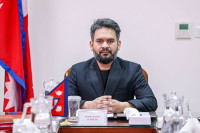
The 23-year-old karateka ended Nepal’s medal drought in Nagoya. Behind his bronze, however, lies a story of meagre state support, deep family sacrifice and an ambition to win gold at the next edition. Karateka Tenzing Sherpa pictured during an interview with Kantipur TV last week. Post Photo
Nepal entered the 2026 Asian Games with a bold ambition—to win a double-digit haul of medals and at least one gold. It sent 135 athletes across 22 sports to Nagoya, Japan. But those ambitions soon began to look lofty. One after another, Nepali athletes bowed out, including karate prodigy Arika Gurung. There were high hopes from the eight-member Karate squad but by September 23, seven athletes had already been eliminated. Forget gold—it began to look as if Nepal’s contingent might return from Nagoya empty-handed.
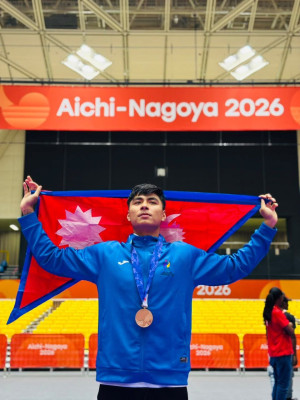
The only karateka still in contention was Tenzing Sherpa, a little-known 23-year-old from Baudhha, Kathmandu. Sherpa rose to the occasion. He beat Laos’ Xayasan Vatthana 9-1 in the repechage and secured bronze for Nepal. His breakthrough, along with a bronze from the women’s kabaddi team, provided the only two podium finishes for the country in an otherwise disappointing campaign.
Sherpa’s heroic finish in Japan was not an overnight miracle. His journey to the podium was built not only on years of personal hardship amid insignificant state support but sacrifices from his family too.
“If it was not for my mother, two sisters, coaches, friends, seniors and juniors, I would not be here,” Sherpa told Kantipur recently, as he sat inside Boudha Dojo, the place where he started karate as a 14-year-old. He had his Asian Games bronze medal hung around his neck. “This medal is not mine alone,” he said.
Karate came to Sherpa’s life after he had already tried his hands at other sports. At 14, he was the captain of his school’s football team and also played other sports, like kabaddi. But many of his friends and senior brothers often talked about karate, and he followed them to Boudha Dojo. The rest, as they say, is history.
Sherpa says that he did not choose a path that fits his life. He is the only son in a family that often struggled to put food on the table. Affording an education for three children was an uphill battle. The only son choosing karate as a profession, hence, only added to the struggle.
“During my early days, I thought that those who practiced karate were cool,” Sherpa recalled with a grin. “They were like the dons of the school… But when I started it, I realised the scale of discipline this sport demands. Then I got addicted to karate.”
But this addiction alone was not sufficient to push Sherpa forward. There were moments when he wanted to change the course. “I left karate for around two years in 2019-2020 as my family’s financial condition only turned worse,” Sherpa said, overcome with emotions. “And that is where my mother and sisters stepped up. They looked after the financial aspect while motivating me to follow my dream.”
For Sherpa, it was a big lesson. After returning to the mat after two years, he doubled down on his work and started winning medals across national tournaments. But he was not satisfied.
He says he is not satisfied with the Asian Games bronze, either.
“People forget soon,” he told Kantipur. “Even now, I don’t think many Nepalis know about Tenzing Sherpa as the guy who won a medal for the country in the Asian Games.” He added, “I have yet to realise my dream.”
Sherpa wants to win gold in the next Asian Games, to be held in Qatar in 2030. And he knows that he needs to train much harder for that.
When Kantipur spoke to multiple of Sherpa’s coaches—from the dojo to the national team—they were all full of praise for the hard working karateka. The only problem they pointed out in Tenzing was his short temper.
“I was told by my national coaches—Kushal Shrestha and Manday Kaji Shrestha—to not lose my cool before my matches in Japan,” Sherpa said with a laugh. “But I am not that angry of a person. It is a different thing that I scowl when I do not get points.”
Sherpa, meanwhile, argues that he feels different as a person after winning the bronze medal. “I feel I have changed a bit after the Asian Games,” Sherpa said with a smile. “This medal will motivate me to train harder for the gold next time.”
After Sherpa won bronze on September 23, Kantipur met his mother, Nir Kumari Shrestha Sherpa, in a small rented room in Bauddha. She said she was proud of her son. “I feel that his hard work has paid off,” she said.
Until the bronze, Sherpa had been surviving on a few thousands rupees he gets every month from his contract with the Armed Police Force Club for the last four years.
Now he is set to receive a Rs1.3 million cash prize from the state for his Asian Games bronze, as the regulations have it. For a young man who once watched his family struggle to put food on the table, the money is more than just an athletic reward—it is a long-overdue way to ease the burden on his mother.
“I won’t say it changes everything,” Sherpa said. “But it will certainly help my mother.”




 18.5°C Kathmandu