Can ‘Mission 2026’ finally deliver Nepal its first Asian Games gold?
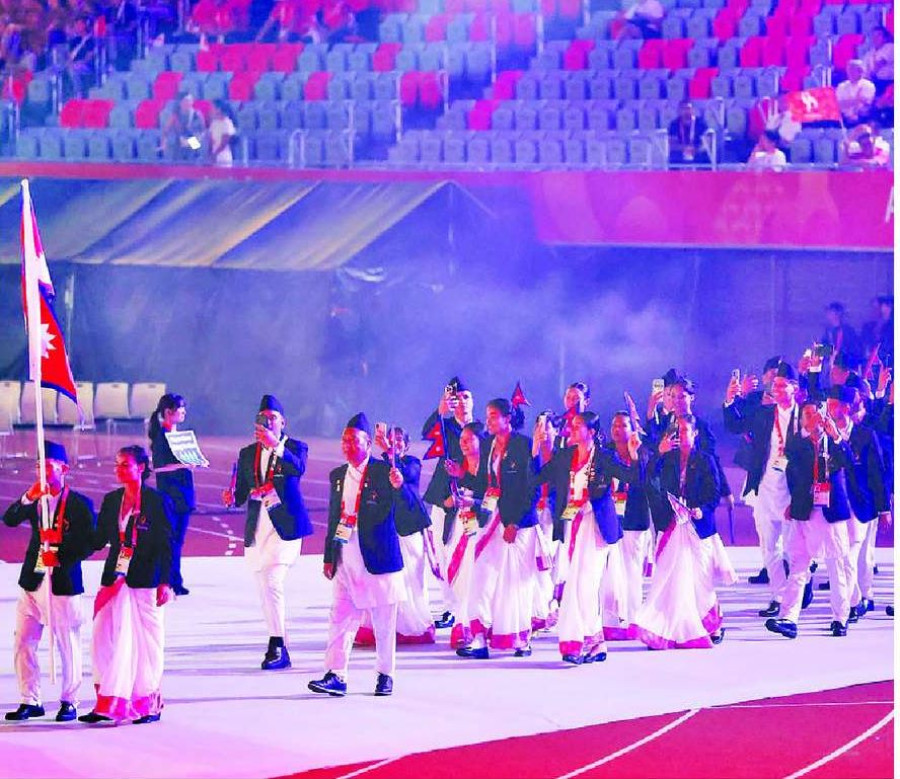
After three years of preparation marred by funding woes, Nepal’s trimmed 135-athlete contingent enters the Asian Games chasing double-digit medals and its first-ever gold. Members of Nepal’s delegation wave the country’s national flag during a parade at the opening ceremony of the 2026 Asian Games at Paloma Mizuho Stadium in Nagoya, Japan, on Saturday. Hemanta Shrestha/TKP
In 18 appearances at the Asian Games, Nepal’s tally stands at 26 medals—23 bronze, three silver and zero gold.
When the 20th Asian Games officially opened in Nagoya, Japan, on Saturday, 40 of the 135-member Nepali contingent from 21 sports marched into the Paloma Mizuho Stadium behind flag-bearers Chandra Bahadur Thapa and Manmati Bist with an audacious goal: reach double-digit medals and bring home the country’s first-ever gold from the continental flagship event.
It is a dream born out of both desperation and design.
Two decades ago, at the 15th Asian Games in Doha, Qatar, in 2006, taekwondoins Deepak Bista, Ayasha Shakya and Manita Shahi secured three bronze medals for Nepal. At the time, karate legend Deepak Shrestha issued a grim warning: without long-term, systemic preparation, Nepal would struggle to stay competitive as rival nations poured millions into sports infrastructure.
His words proved prophetic. For the next three editions, Nepal won only one medal in each edition—a boxing bronze by Deepak Maharjan in Guangzhou 2010, a karate bronze by Bimala Tamang in Incheon 2014, and a paragliding team silver in Jakarta-Palembang 2018—often relying more on individual grit and luck than state strategy.
The narrative shifted slightly at the delayed 2022 Hangzhou Games, which was held in 2023 due to Covid-19, where karateka Erika Gurung clinched historic silver, and the women’s kabaddi team bagged bronze. The double-medal finish prompted the National Sports Council to announce ‘Mission 2026’—a long-term plan promising uninterrupted training, dietary support and adequate exposure for top athletes.
Now, as competition begins in Nagoya, ‘Mission 2026’ faces its final exam.
“Based on the preparation and performance metrics we’ve tracked, we are expecting results that match our effort,” said Deepak Shrestha, who now serves as the director of national team preparation under the National Sports Council. “With the form Erika has maintained, we are firmly expecting a medal haul that includes at least one gold.”
Yet, Shrestha admits the journey to Nagoya was plagued by familiar bureaucratic hurdles. Budget shortfalls earlier this year temporarily disrupted national camps, forcing coaches and sports associations to scramble.
“Government bodies and sports federations treated ‘Mission 2026’ as if it was purely the NSC’s private project,” Shrestha lamented. “When funds ran short, training was derailed, and no one else stepped up. We cannot rely on paper plans alone. But now that we are here, we must convert that preparation into podium finishes.”
Nepal’s highest medal hopes rest on combat sports—karate, boxing, wushu and taekwondo—alongside women’s kabaddi. There would have been hopes for some more medals had the e-sports athletes not been denied participation despite qualifying for the 20th Asian Games.
Gurung, whose silver in Hangzhou revitalised Nepali martial arts, remains the country’s brightest gold prospect. Her coach, Kushal Shrestha, expressed supreme confidence ahead of Gurung’s first match against Yara Naser of Jordan in the quarterfinal of the women’s kumite +68kg on Sunday.
Sanu Maya Thing, who is also expected to bring home a medal, is up against Haeun Choi of South Korea in women’s individual kata’s Round of 16. Gurung and Thing will compete at Toyohashi Gymnasium.
In boxing, flag-bearer Chandra Bahadur Thapa enters the ring on Monday backed by a historic bronze medal performance at the 2025 IBA Men’s World Boxing Championships. Manmati Bist leads a women’s kabaddi squad aiming to upgrade their Hangzhou bronze.
Unlike previous editions where Nepal sent bloated contingents largely for participation’s sake, the roster in Aichi-Nagoya has been slashed by nearly half compared to Hangzhou. Only 135 athletes across 21 sports made the cut following strict internal selection criteria.
The decline of once-dominant sports is also evident. Taekwondo, which historically anchored Nepal’s Asian Games tally, has shrunk to just three athletes in Nagoya—Abhishek Baral in the men’s -80kg category, alongside Yubraj Rana and Swastika Tamang in Poomsae via wildcard entries.
With martial arts events kicking off on Sunday, Nepal’s squad will quickly find out whether three years of flawed yet persistent preparation is enough to alter the country’s sporting history.




 12.97°C Kathmandu