Small Nepali contingent has big hopes in 20th Asian Games
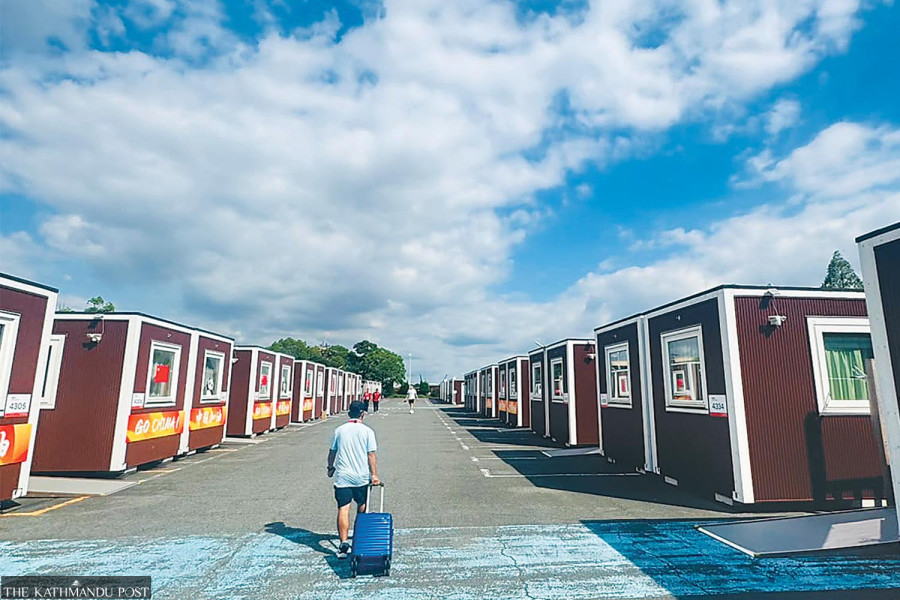
As Japan hosts the Asian Games after 32 years amid housing complaints in Nagoya, Nepal fields a slashed squad of 135 athletes eyeing medal glory in double figures.Around 2,000 athletes are expected to stay at container houses during the 20th Asian Games in Nagoya, Japan. Binod Pandey/TKP
The Asian Games made its debut 75 years ago in New Delhi, India, in 1951. Now, Japan, where the Asian main event is returning after 32 years, is all set for the official inauguration of the 20th edition on Saturday.
This is the third time Japan is hosting the continental multi-sport event, following Tokyo in 1958 and Hiroshima in 1994. The Olympic Council of Asia (OCA) unanimously approved Nagoya and Aichi’s joint bid during its 2016 session in Vietnam.
Headliners at this edition feature Philippine tennis sensation Alexandra Eala, 15-year-old Indian cricket prodigy Vaibhav Sooryavanshi, and 13-year-old Chinese swimmer Yu Zidi. While volleyball and women’s cricket matches kicked off on Wednesday, the official opening ceremony takes place on Saturday, with competitive action resuming in full force across the city of Nagoya in Aichi Prefecture on Sunday. Swimming, diving and equestrian events will, meanwhile, be held in Tokyo.
Nepali athletes have headed to Japan with the aim of fulfilling the government’s aim of winning medals in double figures, including the country’s first gold at the Asian Games.
Nepal has started the Asiad with losses in women’s volleyball and soft tennis.
Cruise ship housing and logistical blues
Over 17,000 athletes and officials—a headcount exceeding that of the Summer Olympics—are attending the Games, including 15,000 competitors. Managing this massive influx has emerged as Japan’s primary logistical challenge.
In a rare departure from tradition, this edition lacks a centralised Athletes’ Village. Traditionally, a dedicated village provides unified residential facilities and serves as a benchmark for the Games’ standard. Japan broke with this tradition by arranging accommodation aboard a massive cruise ship berthed at Nagoya’s Garden Pier for around 1,000 participants. The 300-metre-long, 100,000-tonne “Costa Serena”, brought in from Italy, features 1,000 cabins, seven swimming pools, eight restaurants, and nine bars.
To curb costs, organisers have also housed contingents in wooden container-style temporary shelters and budget hotel rooms. Visiting delegations have voiced sharp dissatisfaction, labelling the container hubs “the worst ever”.
However, Hideaki Omura, president of the local organising committee, defended the temporary housing model as an economically sustainable blueprint for future events.
Dissatisfaction brewed well before the opening, with teams complaining of tight quarters fitting up to four beds per room. The cramped bedrooms pose a severe headache for athletes traveling with heavy gear—such as cricketers—and larger-framed competitors like wrestlers.
Tashi Ghale, Deputy Chef de Mission for the Nepali contingent, acknowledged the organisational hurdles.
“Some of our athletes are scheduled to stay aboard the cruise ship, while their coaches are placed elsewhere and managers are in a different location entirely,” Ghale told Kantipur. “There are significant management issues in these opening days. Many delegations raised concerns during organising committee meetings, but we hope these issues resolve as the Games progress.”
Nepal’s designated Chef de Mission, National Sports Council (NSC) Member Secretary Ram Charitra Mehta, cancelled his travel to Japan at the last minute, as did Minister for Education and Sports Sasmit Pokharel. In their absence, Ghale has assumed Chef de Mission duties. NSC Vice Chairperson Bishal Shrestha arrived in Nagoya on Friday.
Nepal fields 135 athletes
Nepal is fielding 135 athletes in Nagoya. Boxer Chandra Bahadur Thapa and kabaddi captain Manmati Bista will carry the national flag during Saturday’s opening ceremony parade. Thapa won a bronze medal at the World Boxing Championship in Dubai last year, while Bista led the Nepali women’s kabaddi team to a bronze medal at the 2023 Hangzhou Asian Games. Bista is scheduled to land in Nagoya on Saturday.
“It is a moment of great pride to carry my nation’s flag on international soil,” Thapa said. “Having won a medal at the World Boxing Championship last year, I feel honoured to receive this responsibility.”
According to Ghale, only 40 members of Nepal’s 211-strong total delegation will participate in the parade. Nepal’s athlete headcount has been cut nearly in half compared to the 2023 Hangzhou Games, where 253 Nepali athletes competed.
A strict new qualification benchmark introduced this year led to the drastic reduction. For instance, taekwondo—traditionally Nepal’s primary medal prospect—will feature only three athletes. Nevertheless, high expectations remain for podium finishes.
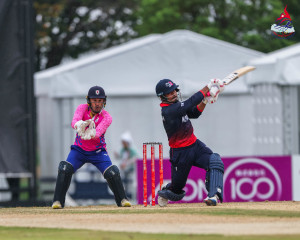
Nepal’s roster comprises 57 women and 78 men competing across 21 sports: archery (2), athletics (6), badminton (4), boxing (7), cricket (15), cycling (2), golf (4), judo (6), kabaddi (24), karate (8), rafting and canoeing (2), skateboarding (2), soft tennis (4), squash (2), swimming (5), table tennis (6), taekwondo (3), tennis (5), volleyball (12), wrestling (6), and wushu (10).
Nepal withdrew its entry from Mixed Martial Arts (MMA) at the last moment. MMA, padel, teqball, and virtual taekwondo are making their Asian Games debuts in Nagoya.
Overall, the Nagoya Asian Games feature 43 sports across 54 venues, with 45 nations and a refugee team battling for 469 gold medals.
China expected to dominate
China is widely expected to maintain its overwhelming dominance atop the medal table. The Asian powerhouse topped the 2023 Hangzhou Games with a staggering 201 gold medals on home soil—nearly four times more than runner-up Japan. At the 2018 Jakarta Games, China claimed 132 gold medals to Japan’s 75.
However, host nation Japan is poised to push China hard, fielding over 900 athletes. China has sent a delegation of more than 800 competitors, while South Korea has fielded nearly 800 athletes.




 12.67°C Kathmandu