Panel says cases against most Gen Z protest accused can’t be dropped
Most of those named in the 445 cases face allegations including murder, arson and looting that cannot be dropped under existing law. Despite intense political pressure to recommend the withdrawal of charges against as many defendants as possible, the study committee—headed by former High Court judge Baburam Regmi—advised that charges can only be withdrawn for around 300 out of 1,778 individuals named in 445 cases. File Photo
A high-level committee formed to study criminal charges against Gen Z protesters has recommended against withdrawing cases for a vast majority of those arrested during the September 9 unrest last year, citing strict legal barriers surrounding criminal offenses.
Despite intense political pressure to recommend the withdrawal of charges against as many defendants as possible, the study committee—headed by former High Court judge Baburam Regmi—advised that charges can only be withdrawn for around 300 out of 1,778 individuals named in 445 cases. The report stressed that existing laws explicitly prohibit the government from withdrawing cases against the remaining defendants, who face accusations of severe criminal acts such as murder, attempted murder, arson, and looting targeting public or private property.
The committee submitted its report to Home Minister Sudan Gurung on October 1. Among the cases evaluated by the panel, courts have already delivered final verdicts in 53 cases.
After examining the status of every defendant, the report classifies them into four categories. In the roughly 200-page report, the names of the defendants have been categorised as ‘sensitive; eligible for withdrawal; ineligible for withdrawal; and already decided by the court.’
Government spokesperson Sasmit Pokharel on Monday confirmed that the Cabinet has officially decided to execute the committee’s recommendations. “The Cabinet has decided to forward the report submitted by the committee led by former judge Regmi to the Ministry of Home Affairs for implementation,” said Pokharel, also the minister of sports and education.
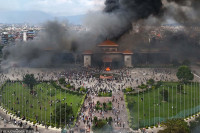
According to a senior official at the Home Affairs Ministry, the committee specifically recommended against dropping charges against individuals implicated in damaging critical national infrastructure, including the Parliament building, the Supreme Court, and the Singha Durbar complex.
“Under current laws, withdrawing charges involving the destruction or looting of private property requires compensating the victimised property owners, which the government cannot afford to cover,” the ministry official said, adding that affected victims or complainants must explicitly consent to any case withdrawal.
A member of the committee told Kantipur that while peaceful demonstrators should not face criminal charges, serious crimes cannot be overlooked.
“If individuals were prosecuted simply for participating, those charges must be dropped,” the member said. “But those who committed grave offenses cannot be released under current laws. We advised that if the government wishes to grant amnesty to more defendants, it must formally amend the law.”
The recommendations stem from a 10-point agreement reached on December 10, 2025 between the then government led by Sushila Karki and representatives of the Gen Z movement. The agreement stipulated that individuals facing criminal investigations or charges purely for participating in political protests on September 8 and 9 last year would be released.
Families of detainees and activist groups have staged demonstrations repeatedly, demanding the release of all those arrested. Families recently protested at an official event at the former Parliament building attended by Home Minister Gurung and Law Minister Sobita Gautam.
Sources told Kantipur that Home Minister Gurung had asked the panel to recommend withdrawing cases against most of those involved in the Gen Z movement, except those accused of murder, arguing that many participants had been prosecuted arbitrarily as an act of retaliation.
“The government wanted the report to recommend withdrawing cases against most of the accused,” a committee member told Kantipur. “But it was not legally possible to make such a recommendation.”
In an interview with Kantipur, published in early August, Gurung had also said that cases had been filed against participants in the movement as an act of retaliation and that the government was preparing to withdraw them. He said those accused in connection with the September 9 incidents had been released following court orders, while those detained in connection with the September 10 incidents remained in custody.
“Their families are out on the streets demanding justice,” he said. “We are now completing all the necessary procedures and working on it.” He added that the committee had already been formed and that, once its report was submitted, it would recommend the release of those in custody.
Gen Z campaign leader Sarishma Thapa criticised the committee’s narrower legal approach, arguing it “strays from the spirit of the December agreement.”
Besides former judge Regmi, the study panel included former Deputy Attorney General Chet Nath Ghimire and retired Deputy Inspector General of Nepal Police Poshraj Pokharel.
“The police unilaterally filed criminal charges against everyone, and it appears the committee merely accepted those charge sheets,” Thapa said. “This does not reflect the understanding reached between the government and the Gen Z movement.”
Thapa said the agreement was intended to provide a pardon for actions carried out without criminal intent or premeditation. “Friends facing vandalism charges are now being asked to pay millions in compensation based on inflated claims submitted by complainants,” Thapa said. “Is that fair? Who has audited the alleged damage to the private property involved? Denying requests to withdraw the cases on such grounds is unjust.”




 20.84°C Kathmandu