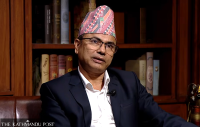
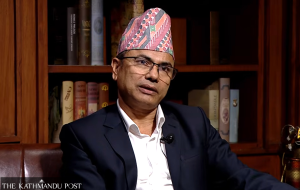
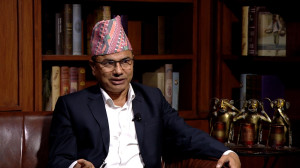
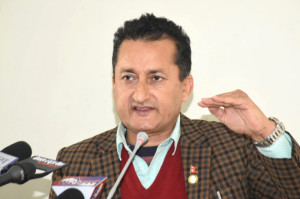
Home Minister Sudan Gurung on police firing, Gen Z justice, religious tensions and the criticism he faces
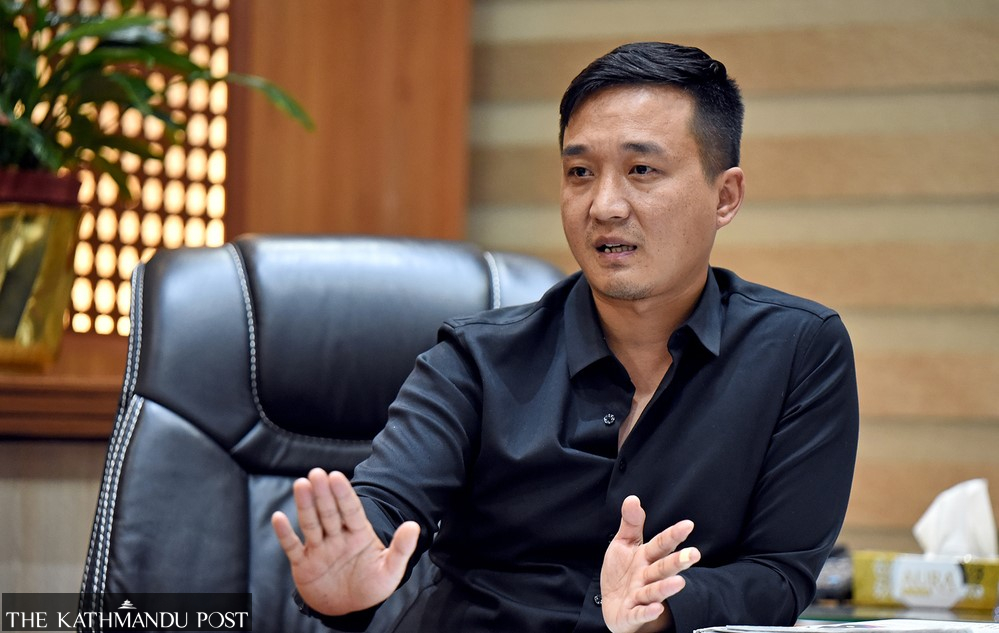
In an exclusive interview, Gurung addresses controversies surrounding him, the challenges of modern crowd control, and his vision for institutionalising the ministry. Angad Dhakal/TKP
Inside the Home Minister’s office at Singha Durbar, amidst security briefing files, memorandums, and discussion notes, sits a small clay pot filled with soil. At first glance, it might look like a simple piece of decor. But for Home Minister Sudan Gurung, it is a keepsake brought from the border village of Susta—a constant reminder of the struggles faced by border communities and the pressing issue of national boundaries.
“This is soil from Susta,” Gurung told Kantipur recently, pointing towards the pot. “A young activist brought it here during a protest, and I have kept it on my desk ever since. As long as I remain Home Minister, it stays here.”
Starting from the story behind this small clay pot, Gurung spoke candidly during an extensive interview on national security, religious tensions, police reforms, riot control—and the controversies and criticism surrounding him.
Below are edited excerpts of the conversation conducted by Kantipur journalists Krishna Acharya, Binod Ghimire, and Gaurav Pokharel:
You are known for reaching sites of any movement and protest quickly to hold talks, yet you delayed your response to the recent trouble in the Tarai. Initially, you had a strategy to contain the situation by mobiling security forces, and you only visited the site on the fifth day. What caused the tension in the Tarai? Where did the government stumble, and what did you do once you reached there?
It was not a protest directed against the government. It was another clash among the types of local disputes that have occurred in the past. However, because both sides became extremely aggressive, the police had to step in. During the incident, a police inspector was hit on the head with a wooden log and needed six stitches.
We took the matter very seriously. Because it involved the Hindu and Muslim communities, we were formulating a strategy from the central level to bring it under control. While we were working on that strategy, the situation escalated. It took some time to prepare a national-level strategy to prevent a small spark from turning into a massive wildfire.
That does not mean the Home Minister needed to be at the scene immediately. The Health Minister was already there representing the government. The injured were receiving treatment, and we were continuously planning strategies to ensure public safety, holding meetings past midnight. The government was working actively.
However, we noticed a growing expectation among the public for the Home Minister to visit in person. We concluded that during times of distress, leadership should be present on the ground. Despite the Health Minister's presence, I went to meet the victims’ families and the injured myself.
We anticipated early on that some elements might try to exploit the situation for political gain, which is precisely what happened later. To prevent that, we reached out to the victims’ families for direct dialogue. Arriving at 7:00 pm, we held discussions throughout the night, explaining the situation to the families and the injured. At dawn, we clearly told them, “Sign only if you trust us; nothing will be done against your wishes.” They signed voluntarily, and the protests quietened down.
Why did it take you so long to reach the affected area?
Understanding the gravity of the situation required time to build a coordinated national strategy. Our primary concern was preventing the unrest from spreading further. The fact that the situation escalated despite extensive efforts demonstrates how sensitive the issue was.
We had to remain at the centre temporarily to evaluate police command reach, determine where additional deployments were needed, and map out strategy accordingly. Kathmandu was the hub for necessary coordination. That caused a slight delay, but in the interim, the Health Minister was already present at the scene.
There are allegations that the police worsened the situation and provoked the crowd by opening fire during a minor dispute.
Consider what would have happened had the police not been there. Crowds of three to four hundred people from both sides were confronting each other, armed with domestic weapons like spears, bamboo sticks, and wooden logs. Had the police not intervened, it is difficult to estimate how many might have been injured or killed. The resulting conflict could have been far more severe.
Even now, social tension remains. Without police intervention, mutual distrust and hatred would have deepened, making it nearly impossible to control later. There was a genuine risk of triggering wider religious conflict. To prevent that, police officers put their safety on the line to stand between the two groups and restore order.
Given that the region borders India, was this purely a dispute between two local communities, or were external factors involved?
That is a matter for investigation. We will know the details only after the inquiry is complete.
The tension spread from Sunsari to Siraha and Dhanusha, leading to unrest in Golbazar. It remains unclear who opened fire in Golbazar. What is the status of that investigation?
An investigation committee has been formed to study that incident. We formed it to ensure an impartial and credible probe. Regarding both investigation committees, we immediately addressed the reasonable demands raised by the victims. When they expressed dissatisfaction with the local Superintendent of Police, we transferred him right away.
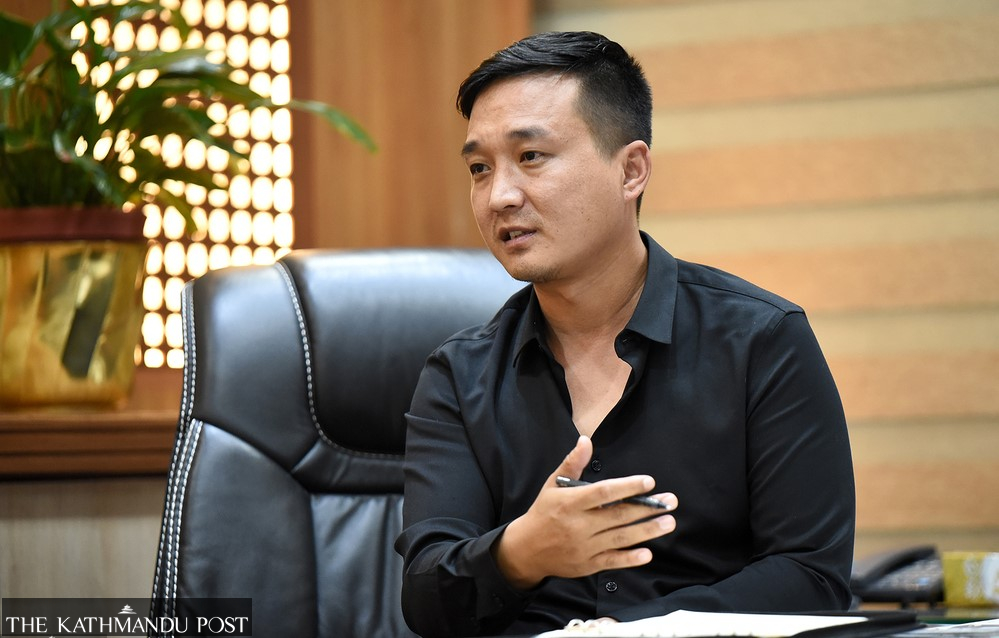
To enhance the credibility of the investigation, we included ballistics, forensics, and other technical experts in the team. These steps were taken to ensure the investigation remains fair, transparent, and grounded in facts. Since the investigation is ongoing, further public comment would be inappropriate. Angad Dhakal/TKP
From the Gen Z movement to the recent events in Sunsari, police firing has led to civilian casualties. Why has non-lethal weapons not been provided to law enforcement after all this time? Why are lethal weapons used directly?
Budgetary constraints prevented us from purchasing non-lethal weapons before mid-July, as we were operating under the previous budget cycle. Now that the new fiscal year budget is available, we are launching the procurement process.
We are purchasing a full range of non-lethal crowd-control equipment. Our main focus is on deploying drones for tear gas delivery, public announcements, and surveillance, alongside upgrading command center monitoring, enhancing barricades, and protecting key infrastructure without human loss.
Some security personnel still retain the old mindset that firing live rounds is necessary when a situation turns hostile. We want to change that mindset by establishing a system that prioritises non-lethal measures.
During the Gen Z movement, tear gas canisters used by the police were date-expired. Police have yet to procure fresh supplies, meaning the problem persists. Is anything being done for immediate measure?
No expired tear gas is being used currently; using expired canisters is strictly prohibited. Beyond equipment, our primary approach to crowd control is de-escalation through dialogue. Direct presence often helps lower tensions, which is why I periodically visit site locations for talks myself.
Regarding defensive crowd-control gear, the budget for purchasing new equipment has only recently become available. The gear currently carried by police stems from older allocations. The strategy was ready, but implementation had to wait for the new fiscal cycle. Now that the budget is accessible, procurement according to our plan will begin.
During the Gen Z protests, intelligence failed to anticipate the scale of events. Was there any advance intelligence regarding the Sunsari incident?
The Sunsari incident was not a protest against the government. It began as a dispute over a flag that escalated into a physical clash. We learned of it only after the clash occurred. However, the potential for tension between the Hindu and Muslim communities in that region was a known issue.
Following the initial clash, emotional reactions spread to other areas, and certain groups exploited the situation politically. Because the trigger event was sudden, predicting its exact trajectory was not possible. Subsequently, several factions amplified the issue, deepening the tension.
What must be done to prevent similar incidents in the future?
I am deeply saddened by the loss of civilian lives due to police firing. It should never have happened. Nepal has no historical tradition of religious conflict, so we must remain vigilant against those who try to exploit religion for political ends. We have framed a national strategy accordingly.
Our practice is to review every incident and correct weaknesses. We have learned key lessons from this event and are now formulating a national-level plan to prevent future conflicts based on these insights.
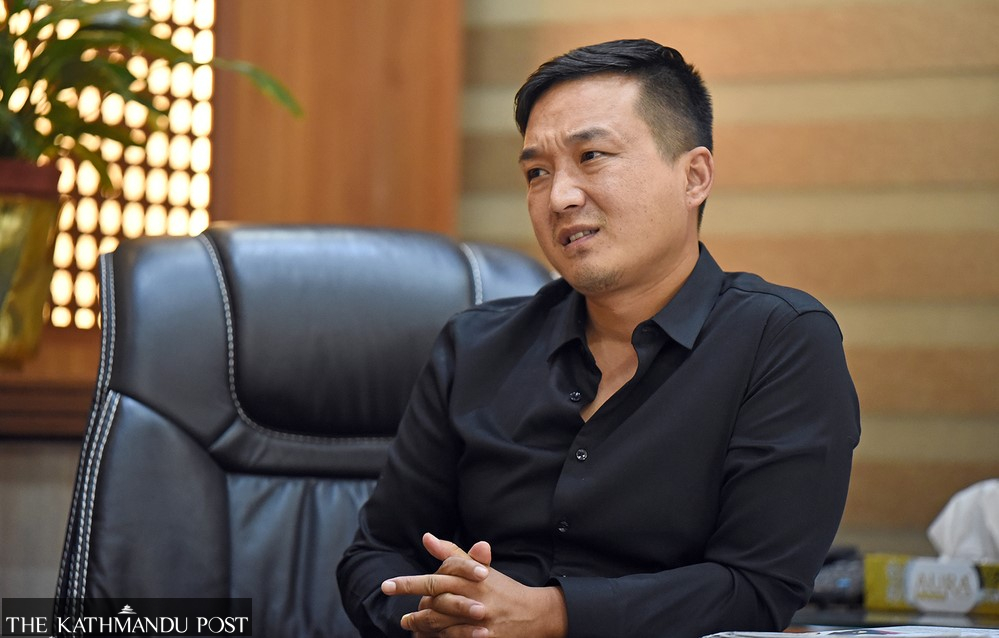
Angad Dhakal/TKP
How has your experience been leading the Ministry of Home Affairs so far? What key reforms do you feel are necessary?
I identified a need for comprehensive reform across all departments and branches within the ministry. A dedicated reform team has been established to create a long-term plan, as managing the Home Ministry with legacy methods is no longer effective. Reforms are also underway within the Central Investigation Bureau and Nepal Police, taking a 50-year perspective.
I noticed that when operational orders are issued, there is initial momentum that slowly fades over time. To fix this, I began collecting public feedback and personally conducting field follow-ups to verify if directions are implemented. The biggest bottleneck across ministries is poor execution and lack of follow-up—initial enthusiasm frequently wanes.
We must formalise operational directives into institutional regulations to ensure lasting impact. Furthermore, there is no structured system to motivate staff. Systemic transparency in transfers and promotions is lacking, and digitisation is practically zero, with operations relying on manual processes.
Security threats have evolved to include cyber attacks and digital offences. The ministry is currently unprepared for major digital threats, lacking robust measures for both digital offence and defence. We are working to address these gaps.
We are digitising the entire administrative structure. Moving forward, internal administrative software will track directives from the minister to the secretary, down to the relevant department and individual employee. This software enables real-time tracking of assigned tasks.
Poor performance will be logged for administrative action, while strong output will form the basis for transfers and promotions.
We plan to roll out this digital evaluation system across both Nepal Police and the Armed Police Force. Promotion and transfer processes have historically faced criticism over nepotism and financial irregularities. Digitisation will standardise performance tracking—such as an inspector's case clearance rate and responsiveness to public grievances—making evaluation transparent and data-driven.
Given that the Home Ministry has Chief District Officers and Police Superintendents in every district, why do you frequently visit the field yourself? Does the system not function?
If the system worked independently, these problems would have been solved long ago. Visiting the field helps identify where the system fails and why existing mechanisms repeatedly fall short.
Going to the ground allows me to assess needs directly and verify whether instructions are being carried out. Our objective is to identify operational gaps and execute necessary structural reforms based on real ground conditions.
Critics have accused your field visits of being publicity stunts, leading you to remark before a parliamentary committee that you might stop going. Will you continue field visits?
I cannot cover every location single-handedly, but criticisms will not deter me from my vision and mission. Given the intense public scrutiny following the Gen Z movement, I would not be in this position if I listened to every critic. I am determined to face challenges directly, so criticism will not alter my working style.
Because I cannot visit every district personally, we are taking a team-based approach. Sometimes I visit directly; other times, a monitoring team goes. This maintains operational discipline, as local officials know monitoring can happen at any time.
Over time, compliance through oversight becomes routine practice, or ‘muscle memory’. The existing mindset among some civil servants is that ministers come and go, while permanent staff remain to outlast terms. I am working to change that mindset.
Do you believe that institutional mindset can be changed?
Yes, I believe it can. Without the possibility of change, election victory and stability would be unattainable. I have neither conceded defeat nor been intimidated.
While I may occasionally show emotion when witnessing public hardship, displaying empathy is not a sign of weakness. It reflects a deep sense of love and responsibility toward the country and its people.
Following your field visits, several police and Armed Police Force personnel were removed from their positions. What key operational issues did you observe on the ground?
Ground realities differ significantly from reports reviewed inside administrative offices. We have no right to decide anyone’s future sitting within the four walls of Singha Durbar. Directly observing public hardship provides the necessary context to amend relevant rules and laws. The primary deficiency currently is execution and follow-up.
Clear directions are being issued—what more could be asked for? They have been told that there will be no political interference and no pressure, nor do they need to lobby for transfers and promotions; they are free to work independently. Has there ever been a time like this before? No, there isn’t.
However, you cannot change people overnight when years of ‘muscle memory’ is at play. That is why proper execution and follow-up are essential. Without follow-up, things frequently go off track. The Home Ministry has the necessary rules, regulations, and procedures, but so far, they simply have not been followed or implemented.
Several high-profile cases handled by your ministry have not reached conclusions. What is the main obstacle?
It feels as though certain judges are uncooperative in some areas. Everyone knows why, though it cannot be stated publicly. The global community recognised the violence during the Gen Z movement as a severe issue, and recent electoral outcomes clearly demonstrated the public mandate. A majority, near to two-thirds, reflects explicit public trust.
Despite this, some judges appear hesitant to deliver justice aligned with public expectations, often relying on legal loopholes. Subtle phrasing in legal interpretations is sometimes used to shift narratives rather than serve the national interest.
How do you plan to address these judicial challenges, given that delivering justice involves the executive, judiciary, and multiple ministries?
We operate strictly within our constitutional jurisdiction, but judicial reform remains essential. We hope the new Chief Justice will introduce reforms to enhance transparency and address delays where legal proceedings outlive the victims themselves.
Seventy-six people were killed during the Gen Z movement. Who fired the shots and how it happened are technical details, but those who lost their lives have not received justice to date. When will they get justice?
Weren’t the cases sent to court right at the start to deliver justice? And haven’t we suffered injustice ourselves? Tell me, who has been arrested over the incidents of September 8? Everyone from September 9 is behind bars, while their families sit in the streets demanding justice.
Only now are we completing all the necessary legal procedures to deal with this. Yet, when procedures aren’t followed, they accuse us of acting impulsively out of emotion. Is this what they call acting with composure?
A committee has only just been formed. Several young Gen Z activists who suffered gunshot wounds are still suffering in jail. We have set up a committee for them, and recommendations for their release can only be made once its report is submitted. We must follow due process. Just because Sudan Gurung is sitting in this chair doesn’t mean he can release people simply because he feels like it.
A separate committee was formed to investigate state response and recommend action regarding security forces and civil servants during the Gen Z movement. What is the current status of that report?
That is also under investigation. They claim it has been concluded, and a report was indeed submitted. However, we are currently expanding its Terms of Reference (ToR) to ensure a more thorough investigation.
After all, someone who didn’t open fire shouldn’t be framed—only those who actually did must be held accountable. Moreover, this involves the highest authorities. What if rushing the process leads to injustice? Injustice affects not only the police but us as well. We came directly from that movement, so we must not suffer injustice in the pursuit of delivering justice. We have to be fair to ourselves too.
To ensure it isn’t rushed and is done properly, we are adding to the ToR to cover whatever was missed. Once it is done thoroughly and maturely, we must be certain that the work is satisfactory, no innocent person has been framed, no action was taken on mere hearsay, and people were arrested with full evidence. That is why it will take some time.
What is the status of the investigation into the Royal massacre?
I cannot comment on that. The Home Ministry is not a platform for releasing sensitive information; only surface-level details are shared.
But has it been initiated or not?
I cannot comment on that either.
During your previous tenure as Home Minister, questions were raised in Parliament and the media regarding your personal assets and share transactions. A government investigation was conducted, after which you returned to office stating you were cleared, but the report was not made public. Why?
It is surprising to hear this brought up in this manner. Prior to taking public office, I was an ordinary citizen who held no government positions, drew no state salary, and possessed no political authority.
Investigations into the abuse of power properly apply to public officials, not private citizens. When the current government initiated broad asset investigations, the courts paused the process based on established legal principles. Legal frameworks dictate that actions must be evaluated against the laws in force when they occurred, rather than applying retroactively.
While my actions as Home Minister are fully subject to public scrutiny, private financial transactions conducted as an ordinary citizen are protected under Article 28 of the constitution, which guarantees the right to privacy.
When questions were raised, I stepped down voluntarily to avoid any conflict of interest, demonstrating that I do not cling to office. The government subsequently appointed an independent panel led by a former judge, alongside the Financial Controller General and a Chartered Accountant, to conduct a thorough audit.
While I cooperated fully, the investigation extended into private personal details unrelated to public office. I requested that while the report may eventually be made public, the personal privacy of non-political private individuals involved in those historic transactions must be protected.
Angad Dhakal/TKP
The National Human Rights Commission recommended action against you for human rights violations during the protests. How do you respond?
I challenge the National Human Rights Commission to provide proof that I instructed anyone to commit violence. Existing video documentation shows me standing on a truck with folded hands, actively asking crowds not to advance toward restricted areas.
When protesters were moving barricades, I instructed them on camera to lower the flex banners and leave the barricades intact. I submitted full video evidence to the NHRC, including documented communication with security leadership at the time, who can confirm our efforts to de-escalate the situation and protect public infrastructure.
When former prime minister KP Sharma Oli resigned during the Gen Z movement, there was widespread public relief. Expressing relief at a political transition does not equate to directing unlawful acts. If there is a single piece of evidence showing I directed arson or violence, I will step down from politics immediately.
As Home Minister, you lead the agency responsible for investigating those incidents. How are those cases being handled?
On September 9, thousands of citizens took to the streets out of frustration. It is neither practical nor legally viable to detain entire crowds driven by widespread anger.
Our correctional facilities are already running over capacity. Public anger must be addressed through political and administrative reform rather than mass prosecution. The electoral mandate reinforced the need to respect the public’s democratic voice.
Minister, there is a clay pot containing soil on your desk. What is its significance?
This is soil brought from Susta.
Why is soil from Susta kept in your office?
A young activist brought this soil to Kathmandu during a movement, and I have kept the country’s soil here since.
What steps is the government taking regarding the Susta boundary issue?
Susta is a long-standing boundary dispute that requires formal bilateral coordination. Border demarcations cannot be settled unilaterally; they require technical survey teams, the Ministry of Foreign Affairs, high-level diplomatic delegations, and a thorough review of historical boundary records.
This issue has remained unresolved since 2014. In the interim, our administration has focused on delivering state services and citizenship documentation to the local residents in the area.
Out of 182 border points, Susta and Kalapani remain the primary unresolved segments. Are active discussions underway?
This does not fall within my jurisdiction; it is a matter for the Ministry of Foreign Affairs. How they handle it is up to them—otherwise, people will accuse Sudan Gurung of exceeding his mandate again.
As for this, it is soil from Susta. It is the soil of our country, and my principles will not allow me to discard it. As long as I am here, this soil will remain right here. That is how deeply I love my country.
Binod Ghimire covers parliamentary affairs and human rights for The Kathmandu Post. Since joining the Post in 2010, he has reported primarily on social issues, focusing on education and transitional justice.




 20.51°C Kathmandu