Indigenous climate activist Pema Wangmo Lama on flood recovery, loans and who gets to say no to hydropower
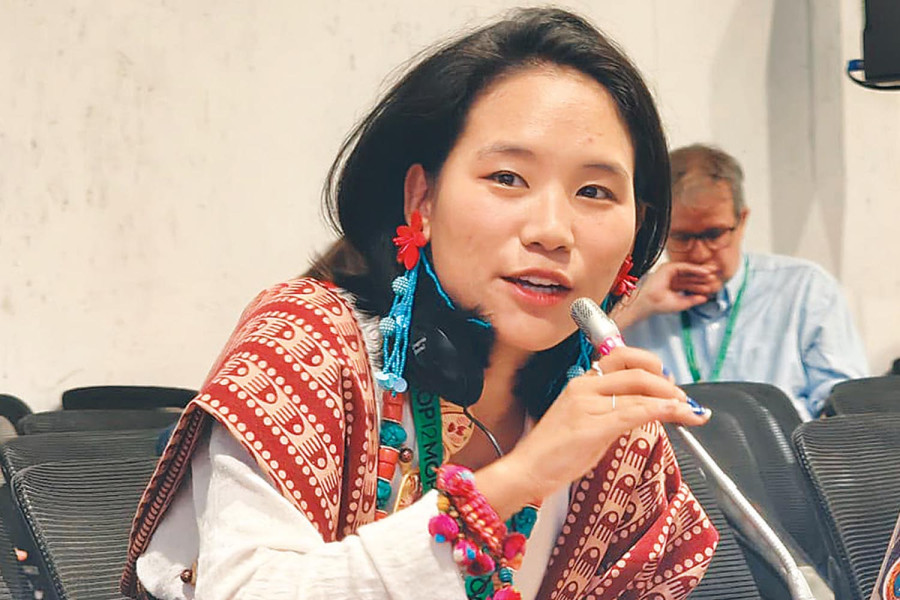
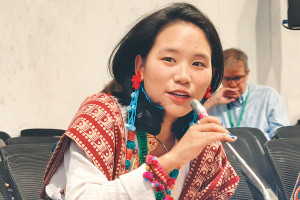
Lama, who recently attended the UN biodiversity talks, says post-disaster work in Nepal focuses on infrastructure rather than communities, and that safeguards for Indigenous people near hydropower projects rarely work in practice. Pema Wangmo Lama, an Indigenous climate activist Photo: Courtesy of Pema Wangmo Lama
As Nepal seeks international climate finance, questions remain over who will receive the money, whether it will come as grants or loans, and how much will reach affected communities rather than infrastructure.
For Pema Wangmo Lama, an Indigenous climate activist from the Mugum community who has followed UN climate negotiations since the 2015 Paris Agreement and spoke at the opening plenary of COP28, the disaster points to deeper problems in Nepal’s development model. She argues that climate finance should reach affected communities directly, that Indigenous peoples must have a meaningful say in decisions about their territories, and that general disaster recovery funds should go towards rebuilding communities rather than damaged hydropower plants.
Lama is part of the People’s Movement for Climate Justice, a coalition that delivered a letter to the World Bank’s Nepal office on October 16 opposing concessional loans for disaster recovery and raising concerns about hydropower financing. COP17 (UN Biodiversity Conference) just concluded its meeting in Yerevan, Armenia, running from 19 to 30 October 2026, where Lama represented Nepal. In an interview with The Post’sAarya Chand, she discusses the gaps in Nepal’s disaster response, the limits of international climate negotiations and what climate justice should mean for affected communities.
What are you carrying from affected communities into the negotiating rooms?
I supported the initial coordination from Kathmandu. On the first day, even prominent disaster-response organisations we reached out to had received no communication from the affected areas, highlighting how difficult it was to assess the scale of the disaster and coordinate an effective response.
In Amachhodingmo Rural Municipality in upper Rasuwa, people displaced by the disaster were relocated to Sundarijal, but the government had not recognised the site as a temporary shelter or holding centre until very recently. This raises questions about whether displaced communities are being properly identified, their living arrangements recognised, and their needs addressed.
There are also concerns about hydropower development. Indigenous communities protested these projects even before the disaster, arguing that risk assessments did not adequately consider the threats to their territories. We call hydropower clean energy, but we must ask whether it is truly sustainable if local communities bear the risks while electricity exports are prioritised.
The broader problem is that Nepal’s disaster response remains infrastructure-centric rather than community-centric. Rebuilding roads, houses and schools is not enough if people cannot return to their homes or traditional livelihoods. For Indigenous communities, whose livelihoods, cultures and identities are closely tied to their territories, recovery must address their needs and help them rebuild their lives, not just physical infrastructure.
How are the agendas of these summits organised?
The problem is that negotiations largely happen from a country-level perspective, while community perspectives are mostly confined to side events. Climate change, biodiversity and desertification are interconnected, but the connections between climate impacts and biodiversity are often missing from formal discussions.
Indigenous peoples consistently argue that humans cannot be separated from biodiversity. In Nepal, for example, human-wildlife conflict is increasing, partly because conservation approaches often treat people and nature as separate.
We need to ensure that vulnerable groups are consulted when national biodiversity strategies and other plans are developed and implemented. They must be included in decisions about protected areas, conservation and sustainable development.
The loss and damage fund has attracted requests far exceeding the money available. Is Nepal’s emergency appeal a precedent, or could the mechanism fail?
It is too early to say whether the mechanism will succeed or fail. The fund took considerable time to operationalise, and proposals worth more than $2 billion were submitted in its first funding round, while available pledges remained far lower. We have seen similar gaps in larger climate finance commitments. The initial $100 billion annual pledge went unmet for years, while the newer climate-finance goal—$300 billion annually by 2035, alongside a call to scale mobilisation to $1.3 trillion—raises questions about whether countries will deliver the resources required.
What has happened is nevertheless a precedent. Trigger-based funding creates an opportunity to discuss how emergency financial mechanisms should work, who should capitalise them and where resources should come from.
What did your coalition’s letter to the World Bank demand?
A few days after the Rasuwa floods, when the World Bank announced concessional loans, several climate activists began an email campaign arguing that concessional loans were not the answer. That effort developed into a petition and eventually the People’s Movement for Climate Justice, a coalition bringing together activists, organisations and rights holders.
Before the World Bank's annual meetings, we consulted representatives from other Asian countries about the problems associated with development projects and clean-energy financing. We prepared a position paper, gathered endorsements and delivered a letter after a demonstration outside the World Bank's Nepal office on October 16.
Our main concern was hydropower projects financed by the World Bank. We argued that environmental and social impact assessments were flawed, affected families had not received proper compensation, and serious human rights violations and displacement had occurred.
We want development institutions to invest in genuinely just development and clean energy. Climate-vulnerable countries and communities should receive direct financial support without debt obligations or rigid conditions.
Your coalition opposes concessional loans for disaster recovery. Should Nepal refuse them altogether?
It is very difficult to tell the government to reject concessional loans entirely. Nepal lacks the fiscal space to do so, and if donors do not provide grants, the government may have to take concessional loans or even borrow at market rates.
As activists and civil society, however, we must continue to demand grants rather than loans for climate disaster recovery. If loans are accepted, the money must reach communities and respond to their needs.
Look at Thame. The glacial lake outburst flood in August 2024 brought significant attention to the area, yet during our recent visit, many households had still not received funds to rebuild their homes. Some families have moved to Kathmandu, while people who previously depended on tourism are now going abroad for seasonal wage labour.
Recovery must strengthen communities' social fabric and long-term livelihoods. It should not simply direct money towards infrastructure that may be damaged again. In international forums, our position must remain clear: climate-vulnerable countries should receive grants for disaster recovery, not additional debt.
What safeguards exist for Indigenous communities affected by hydropower projects?
Nepal has safeguards on paper, but they rarely work in practice. Although Nepal’s constitution recognises Indigenous nationalities, we lack adequate legal mechanisms guaranteeing communal ownership of ancestral territories.
Our national climate plan includes free, prior and informed consent, or FPIC. In practice, developers can reduce this to a short presentation to a small group of villagers, promising jobs and shares in a project. They collect signatures, and the government treats that as consent.
But communities cannot assess decades of ecological and social consequences through a one- or two-hour presentation. Indigenous experts, community leaders, women and young people must be involved in assessments and implementation.
FPIC is not a one-time signature. The community must define how its consent is sought, and the process must continue throughout a project's life. If rights are violated or unexpected harms occur, communities must be able to withdraw consent and demand that the project be halted. Nepal has not adequately enforced these protections.
Who should pay to rebuild damaged hydropower projects, and could climate finance end up reinforcing a failed development model?
The failures began when the projects were designed. When early warnings identified risks to local geography and communities, rigorous assessments should have been conducted. Instead, projects were approved despite concerns about their impacts.
Most hydropower ventures are commercial businesses that depend on loans and insurance. When disasters occur, insurance may not cover all the losses, leaving the state to take on additional public debt.
In my view, general disaster recovery funds should be used to rebuild affected communities rather than damaged hydropower plants. Infrastructure-specific financing and insurance settlements are different, but the government must reconsider its priorities and diversify the economy instead of relying so heavily on electricity exports.
Donors should not dictate how recipient countries use compensatory climate finance. But finance alone is insufficient. Support under the UN climate convention also includes technology transfer and capacity building.
Ultimately, whether climate finance reinforces a failed development model depends on whether the government is willing to rethink its vision. Nepal must prioritise social equity and resilient energy systems and sustainable livelihoods, rather than repeatedly approving major projects that displace Indigenous and local communities.
Aarya Chand is a reporter at The Kathmandu Post covering social issues. Before moving to the social beat, Chand was an intern covering culture and lifestyle for the Post.




 22.03°C Kathmandu