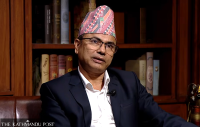
Gagan Thapa on giving Congress a new generation and a new purpose
As he seeks re-election, the Nepali Congress president outlines his vision for a party that goes beyond elections and power to become a broader social movement.
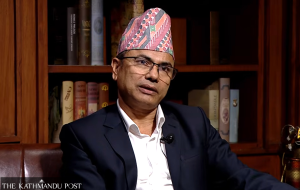
Gagan Thapa, who was elected president of the Nepali Congress at the special general convention nine months ago, is seeking to be re-elected at the 15th General Convention starting Sunday. He faces a parallel convention led by former president Sher Bahadur Deuba, a party at odds with itself, and growing demands from younger members.
Kantipur’s Krishna Acharya and Kul Chandra Neupane sat down with Thapa to discuss the party’s direction, the rift with Deuba and the government’s first six months. Excerpts, edited and condensed from the original Nepali interview:
Nepali Congress’ website says, “We changed Congress, we will change the country.” How much has it actually changed?
Change is a process, not a journey from A to B. The slogan means holding on to the party’s founding values, cleaning away the dirt that accumulated in practice, and connecting with society’s new aspirations.
Before the special convention, our entire focus was on gaining access to state power. Becoming part of government became the overriding concern, and we were ready to make any compromise for it. That image took hold between 2015 and 2025.
After the constitution was written, our job was to implement its commitments. We did not. We chased power instead. The special convention resolved to close that chapter. The leadership and the rank and file now feel that we have made many mistakes. Correcting them will take time.
You called it ‘Congress 2.0’. Is that chapter over?
It continues; we’re just getting started. A party’s core is its ideology. Until 2015, anyone with a liberal outlook in Nepal’s political landscape would naturally pick Congress. Since then, people have asked, “Why Congress?” We did not make the extra effort to answer, and we failed. That is why about one million voters who used to back us did not do so this time, and no new voters came. Around 250,000 families decided Congress was not their choice. We must win them back.
But critics say ‘Congress 2.0’ abandons the party’s legacy of struggle.
BP Koirala was Congress’ most dynamic leader. His generation set out nationalism, democracy and socialism as the party’s ideals, and BP kept rethinking the political line and economic policy to suit the times. I see Congress’ tradition in that spirit. Our values stay the same, but our priorities and policies must be debated and renewed. If we fail to do that, we abandon the tradition.
What has the party been working on since the Gen Z uprising?
Look at what we did in government between 1991 and 1994. Our economic policies were largely right, and the country suffered most because they were not continued. The party accepts this, but has not said it openly. Part of the reason was pressure from the opposition of the time. We took the easy route.
At this convention, I will table a ‘Vision Document for a Prosperous Nepal’. It rests on nationalism, democracy and socialism, seen as one project. On whether the economy should centre on the state or the market, we regard both as means. The citizen must be at the centre.
Investment in maternal care, nutrition, early childhood care and education before a child is even born is not merely a matter of social justice. It is economic. Empowered citizens strengthen the economy, and a stronger economy builds the state. Prosperity and social justice cannot be sequenced, with growth first and equality later. The experience of capitalist countries shows that it does not work, whereas the Scandinavian countries pursued both together. Social democracy is being redefined worldwide, and we do not want to confine ourselves to one tradition. We want a citizen to decide whether to join Congress by reading this programme.
Does that mean moving away from ideology towards a ‘project’?
I would not say we are abandoning ideology. In 1991, after the Soviet collapse, the world was uncertain, yet Congress stood firm. We secured political rights but fell short on prosperity. European social democratic parties have shrunk after losing their legacy, and we have studied why. A party can preserve its values only up to a point, so we must change with the times. Technology is reshaping power relations. Congress must tell an 18- or 19-year-old that it carries their issues.
We are building three structures: an election bureau, a leadership academy and a government institute. The bureau will end the practice of a few people picking candidates. From the next election, every member will help choose them. The academy will train office-bearers at all levels. The institute will keep elected representatives connected to the party and support research on policy areas such as education and health.
Does that make Congress a project-implementation body rather than a political party?
No. These are party structures, guided by the document the convention approves. A party is also a great social movement. We have focused only on elections and drifted from that. Congress has 800,000 members and an organisational structure in every ward, so it is arguably Nepal’s largest social organisation. Yet it has been drifting away from social issues. BP Koirala once directed that anyone practising untouchability be expelled. That was a social movement, not just a decision.
Today, a ward might have 100 members, but 98 are unhappy because only two got positions. We made winning tickets and positions the only measure of success. People did not join Congress during the Panchayat era for that. We want social issues to be part of Congress culture, and every member to be an activist. Changing the country does not require being in government.
Yet the party is still divided. Sher Bahadur Deuba, five-time prime minister and twice party president, is leading a parallel convention. How did it come to this?
I believed Deuba and other leaders would join the 15th convention, because the political case for it was strong. But the matter reached the courts. The court could have declared the special convention invalid but did not. I have visited leaders at their homes and tried hard. Some have joined, but not all. It feels hollow, but I have done my duty.
It is sad that a man who has held the party’s top post is leading the dissenters. But I do not think only of central committee members. The party has millions of well-wishers and supporters, and my priority is how to bring them in. Deuba is part of that, but I cannot think of him alone.
Is there still room for agreement?
Right up to the last moment. But their demands were impractical. For instance, they asked us to halt the digitisation of party membership. That was not reasonable, though I bent on other matters, such as allowing membership renewal. I kept giving way. We still hope Deuba will attend as chief guest.
Have you formally invited him?
Yes, a formal invitation has gone out. If a meeting makes it easier for him to come, we are ready for that too. After he returned from abroad, I held back, as he was to attend a gathering and I did not want to crowd him. Later I phoned to ask for a meeting and tried through several leaders. He has not agreed to meet. My efforts have not become public.
There is talk that Deuba would chair the opening session and you the closing session.
That did not come from us. Party rules govern this. If it keeps the party united, we are ready, and there is nothing personal in it. As outgoing president, Deuba should not have forgone the respect due to him. I think he will eventually accept that. About 80 percent of those at the convention worked with him, and their concerns deserve a hearing.
Some say relations soured because you did not wish him a speedy recovery after he was attacked during the Gen Z protests.
On September 8-9, we were arguing with him about how the government was run. After the protests on September 8, our disagreement deepened. We said the home minister must resign. On the morning of the 24th, I spoke to him by phone three times, each time urging him to leave government. Children had been killed, and we had to show sensitivity. Then came our separate ordeals. My house was set on fire with my parents and family inside. Neighbours shouted that ‘the dog is burning, get it out’, and I hoped they would at least rescue my daughters. Local friends broke the back door and got us all out.
On September 10, Bishwa Prakash Sharma and I issued a statement condemning the attack on Deuba and demanding action. We may have been the first to do so. We tried to visit him in the hospital but were not allowed. The following month, Ramesh Lekhak helped me prepare his speech for a party meeting, and he thanked me.
You also denied him a ticket in Dadeldhura in the March election.
Yes. The party had decided that a certain tier of leaders should take a break this time. It was not only Deuba. Others did not get tickets either. Had there been time, we would have asked many leaders to step aside. That may apply to me one day. Everyone must rest.
I don’t think so. As far as I know, Deuba himself petitioned the court, saying he would return by the end of Shrawan and had nothing to hide. His return was settled long before. Later the cases came up. Perhaps he believed I had promised that everything was sorted, and I may have misled him.
Doesn't infighting hurt the party ahead of local elections?
Look at it differently. The UML was united before the election, and its infighting came afterwards, yet it recorded its worst-ever vote loss. Pushpa Kamal Dahal's party went in as a combined communist force. The communists used to win around 60 percent of the vote together; this time they got under 25 percent, and there was no infighting. We held a two-thirds majority and governed in all seven provinces, and lost it all. Grassroots workers care little about quarrels at the top. The million voters we lost left when Deuba and I were together. They were angry at alliance politics and at those who would do anything for power.
You were part of those alliances, and critics say you only dissented within the party.
About 40 Rastriya Swatantra Party MPs have, at some point, worked with me or come to do so, and some are in government. We voiced society's sentiment, but did not deliver. Had the party changed, we would have been on the right track. The issues we raised were right. For example, Bishwa Prakash Sharma kept asking that Deuba be told not to become prime minister again. I contested the parliamentary party leadership against him, and he offered me the deputy prime ministership. I told him the country did not want him as prime minister.
Will youth participation amount to more than numbers?
Many under-35s have come. We will take at least 21 into the central working committee, along with people from varied professions. Candidate selection will leave no room for personal connections or financial opacity. Voters will decide the outcome, but the party's selection process will be clean.
In 1991 I was 15, too young to vote but out campaigning. My grandfather, my father and I all believed in Congress. Over the next four years, I want it to inspire three generations again. Young people see Congress as old, but we are Nepal's oldest party, and we will pair our values with change.
What is Congress's exit policy, so young leaders do not fight the next Gagan Thapa?
There is one. No one can serve more than two terms as president. Bishwa Prakash and I will not stay beyond two terms either. We want this to become a culture. We also want older leaders' experience, and the energy of those below us.
Congress is in opposition, but has it been effective?
For about six months we kept our voice low, deliberately. A loud start would have looked like a failure to accept the election result gracefully. After this convention, that period is over.
Does that mean street protests?
We do not plan street agitation in advance. The government has a strong mandate for good governance and economic reform, and we respect it. But it must act within democratic limits. We bore the Panchayat for 30 years because we opposed its way of ruling, not its rulers personally. This government increasingly shows authoritarian tendencies. Take the arrest of former Chief Justice Cholendra Shumsher Rana. We impeached him and have questions for him, but the rule of law is democracy's most basic principle.
The government spokesperson's reply stunned me. It belittled citizens. Evicting squatters, parking vehicles in front of citizens' homes, picking people up at night: we must oppose that. Until now we have done so mildly; we will not any longer.
Will you join the UML, which plans street protests after Dashain and Tihar?
No. We will not form a front or lay siege with anyone. We will support the government where it is right and oppose it where it is wrong.




 17.49°C Kathmandu