Three catastrophic floods in three years have tested three administrations. What has been less tested is whether any of the previous disasters changed what the government does next time. Security personnel use drones and rubber boats during a joint search operation for missing persons in Chitwan. Photo: Nepal Photo Library
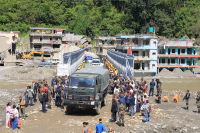
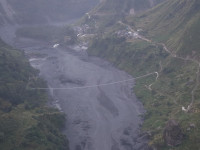
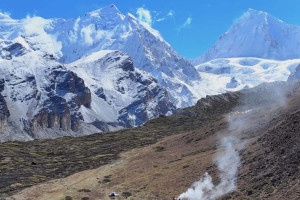
When the flash flood tore through the Bhotekoshi corridor on August 26, it hit a road that had already been taken once. The stretch connecting Syaphrubesi to the Rasuwagadhi border crossing was rebuilt and reopened about a month after the July 2025 flood that destroyed the “friendship bridge” linking Nepal to China and killed at least eight people. That repair was the fast part. The rest of the valley’s reconstruction was still unfinished 13 months later when the water came back, this time carrying ice and debris from a collapse high on Langtang Lirung.
“People were starting to forget the pain of last year’s flood,” Kaisang Nurpu Tamang, chairperson of Gosaikunda Rural Municipality, told the Kathmandu Post. “Everything was becoming normal.” Tamang’s own municipal building, thirteen kilometres up the valley in Timure, is gone now too, swept away along with the rest.
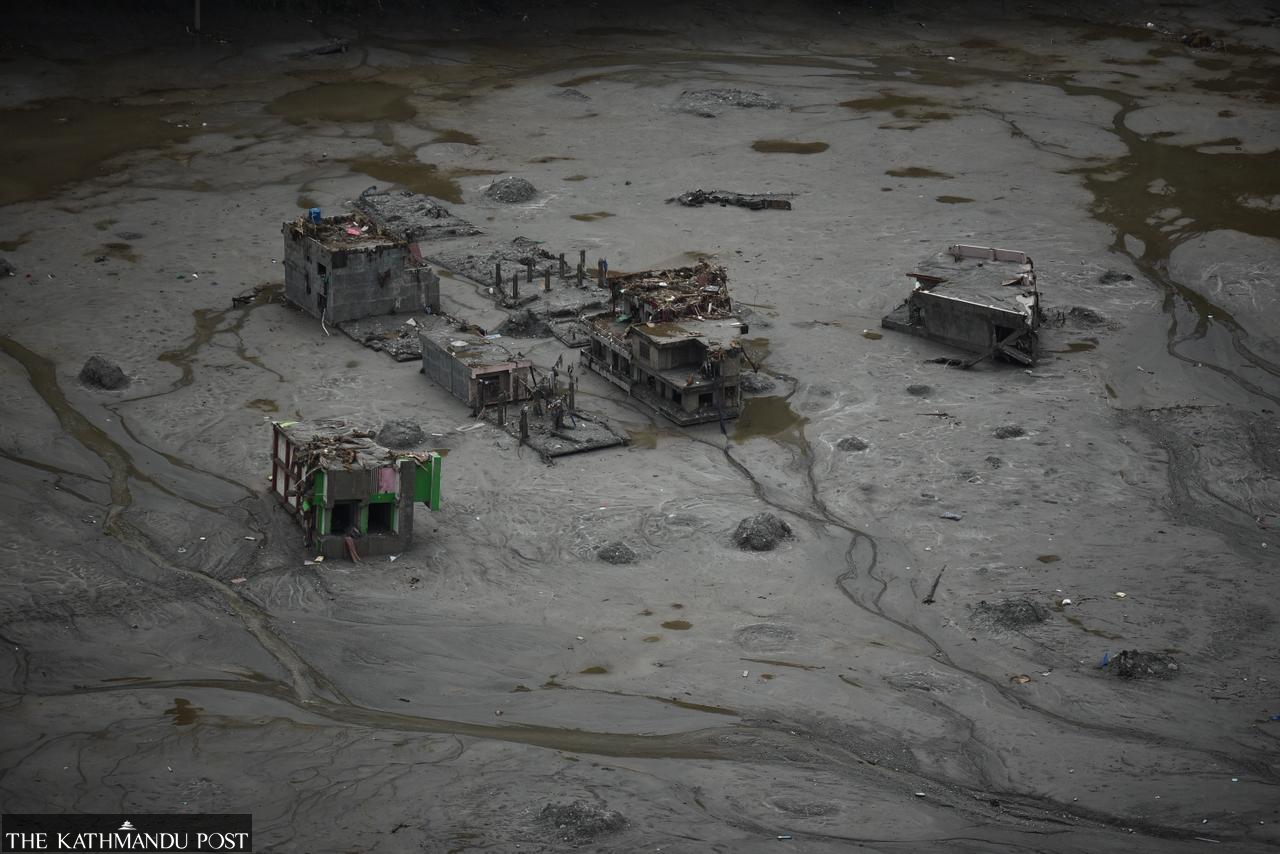
The 2026 flood has killed more than 900 people in Nepal, with over 4,200 still missing. Forty-one bridges and 42 kilometres of road were gone in a single morning. Swarnim Wagle, the country’s finance minister, told Reuters the preliminary estimate to rebuild could be anywhere between $4 billion and $5 billion. Binod Chaudhary, Nepal’s only billionaire, told Bloomberg Television days earlier that rebuilding could cost $5 billion.
Both estimates are less than what the 2015 earthquake reconstruction took. It is a fair comparison, except that Nepal was still working through pieces of that earthquake recovery when the floods of 2024 arrived, killing 300 more people across the eastern lowlands. Then came Rasuwagadhi in 2025. Last week’s was the latest.
For anyone paying attention — which most Nepalis are — three consecutive years of disaster have been described in strikingly similar language. Officials called last week’s Bhotekoshi flood unprecedented. The 2025 flood was described the same way. The 2024 floods were the worst rainfall the region had recorded since 1970. At some point, one has to ask: when the same word is used every year for the same kind of event, does it still describe the event, or has it started describing our relationship to it?
I asked Nepal’s foreign minister, Shishir Khanal, whether the government sees a pattern here or is still treating each flood as its own emergency. “We should anticipate such disasters are likely to be more frequent occurrences than in the past, and be prepared for them,” he said.
The 2026 flood has killed more than 900 people in Nepal, with close to 4,250 still missing. Angad Dhakal/TKP
There is a useful contrast next door. Bangladesh used to be cyclone country the way Nepal is flood country now — a place where a single storm could kill on a scale that defied comprehension. The 1970 Bhola cyclone is estimated to have killed between 300,000 and 500,000 people, among the deadliest disasters of the twentieth century. Bangladesh did not stop having cyclones after that. It has been hit by dozens since, but Bangladeshis now have a system that works. They have built a national network of concrete shelters, trained tens of thousands of volunteer evacuators village by village, and tied a warning system so tightly to that structure that a storm of comparable strength now kills in the dozens.
There’s a caveat in the comparison, of course. A cyclone is a meteorological event that announces itself days out, and the people at risk live in a flat, densely settled area where they can be moved to a shelter. A glacial collapse, like the one last week, forms in a high-altitude terrain, sometimes across an international border, and arrives down a narrow valley in minutes.
Nepal’s own mountain research body has been saying something similar about the ground itself. Five months before last week’s flood, the Kathmandu-based International Centre for Integrated Mountain Development (ICIMOD) published findings that ice loss across the Hindu Kush Himalaya had doubled since 2000. Of 38 glaciers it monitors, only seven meet global monitoring standards; large parts of the range, it said, remain unmonitored altogether.
“We are trying to navigate a rapidly changing future with an incomplete map,” Mohd Farooq Azam, a cryosphere specialist at ICIMOD, said at the time. “Accelerated changes in water flows and cryosphere risks could remain undetected until the impacts are severe.” ICIMOD’s director general put it even more matter-of-factly. “These aren’t blind spots becoming surprises anymore,” he said. “They are our new reality.”
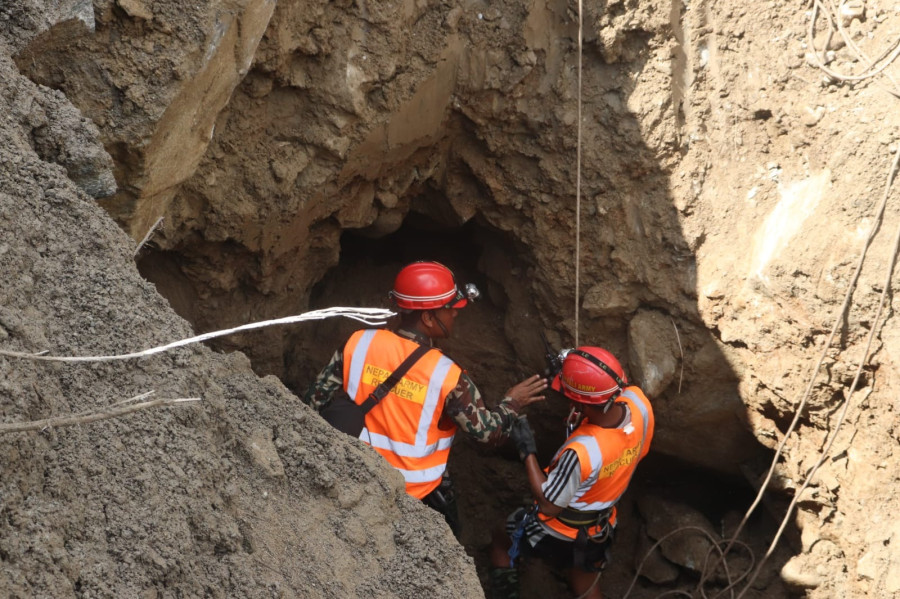
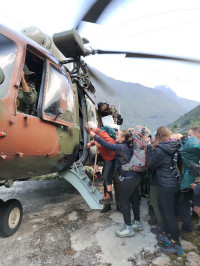
Nepal’s pattern over the last three years runs the other way from Bangladesh’s. Each flood over the past few years has been met with an improvised response built largely from scratch: army units are mobilised after the fact and drone surveys are ordered once the water level has receded.
“Our primary challenge is that our initial hydrological station was swept away on the first day,” Dharmaraj Upreti, chief executive of the National Disaster Risk Reduction and Management Authority, told the Post on Sunday. Replacing it, he said, requires the consent of both Nepal and China — a diplomatic step now unfolding in the middle of a disaster.
Each flood over the past few years has been met with an improvised response built largely from scratch: army units are mobilised after the fact, and drone surveys are ordered once the water level has receded. Photo: Courtesy of Nepali Army
Prime Minister Balendra Shah, five months into office, said the state has been mobilised at full capacity. He visited Nuwakot to assess the damage, which is what his predecessor did after the 2025 flood, standing in front of a different stretch of the same river. Part of what makes the pattern hard to see, let alone address, in a country like Nepal is that each flood resets the political clock. Every natural disaster is an act of geology or weather that no government could have prevented, so the response gets judged only on the speed and visibility of relief.
When the Post asked the head of NDRRMA what it had learned, Upreti had this to say: “We are reviewing helicopter deployment logistics, helipad placements, body management procedures, and the availability of body bags. We have many lessons to implement from this experience.” But these are machinery for responding faster next time, not for catching the next flood before it happens.
Tamang, the Gosaikunda chair whose rural municipality has yet to receive federal coordination since the flood, described the same sequencing problem locally. A geologist needs to survey the area to determine what ground is safe, he said, before any long-term plan can be made. “Right now, we haven’t even been able to think that far,” he said.
Minister Khanal told me that two months before the flood, he had been pressing Chinese counterparts for a bilateral framework on hydrological and meteorological data-sharing across the border. The two sides, he said on Monday, were actively exchanging communications toward a framework agreement. It was not in place as of last week.
“I was told by some scientists who know the region very well that the glacial collapse didn’t even have a name in Nepali,” Khanal said, which probably means that Nepal either didn’t know it existed or didn’t consider it an imminent threat. Since the disaster, he said, Chinese authorities have been sharing real-time information on the new lake that formed upstream — the cooperation the framework was meant to formalize before there was a lake to worry about.
That new lake, high in the mountains in Tibet and formed by the same landslide, is being labelled “extremely concerning” by global scientists. Tamang, cut off from his own municipal building, said he and his community have no idea what’s happening above them. “There’s no electricity here, the telephone network still has no signal,” he said. “So we’re quite confused about what’s happening further up.”
Anup Kaphle is the Group Editorial Director of Kantipur Media Group. He previously served as the editor-in-chief of Rest of World in New York, where he led award-winning coverage of technology's impact in the emerging markets. He has spent nearly two decades in U.S. newsrooms covering international affairs and national security, including roles at The Washington Post, BuzzFeed News and The Atlantic.




 20.51°C Kathmandu