NDRRMA chief Dharmaraj Upreti on early warning system, survivor rescue and relief management
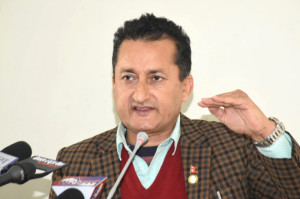
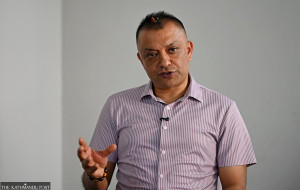
In an interview with Kantipur, NDRRMA Chief Executive Upreti details the multi-agency response to the disastrous Bhotekoshi flood, highlighting the critical priority of rescuing survivors, deploying transboundary early warning systems, and managing relief and displacement across affected districts. Dharmaraj Upreti, chief executive of NDRRMA Post Photo: Deepak KC
A gargantuan flood in the Bhotekoshi River on August 26 rushed through and destroyed settlements—lives and physical property included—along the river basin in the districts of Rasuwa, Nuwakot, Gorkha and Chitwan. The exact extent of deaths, missing persons, injuries, and physical damage has not yet been confirmed. But five days later, at least 780 persons have been confirmed dead.
Search, rescue, relief and rehabilitation operations for those affected by the flood are underway under the leadership of the National Disaster Risk Reduction and Management Authority (NDRRMA), which is directing the security forces.
Kantipur’s Durga Dulal and Jaya Singh Mahara sat down with Dharmaraj Upreti, Chief Executive of the NDRRMA, to discuss the origin of the Bhotekoshi flood, its impact, the precautions needed for the coming days, and the management of the displaced.
How is the Authority working on the search, rescue and management of those affected by the Bhotekoshi flood?
Because roads are blocked, dispatching relief materials and conducting rescues has become difficult. Helicopters are our only option, but they come with limitations. Only a restricted amount of material can be transported, and landing zones are required, which creates hurdles. Nevertheless, we are treating this as a top priority. We have deployed private-sector helicopters alongside the Nepali Army, using an integrated dispatch system.
We have now entered the phase of sending medical supplies. On Friday, we sent food and medicines targeted at Rasuwa. We received grievances that rescues were difficult in remote areas of the district and that there was a lack of food, so we are focusing our efforts there.
There were specific complaints from the Uttar Gaya area of Rasuwa. In response, the Authority dispatched relief materials and medicines early Friday morning. In addition to food, we have started sending oxygen cylinders to other areas.
The Nepal Electricity Authority has restored power supply in Nuwakot. Similarly, Nepal Telecom and Ncell are restoring telephone towers, so communication will soon be re-established. For food, we have begun sending items that can be consumed immediately, such as dry food like biscuits. Overall, we have not let any gaps remain in our preparations and are carrying out all necessary state duties.
Given the scale of the disaster, we realise that massive preparation is required. Despite the scale, we are working continuously. Looking at the rescue numbers, we feel significant work has been accomplished under tough conditions. We successfully rescued 350 people from a single tunnel. On Friday morning alone, we rescued 500 people, bringing the single-day rescue total to 3,500 people.
How is coordination being handled for search and rescue operations?
To avoid duplication and make the operation smoother, the NDRRMA formed 12 teams to carry out the work. We have deployed all three security agencies—the Nepali Army, Nepal Police and the Armed Police Force—to search for and rescue the missing persons.
Each team has a designated team leader, focal point and contact person to handle coordination and execute responsibilities. The overall command post is led by the NDRRMA. Security personnel from all three agencies are in the field, working in full coordination.
The displaced require relief. How is relief being distributed?
We have established a single-door policy for relief and designated command centres in three locations: a warehouse in Kathmandu, the Tribhuvan International Airport and Nuwakot.
Materials arriving in Kathmandu are stored in the warehouse. From there, based on need, they are sent to the airport, then to Nuwakot, and finally dispatched to the affected areas via helicopter. We used this exact method for supplies sent by India and China, and we will apply the same process to materials from other donors.
How are the bodies of the deceased being managed?
Teams of police and army personnel have been deployed at various points to collect data. The most difficult task right now is recovering the bodies. Given the hot weather, if bodies are not retrieved in time, decomposition poses severe epidemic risks.
Storage is also a challenge. As bodies decay, the risk of infection grows. We dispatched medical teams today to address this. In coordination with the Health Ministry, a team of doctors led by the Nepal Police is heading to the field to set up camps and prevent the spread of infections.
Bodies are being found from the origin in Rasuwa down to Chitwan, and some even in India. What is the plan to consolidate and manage them?
Body recovery is moving rapidly, but an even more critical task is the immediate rescue of survivors and providing them with food and necessities. Many have gone without food for a long time. Some are stranded across rivers and streams and cannot cross over. We must transport them across to safe areas.
New flooding has also occurred, and there is no certainty as to how long this trend will continue. The possibility of fresh flooding causing further obstructions creates uncertainty during rescue operations.
At the same time, we must prevent new floods from causing further disasters. This involves issuing alerts and moving downstream residents to safer locations. We have already issued public notices. We are simultaneously executing three key tasks: issuing alerts, conducting ground operations, and delivering food.
Road damage remains the biggest obstacle. We transport supplies by road to Nuwakot and airlift them to remote areas of Rasuwa from there. We are working on a 24-hour alert, but the massive scale of the flood makes it challenging.
Did the government and the Authority have prior warning about a flood of this magnitude?
Initial estimates suggest the flood was caused by an avalanche near the border rather than deep inside China. The avalanche created a temporary dam/lake that burst all at once, releasing a sudden surge of water. Because heavy rock debris fell, it continues to form temporary blockages. The debris did not clear all at once, so secondary flooding remains a risk, though we project future surges will be smaller in scale.
Our primary challenge is that our initial hydrological station was swept away on the first day. Efforts to set up another station are ongoing. The Department of Hydrology and Meteorology (DHM) requires mutual consent from both countries to establish a new station. I discussed this with representatives from the Chinese Embassy, and we agreed on continuous information sharing. Cross-border information sharing is vital; without it, we risk facing even greater disasters. With higher-than-average temperatures forecasted alongside El Niño impacts, the coming days pose further challenges across Asia.
There are assessments that a 4.4 magnitude earthquake triggered a lake outburst. Is that correct?
A 4.4 magnitude earthquake did occur, which weakened the permafrost structure. Rising temperatures had already compromised the permafrost integrity, and even a mild earthquake was enough to cause a collapse and block the river. Our studies indicate that the sudden breach of this dammed river created this terrible catastrophe.
Moving forward, organising early warning systems is key, but managing the immediate disaster remains our priority.
Did downstream areas fail to receive alerts this time, leading to heavy casualties?
The early warning system saved many lives in downstream areas. Within five minutes of the flood entering Nepali territory, DHM dispatched SMS alerts. The NDRRMA sent separate targeted messages to the District Disaster Management Committees and Chief District Officers of four districts from Rasuwa to Chitwan, as well as to security agencies.
Flood warnings were also posted on the social media accounts of the Prime Minister and the Prime Minister’s Office. Because of these timely alerts, many people fled to higher ground and survived.
However, the flood destroyed our primary data collection stations upon impact. As a result, we could only determine the exact flood levels after it travelled further downstream about an hour and a half later, confirming it had reached danger thresholds.
Was there a communication lapse in Rasuwa?
As mentioned, the time lead was extremely short closer to the border—only four to ten minutes. The flood hit immediately upon crossing into Nepal, and broadcasting the alert itself took five minutes. Furthermore, local powerhouses were damaged, cutting off electricity and internet services, which likely delayed messages.
How systematically are preparations for the coming days being handled?
Discussions have taken place with the Chinese side regarding the strengthening of a bilateral, transboundary early warning system, facilitated by the Ministry of Foreign Affairs. Internally, we must focus heavily on pre-disaster preparedness rather than just post-disaster response. We are reviewing helicopter deployment logistics, helipad placements, body management procedures, and the availability of body bags. We have many lessons to implement from this experience.
What is the status of casualty figures and missing persons, and when will formal damage assessments begin?
Data collection is ongoing. We cannot provide a fixed figure yet because numbers fluctuate constantly; we upload updated figures to our social media every three hours.
Can swept-away settlements be rebuilt in the same locations?
Plans are being formulated. Teams comprising officers from the Ministry of Infrastructure Development, the National Planning Commission, the NDRRMA, and relevant ministries have been formed to conduct Post-Disaster Needs Assessments and Detailed Damage Assessments within 15 days.
Once the report is finalised, we will determine relocation sites and reconstruction modalities. Swept-away settlements will certainly not be rebuilt in the same vulnerable spots; relocation will follow thorough geological studies.
Foreign nationals have also been affected or reported missing. How are their cases being managed?
To manage the deceased foreign nationals efficiently, the Cabinet passed an amendment to simplify the post-mortem procedure. After processing, bodies will be consolidated for handover. We are utilising available cold storage facilities, taking fingerprints via Nepal Police for identification, and deploying sniffer dogs to locate missing persons.
Is there a high volume of inquiries from relatives of missing foreign nationals?
Yes, particularly from India. Many foreign tourists were rescued alive and brought to Kathmandu, while search operations continue for those still missing. Lists of missing persons are being released in phases.
What is the mechanism for utilising funds collected in the Prime Minister’s Disaster Relief Fund?
Many development partners have pledged support, which will be mobilised according to established guidelines. Relief funds are deployed immediately. For temporary shelter, government guidelines provide Rs50,000 per household (distributed in two tranches of Rs25,000), separate from tent provisions. Permanent rehabilitation plans will follow the detailed damage assessment.
What is the estimated number of displaced households?
Initial estimates indicate around 9,000 households have been affected, but that is a preliminary figure—the actual number may be higher.




 22.22°C Kathmandu