More posts, more contestants in Congress leadership race
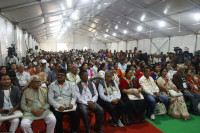
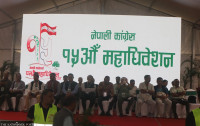
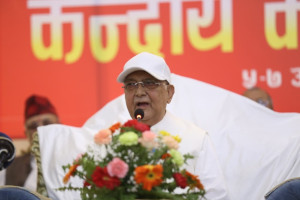
Gagan Thapa’s bid to consolidate his hold on the party comes amid competing ambitions, factional tensions, and growing demand for greater representation. A view of the closed session of the Nepali Congress at Khula Manch, Tundikhel, on Monday. The party’s ongoing 15th general convention is scheduled to conclude on October 8. Dipesh Darshandhari/TKP
Five years ago, when then party president Sher Bahadur Deuba increased the number of office-bearers at the Nepali Congress’s 14th General Convention, then-general secretary Gagan Thapa opposed the move, accusing Deuba of creating additional posts to accommodate his faction.
Now, as party president, Thapa is overseeing an even larger expansion of the party’s central committee to accommodate a growing number of aspirants.
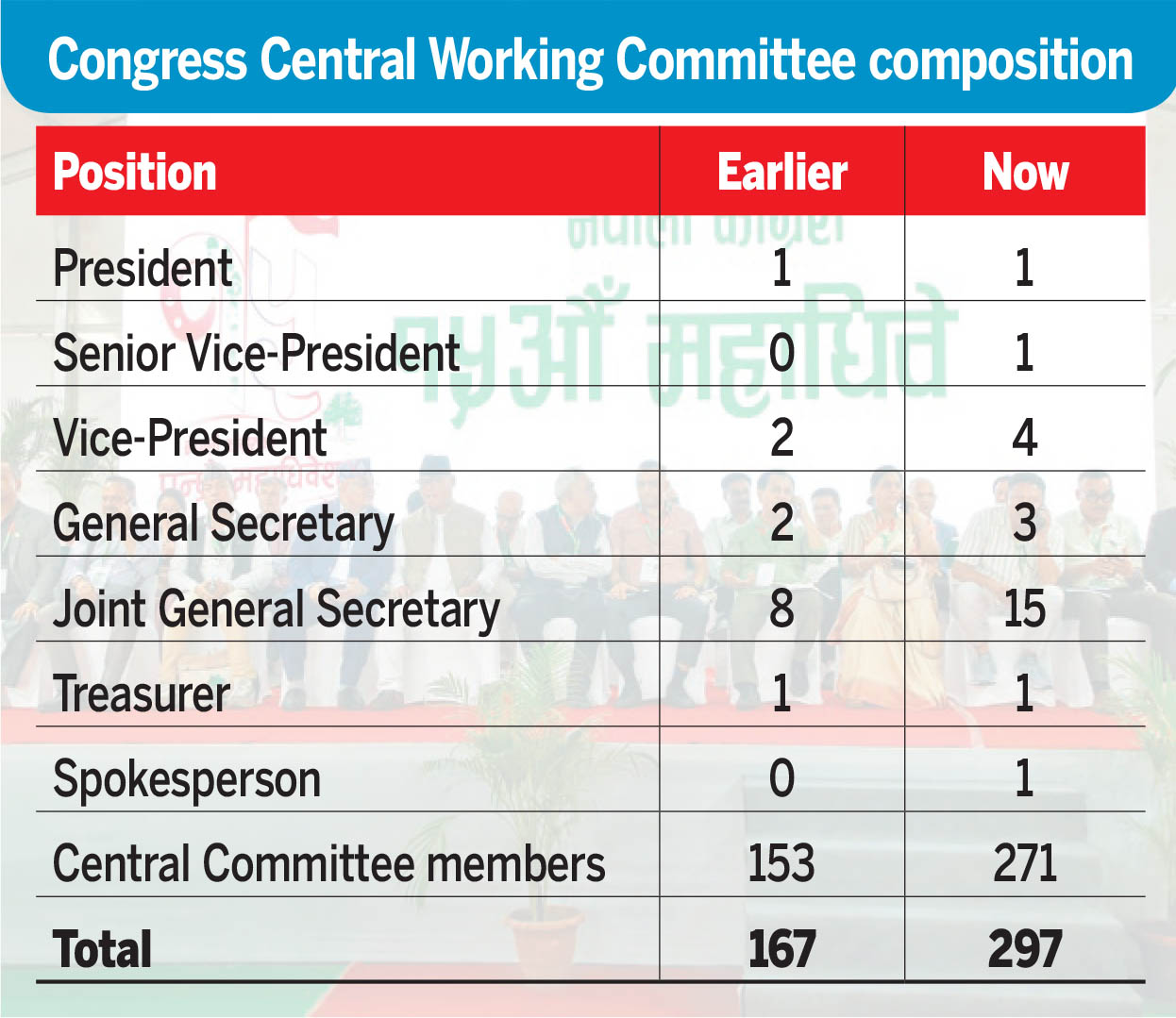
The Congress has increased the size of its central working committee from 167 to 297 members. The number of office-bearers has risen from 14 to 26.
The changes were proposed in a report presented to the closed session of the 15th General Convention by a panel led by general secretary Pradeep Paudel. With the proposal approved by the convention, the new provisions will come into force when nominations begin on Tuesday.
Paudel said the expansion reflected the growth in party membership and a broader approach to inclusion rather than simply an effort to create more posts.
The number of convention representatives has risen from 4,743 at the 14th General Convention to more than 7,500 this time. Paudel said the central committee would account for 4.5 percent of the convention’s representatives, up from 4 percent previously.
“This is not a large number relative to the size of the membership,” Paudel said. “Youth participation has been increased and inclusion has been broadened. People from the party’s overseas organisations, intellectual groups, workers and conflict-affected communities did not have representation before. This time, representation has been ensured.”
He said broader representation also created greater expectations of access to the party leadership.
“When representation is broadened, those groups also seek access to the centre and aspire to leadership. There is a need to manage those aspirations,” he said.
The expansion has also intensified competition for party posts.
Thapa faces little challenge to his bid for party president, but his bigger political challenge is to keep the party united. Former president Deuba is working to organise a separate general convention, and his faction is estimated to account for around 20 percent of the party.
Around 55 leaders from the Deuba camp joined the mainstream Congress shortly before the convention.
“Bringing the leaders who joined later [after the January special convention] into the mainstream emotionally and organisationally has also proved challenging,” a party office-bearer said. “That is another reason why the number of office-bearers and central committee members had to be increased.”
More posts, wider inclusion
Under the new structure, the number of vice-presidents has increased from two to five. One will be a senior vice-president, a new position created this time, with Bishwa Prakash Sharma emerging as the sole claimant so far. A Congress leader said the position was created as the number of aspirants for vice-president grew. No other leader had declared a candidacy for senior vice-president as of Monday night. Of the other four, one will be reserved for a woman, one for an inclusive category, and two will be elected from the open category. All five vice-presidents will be elected.
The number of general secretaries has increased from two to three. Two posts will be open to all candidates, while one will be reserved for women.
The biggest increase has come in the number of joint general secretaries. Previously, eight joint general secretaries were elected from constitutional inclusion categories: Madhesi, Tharu, Indigenous nationalities, Khas Arya, Muslim, Dalit, women, and the underrepresented regions.
The number has now increased to 15. Eleven will be elected, including two from the open category, and one from among minority and disability groups. The remaining four, including one woman, will be nominated by the party president.
Under the previous system, the president could nominate only the treasurer among the office-bearers. The new rules give the president the power to nominate four additional joint general secretaries. The president will also have the power to nominate the party spokesperson.
The number of nominated central committee members has also increased. After the 14th General Convention, the party president had nominated 41 members. Under the new rules, the president can nominate up to 66.
The 297-member central committee will comprise 26 office-bearers, 205 elected central committee members, and 66 members nominated by the party president. The various youth and inclusion quotas described below form part of the elected membership rather than being additional seats on top of the 297.
The new structure also reserves seats for younger members and groups that previously had limited or no representation on the central committee.
Twenty-one seats are reserved for people under 35—two from each of the seven provinces and seven from the open category. Seven additional seats are reserved for people entering the party from professional backgrounds outside traditional party politics.
The new quotas also include three seats for [Maoist] conflict-affected people and martyr families, seven for members of the party’s overseas organisations, three for workers, one for a person with a disability, and one for a minority community. Two additional central committee seats have been allocated to Kathmandu Valley.
The party has also increased the number of seats in existing open and inclusion categories. Open seats have risen from 35 to 45; women’s open seats from nine to 15; provincial seats remain at 28, with four from each province; Dalit seats from 10 to 14; Indigenous nationalities from 15 to 20; Khas Arya from 13 to 18; Madhesi from nine to 13; Tharu from four to six; Muslim from three to five; and seats for underrepresented regions from one to two.
Thapa’s political adviser Pratap Paudel said the enlarged committee was intended to expand representation and access rather than manage factions.
The party claims its active membership has increased by nearly 200,000 since the previous convention, from 788,000 to 988,000.
“More than 3,000 convention representatives have been added. Around 100,000 young people have joined various party processes, and representation from all classes and communities has increased,” Paudel said. “The new structure ensures representation by geography, age, and generation, which is another reason the central committee has been expanded.”
He said the new provision for women in the posts of vice-president and general secretary was also intended to strengthen their role in decision-making.
Previously, inclusion at the office-bearer level was largely limited to the eight joint general secretary positions. Candidates had to compete in the open category to rise to higher posts. Under the new rules, inclusion has been extended to the vice-presidency, while one of the three general secretary positions is reserved for a woman.
Vice-president Pushpa Bhusal said the enlarged central committee should not be viewed only through the lens of representation.
“It also creates a major opportunity to organise the party and build its organisation,” Bhusal said.
She said the Congress had gone beyond numerical inclusion by creating pathways for women to reach positions of decisive authority.
“There is no other party with this level of inclusion or with as many women being brought into leadership,” Bhusal said. “Previously, women’s representation through inclusion was limited to 33 percent. There were even legal challenges calling for a greater representation of women in decision-making positions. The Congress has now addressed that demand.”
Competition grows as more posts open up
The creation of the new senior vice-president position has left Bishwa Prakash Sharma virtually unchallenged for the post. No one had declared a candidacy for senior vice-president as of Monday night.
The other four vice-presidential posts, however, have attracted a growing field of candidates.
Former minister Gyanendra Bahadur Karki and industrialist Binod Chaudhary are among those seeking the posts. Karki left the Deuba camp and rejoined the mainstream Congress after the March 5 election, while Chaudhary has been active in the party since the special convention.
Other declared candidates include parliamentary party leader Bhishmaraj Angdembe, former Nepal Students’ Union president Gobinda Bhattarai, former vice-president Dhanraj Gurung, Gandaki Province chief minister Surendra Pandey and former joint general secretary Jeevan Pariyar.
Bhusal has said she will contest the women’s vice-presidency, while party spokesperson Devraj Chalise has also declared his candidacy.
For the women’s general secretary post, Mahalakshmi Upadhyay (Dina) and Dila Sangraula have declared their candidacies.
The two open general secretary posts have also attracted several candidates, including incumbent general secretaries Pradeep Paudel and Gururaj Ghimire. Other contenders include Udaya Shumsher Rana, Madhu Acharya, Nain Singh Mahar, Sunil Sharma, and Amar Pun.
Rana is currently a joint general secretary, Sharma is a former lawmaker and central committee member, and Pun heads the Congress’s Lumbini provincial committee.
At least 15 leaders are seeking the 11 elected joint general secretary positions, including Min Bishwakarma, Jeevan Bahadur Shahi, Ramhari Khatiwada, Pratima Gautam, Manojmani Acharya, Yogesh Gauchan, Prakash Snehi, Farmullah Mansur, Sita Gurung, Om Bahadur Gharti, Ajay Babu Shiwakoti, Yogendra Chaudhary, Bikash Koirala, Mukta Kumari Yadav, and Abhishek Pratap Shah.
Sharma has said there will be no factional panels at this convention, unlike during previous general conventions.
“There will be no factions like in the past. I will not allow them to form,” Sharma said. “That does not mean ideas will be excluded. The Congress will always welcome different ideas.”
The absence of formal panels has made campaigning easier for candidates, said Khatiwada, who is contesting for joint general secretary.
“When panels were formed, there was always concern about whether one would be included in a particular panel. But after the president said there would be no panels, it has become easier to seek votes,” he said.
The enlarged central committee has also created intense competition among younger candidates, including those from the Gen Z age group.
While the convention’s closed sessions continue, candidates have been spending much of their time outside campaigning for votes.
“However much we try, everyone’s attention at the convention has shifted from ideas to the selection of leadership,” a central committee member said. “Candidates have been sitting around television cameras and campaigning for votes from morning until evening. This time too, the focus is more on the election than on political ideas.”




 20.85°C Kathmandu