Himalaya Airlines, Nepal-Tibet joint venture, comes under financial stress
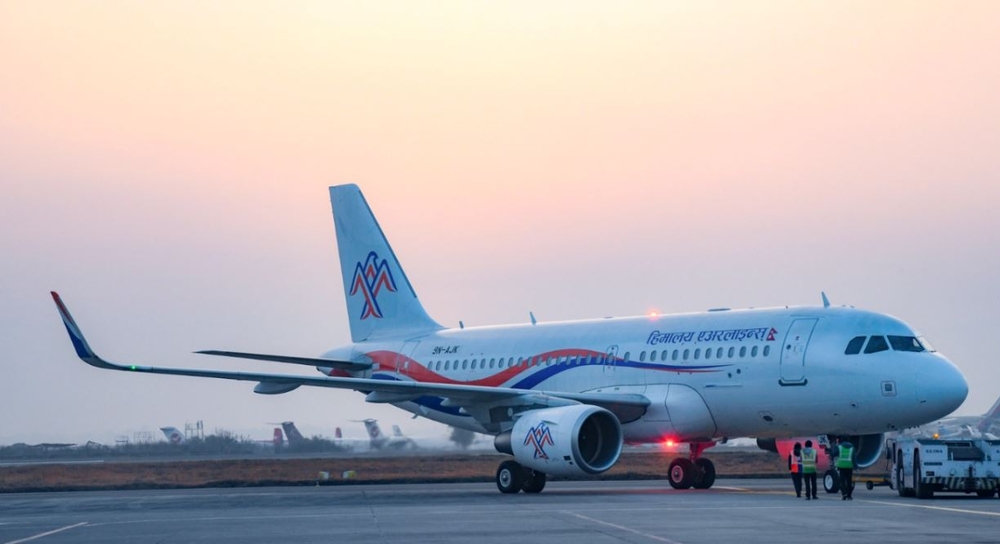
The airline says accumulated losses have reached Rs15 billion as rising fuel, airport and tax costs, disruptions and weak passenger demand squeeze its finances. Himalaya Airlines was established in August 2014 and began scheduled commercial operations on May 31, 2016, with a flight from Kathmandu to Doha. Photo: Courtesy of Himalaya Airlines
Himalaya Airlines, the Nepal-Tibet joint venture, is facing growing financial pressure, with its outstanding dues to Kathmandu’s Tribhuvan International Airport reaching Rs629 million as rising operating costs, weak passenger demand, and repeated disruptions continue to weigh on its finances.
The outstanding amount includes landing, parking and navigation charges, passenger service fees collected from travellers, and cargo-related charges, according to the Civil Aviation Authority of Nepal.
The civil aviation regulator said the airline’s dues have accumulated under 11 different headings, with passenger service fees accounting for the largest share at around Rs440 million.
The airline collects a passenger service fee of Rs3,000 from each passenger departing Kathmandu as part of the ticket price and is required to remit the amount to the Civil Aviation Authority of Nepal (CAAN).
Bikram Gautam, CAAN spokesperson, said the regulator could eventually suspend the services of an airline that fails to clear its dues for an extended period.
Airlines are required to provide security deposits for the use of airports and other services. If charges are not paid within the prescribed period, late fees are imposed. “And if the dues remain unpaid for a prolonged period, debt can be classified as ‘doubtful debt’, after which the process of suspending services begins,” he said.
Himalaya Airlines was established in August 2014 and began scheduled commercial operations on May 31, 2016, with a flight from Kathmandu to Doha. At the time, it was the largest foreign direct investment from China in Nepal’s aviation sector. In March 2016, the airline took delivery of its first Airbus A320 aircraft.
The airline faced difficulties almost from the beginning after India rejected its application to operate flights to New Delhi, one of the most lucrative regional routes, amid strained relations between Beijing and New Delhi.
Himalaya currently operates four aircraft—three Airbus A320s and one Airbus A319.
It operates regular services to the United Arab Emirates, Malaysia, Qatar, Saudi Arabia, Kuwait, Bangladesh, and several cities in China.
Vijay Shrestha, vice-president of Himalaya Airlines, acknowledged that the carrier is under extreme financial pressure.
“The fuel price has doubled. The government added extra VAT on passenger tickets, while landing, parking, and passenger service charges more than doubled [since 2022],” Shrestha said.
The airline was hit by the Covid pandemic, followed by the closure of Kathmandu airport for 10 hours a day for five months in 2024 for runway and taxiway maintenance during the peak tourism season.
That disruption was followed by the Gen Z protests in September last year, when Kathmandu airport was temporarily closed. The conflict in West Asia has further increased the cost of aircraft parts and fuel, Shrestha said.
The recent Bhotekoshi disaster during the peak tourism season has also affected the carrier’s passenger occupancy, he said.
“We have suffered right from the beginning,” Shrestha said. “The accumulated loss of the airline hovers around Rs15 billion.”
He said airlines operate on thin margins and that repeated natural disasters and political unrest have dealt a major blow to the company’s earnings.
Himalaya had sought permission to undertake self-ground handling at Kathmandu airport, which it said would have allowed the airline to save Rs3 billion to Rs4 billion annually.
Nepal Airlines currently provides ground-handling services at the airport, and the government has not deemed it necessary to allow Himalaya to undertake the service on its own.
“Though we have the legal rights to operate self-ground handling, we were not permitted,” Shrestha said. “Despite all odds, we have been operating.”
“Himalaya is not the only airline facing this problem. The entire Nepali airline industry is under financial pressure. The difficult situation in the industry has put pressure on our revenue and cash flow.”
International airline representatives have long complained about the high cost of operating through Kathmandu airport.
Himalaya had sought permission to undertake self-ground handling at Kathmandu airport, which it said would have allowed the airline to save Rs3 billion to Rs4 billion annually. Photo: Courtesy of Himalaya Airlines
In 2022, the government sharply increased airport passenger service charges. Under the new Airport Service Charge Regulation 2022, approved by the Cabinet in April that year, the charge for domestic passengers was doubled and that for international passengers was increased threefold.
International travellers now pay Rs3,000 each for passing through the airport, up from Rs1,000 previously.
The concession for passengers flying to destinations within South Asia was also removed. Previously, such passengers were charged Rs700 in the spirit of regional solidarity.
In addition, the airport ground-handling charge added to the ticket price is Rs3,600, while the Nepal Tourism Board charges Rs1,130 as a tourism service fee from each departing tourist.
Together, these charges mean the minimum cost of an international air ticket from Kathmandu starts at around Rs8,000 before the actual airfare and fuel surcharge.
Nepal Oil Corporation historically uses high profit margins and inflated prices on aviation turbine fuel (jet fuel) to cross-subsidise consumer petroleum products—most notably household cooking gas and sometimes kerosene or diesel.
The Civil Aviation Authority of Nepal had previously allowed Himalaya to clear its dues through installments. In April, the airline committed to settling its outstanding payments and agreed to a fixed repayment schedule.
But the airline failed to maintain the agreed payments, according to officials at the civil aviation body. With new bills and penalties added, officials estimate the total outstanding amount could reach around Rs700 million.
On Monday, Himalaya proposed a new repayment plan to the regulator. Shrestha said the airline would immediately settle Rs200 million and pay the remaining amount in installments.
“We are awaiting a response from the civil aviation regulator,” he said.
The airline has also proposed pledging ground-handling equipment worth around Rs500 million at Kathmandu airport as security against its outstanding payments.
An official at the finance department of the Civil Aviation Authority of Nepal said Himalaya had made one installment payment after the April agreement but failed to continue.
“At that time, around Rs200 million in dues was not a large amount for an international operator,” the official said. “An agreement was made to allow payment in installments, but Himalaya could not comply with it.”
Shrestha said the airline did not have sufficient assets to provide a bank guarantee and had therefore proposed pledging its ground service equipment.
The Civil Aviation Authority of Nepal issues airlines their regular monthly bills by the seventh day of each month and generally gives them up to 60 days to settle the amount. Once the 60-day payment period expires, late fees begin to accrue.
Under the prevailing rules, a late fee of 0.05 percent per day is charged for up to 60 days, followed by annual interest of 15 percent on the outstanding amount.
Himalaya’s unpaid bills have now become more than a routine revenue-collection issue and could affect the airline’s future flight operations, according to officials at the Civil Aviation Authority of Nepal.
“Once the outstanding amount has crossed Rs600 million, it is not possible to approve the schedule as usual,” another official at the civil aviation body said.
Normally, airlines operate under two seasonal schedules. The summer schedule runs from the last Sunday of March to the last Saturday of October, while the winter schedule runs from the last Sunday of October to the last Saturday of March.
The regulator, however, said it was seeking a way to resolve the issue rather than immediately halt Himalaya’s flights, as such a move could affect hundreds of jobs and passengers.
“Stopping flights would not send a good message internationally,” the official said. “Besides, Himalaya is a foreign direct investment.”
“It would not be good for them, and it would not be good for us either if the dues are settled before it balloons. No final decision has been made.”
Suraj Kunwar is a senior correspondent with over two decades experience covering Aviation, Tourism and Mountaineering. He received the IFJ Tolerance Award in 2005.




 25.92°C Kathmandu