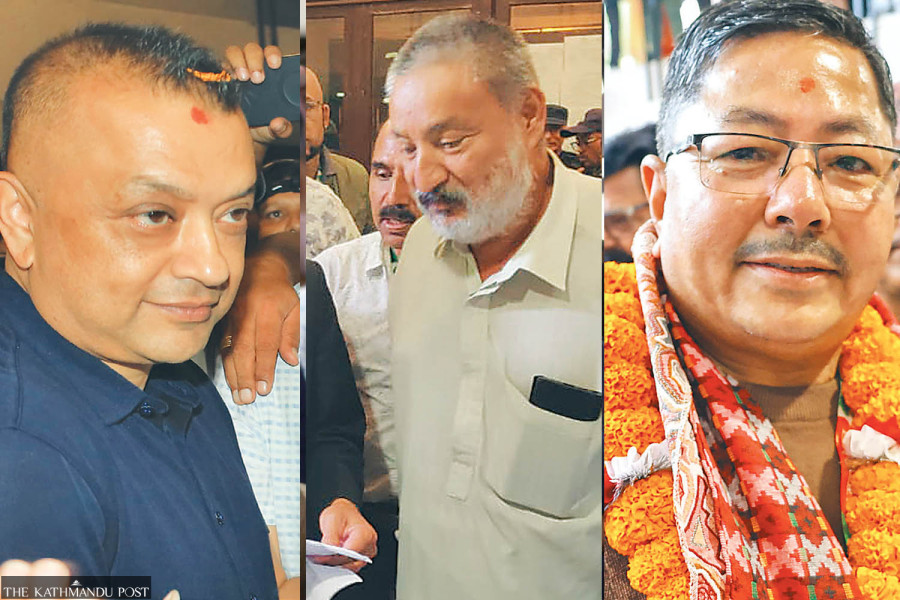
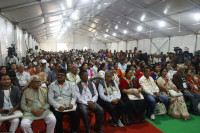
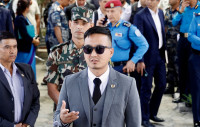
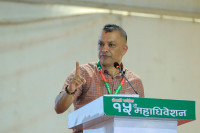
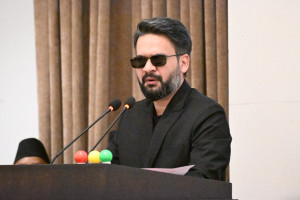
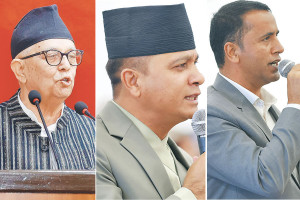
Thapa faces two challengers for party presidency. The race for 25 office-bearer positions is testing his efforts to bring together factions divided over special convention. This combination photo shows (from left) Nepali Congress leaders Gagan Thapa, Kishor Singh Rathore and Shyam Krishna Khadgi, filing their nominations for the party presidency at Rastriya Sabha Griha in Kathmandu on Tuesday. The election is scheduled for Thursday. Nepal Photo Library
Established leaders dominate the race for office bearers at the ongoing Nepali Congress general convention, while younger politicians are seeking seats on the central committee.
Party president Gagan Thapa is seeking another term without a serious challenger. Former Nepal Students Union president Kishor Singh Rathore and Shyam Krishna Khadgi have also filed their nominations for the presidency, turning what appeared to be an uncontested race into a three-way contest.
Rathore had announced his candidacy about a week earlier. He reached the Rastriya Sabha Griha at 7:25 pm on Tuesday, soon after votes cast in Bardiya constituency 2 to elect convention representatives (including Rathore) were counted. An internal dispute had delayed the election of representatives until Tuesday and nearly prevented Rathor from becoming a delegate to the general convention.
Rathore cited the Gen Z movement, the party’s defeat in the March 5 election, and the special general convention as reasons for entering the leadership race. “Even if I lose this time, I am preparing to win the presidency at the 16th general convention,” Rathore said after registering his candidacy.
Khadgi said he entered the race because every previous Congress president had been elected through a vote. He said Thapa, too, should become president through an election rather than an uncontested process. “My candidacy is not about winning or losing,” he said. “It is about keeping internal democracy alive.”
Tough contest for vice-presidents
The party has expanded the number of office-bearers from 14 to 25 to accommodate competing leaders. The new structure has five vice-presidents, three general secretaries, and 15 joint general secretaries. Four joint general secretaries and the treasurer are nominated by the president; the other 20 office-bearers are elected.
Bishwa Prakash Sharma is the sole candidate for senior vice-president and Pushpa Bhusal the only candidate for women’s vice-president. They are expected to be elected unopposed.
The open and inclusive vice-president positions have attracted strong competition. Five leaders—Jeevan Pariyar, industrialist Binod Chaudhary, Farmullah Mansoor, Sita Gurung and Ranjit Karna—are contesting one inclusive post.
Pariyar and Mansoor were elected joint general secretaries during the 14th general convention; Gurung is a central member; and Karna is a former Nepal Students Union president.
Nine leaders are contesting the two open vice-president positions, including Minendra Rizal, Govinda Bhattarai, Chandra Bhandari, Dhanraj Gurung, Surendra Raj Pandey, Madhu Acharya, Devraj Chalise, Deepak Giri, and Chandra Mohan Yadav.
Rizal contested general secretary at the 14th convention and resigned as defence minister after losing. Bhattarai is a former Nepal Students Union president, while Pandey is current chief minister of Gandaki province. Bhandari lost the vice-presidency at the 14th convention, while Dhanraj Gurung has previously served as vice-president. Acharya and Chalise led the signature campaign for the special convention. Giri has served repeatedly as a lawmaker but has never held a party office.
Eleven in race for three general secretary posts
Three general secretary positions have attracted 11 candidates, with eight competing for two open seats and three for the single women’s seat.
Incumbent general secretaries Pradeep Paudel and Gururaj Ghimire are seeking the open posts. Paudel had lost the general secretary election at the 14th convention before becoming general secretary through the special convention. Ghimire led a signature campaign for that convention and was also elected through it.
Former joint general secretary Udaya Shumsher Rana, former minister and Lumbini Province Congress president Amar Singh Pun, former Nepal Students Union president Nain Singh Mahar and medical entrepreneur Sunil Sharma are also in the fray. Santosh Upadhyay and Shankar Tiwari are newer faces seeking the post directly.
For the women’s general secretary position, former joint general secretaries Mahalalaxmi Upadhyay ‘Dina’ and Dila Sangraula are competing with newcomer Rita Khanal. Upadhyay became joint general secretary at the 14th convention, while Sangraula assumed the position through the special convention.
Thapa faces a difficult balancing act
The crowded office-bearer race has created a major management challenge for Thapa. He increased the number of positions partly to accommodate leaders associated with former party chief Sher Bahadur Deuba and other senior figures, including Shekhar Koirala and Purna Bahadur Khadka.
Many leaders from those camps have now entered the Thapa-led process, but Deuba remains outside its mainstream structure and is pursuing a parallel convention. The division has its roots in the January special general convention that elected Thapa president. The Supreme Court’s decision to review its earlier ruling added to the dispute, although efforts to bring former central committee members back have reduced the divide.
Thapa spent much of Tuesday trying to balance competing aspirations rather than attending the closed-door session. He personally telephoned some leaders to encourage them to contest and others to withdraw.
“My wish is to erase the division between those who came to the special convention and those who did not,” said Thapa after filing his nomination. “Everyone is welcome to contest.”
He said he did not want capable leaders pushed out simply because too many candidates were competing for the same posts. “There are so many friends competing now,” Thapa said. “If people the party needs are left out while contesting different positions, I don’t want a situation where their ability, capacity, and intellect cannot be used.” He said he had telephoned leaders including Minendra Rizal and Min Bishwakarma.
Party sources say Rizal had not planned to contest until Monday night but decided on Tuesday morning to enter the race for vice-president. Bishwakarma also considered contesting before withdrawing, while Gyanendra Bahadur Karki was preparing to contest for vice-president before stepping aside.
“I told them that what matters is staying together,” Thapa said. “Let us not all contest. If possible, I want to take everyone along.”
Youth push for central committee
While older and established leaders dominate the office-bearer contests, the biggest generational shift is expected in the central working committee.
The party has reserved 21 central committee seats for members below 35 years of age, following an amendment adopted at the special convention. The move has encouraged young delegates, including members from the Gen Z, to seek central positions.
The Congress says the new structure should bring a younger generation and people from varied professions into its leadership. Thapa recently said at least 21 under-35 members would enter the central working committee.
Among the youngest aspirants is Abhipsa Paudel, 18, who is contesting from Bagmati Province in the young women’s category.
The convention therefore presents a contrast—familiar names dominate the top leadership race, while the central committee is becoming the main arena for younger politicians seeking a foothold in the party’s future leadership.




 20.41°C Kathmandu