From blankets to handmade dolls, two foreign women bring comfort to flood survivors
A Malaysian music teacher and a Czech mother travelled to Nepal’s flood-hit communities with relief supplies—and a simple desire to help. Malaysia’s Wong Siew Ngan (right) and the Czech Republic’s Katerina Svejnohova.
At the compound of the District Coordination Committee in Bidur, Nuwakot around two weeks ago, flood survivors rummaged through piles of relief supplies, picking out what they needed. Some picked up plates, bowls and water jugs. Others reached for cooking pans and ladles. Nearby were stacks of food, clothes and other household essentials.
For people who had lost their homes in the Bhotekoshi floods and were now living in temporary shelters or rented rooms, being able to choose what they needed themselves was a small measure of dignity.
Watching them from a corner was Malaysian music teacher Wong Siew Ngan, visibly emotional. She had travelled from Malaysia with relief supplies such as antiseptic ointment, towels and socks, then bought more essentials, including cooking oil and a truckload of green blankets, after arriving in Kathmandu. Last week, she took the supplies to Nuwakot to distribute them to flood survivors.
Meeting the women displaced by the floods moved her deeply.
“I had been worried about whether the relief system in Nepal would actually get the things I brought to the people who needed them,” she told Kantipur. “But seeing them choose the supplies themselves today has reassured me.”
Wong had handed her relief supplies to Krishna Prasad Humagain, assistant chief district officer of Nuwakot. Watching survivors select what they wanted, she said, left her both happy and overwhelmed.
“When the floods hit Nepal, I was in South Korea,” she said. “As I was returning to Malaysia, I felt that I had to come to Nepal. It felt as though nature itself was calling me.”
She did not want to arrive empty-handed.
“I messaged my friends and asked them to help with relief,” she said. “At first, I had hoped to support 100 families. With my friends’ help, we were able to collect enough to support 300 families.”
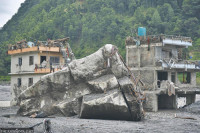
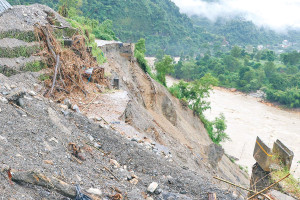
The August 26 disaster caused widespread destruction across Nuwakot, Rasuwa, Dhading and other affected districts, killing hundreds, leaving thousands missing and displacing thousands of people. It also destroyed homes and infrastructure worth billions of rupees.
According to figures from Nepal’s National Disaster Risk Reduction and Management Authority, 1,453 people have died and 5,285 remain unaccounted for. Another 11,226 people were injured, and 13,795 were rescued. Some 1,109 displaced people are still living in holding centres in Rasuwa, Nuwakot and Dhading.
The disaster reverberated far beyond Nepal. Last week, Wong and another woman, Czech national Katerina Svejnohova, travelled separately to flood-hit communities in Nuwakot and Rasuwa.
Neither came as part of a government mission or a large aid organisation. They came simply because they felt compelled to help. Both were shaken by what they saw.
***
Wong, a well-known music teacher in Malaysia, travelled to Nuwakot with blankets, towels, socks, cooking oil, hygiene supplies and ointment. She is known for developing ‘Joyful Braille Music Notation’, a system for people with visual impairments, and has been listed in the Asia Book of Records.
She is also president of the Hearts Symphony Society, a musical group that once performed at Kathmandu’s LRI School.
When she heard about the floods in Nepal, she began raising relief supplies through members and supporters of her musical group and flew to Kathmandu.
The LRI School provided a van, which she used to transport blankets and other supplies to affected families in Nuwakot.
After spending several days there, Wong returned to Kathmandu, where she distributed tracksuits and other items to 65 orphaned children at Yangla Sing Gumba before returning to Kuala Lumpur.
Before leaving Nepal, she said she had initially been anxious about how she would reach communities cut off by the disaster.
“During the 2015 earthquake, we could climb into the hills ourselves and distribute relief,” she said. “This time, I had heard that 40 kilometres of road had been destroyed, so I wondered how we would get the supplies there.”
For a small donor like her, using helicopters would have been prohibitively expensive, she said. “But here, people can choose the things they need themselves,” she said. “That made me feel good.”
***
In Rasuwa, meanwhile, 51-year-old Czech national Svejnohova travelled deep into remote villages carrying a very different kind of relief: small cloth dolls.
Svejnohova, who works for a pharmaceutical company in Prague and is a mother of three, launched a campaign through the organisation People in Need after hearing about the floods.
With help from her eldest daughter, Svejnohova made 56 cloth dolls by hand. Donors contributed as though they were buying an air ticket for each doll, helping raise 33,400 Czech koruna, or about $1,500.
Each doll carried a tag bearing the name of the person who had helped fund it.
“I travelled from village to village and gave the dolls to children who had lost their parents or were suffering,” she said. “Seeing some happiness on their faces, even for a few moments, made me feel lighter.”
She added, “I am not rich or powerful. But I believe that even small efforts can bring happiness to someone else’s life.”
Svejnohova travelled to Nepal with her 64-year-old husband, Martin. Because roads had been damaged by the floods, reaching the communities was far from straightforward.
From Uttargaya Public English Secondary School, the couple climbed uphill, walked across slopes and descended again before crossing a wooden footbridge at Betrawati. From there they continued towards Dhunche and Syaphrubesi in Rasuwa.
In the flood-hit villages, Svejnohova handed the dolls to children who had lost relatives and were still struggling to comprehend what had happened around them.
In a conversation with Kantipur, Svejnohova reflected on the perceived differences between life in Europe and Nepal.
“In Europe, we have material comforts, but life is often rushed and full of pressure,” she said. “In Nepal, I saw warmth between people, patience and a strong spirit of mutual help.”
She added, “Being able to bring even a little comfort to people affected by the floods has become one of the most emotional and unforgettable experiences of my life.”
For Svejnohova, one encounter was particularly difficult. She had brought the dolls for children. But in one village, she quietly handed one to a 70-year-old woman who had lost six members of her family in the floods.
The woman burst into tears. Svejnohova did too. “That was the most difficult and moving moment of the trip,” she said.
“Children are happy when you give them dolls because they do not yet fully understand the seriousness of what has happened. But the pain of that elderly woman was incredibly deep.”
Over a month after the floods, the woman was still spending her days crying and praying, Svejnohova said.
Svejnohova lost her own father seven years ago. Yet she said she could not imagine the pain of losing six members of a family at once.
“These were not people who were sick or expected to die,” she said. “They were ordinary people who simply did not come home one day.”
Her experience in Nepal also made her think about how countries respond to disasters.
The Czech Republic experienced a devastating flood in 2002, she said, when authorities were poorly prepared. The disaster prompted the government to strengthen river monitoring, introduce new laws and improve preparedness.
When floods struck the Czech Republic again two years ago, those measures helped prevent loss of life and significantly reduced the damage, she said.
Nepal, she argued, could take similar steps.
Regular monitoring of rivers, stronger legal and policy frameworks and concrete disaster-preparedness measures could help reduce the human cost of future floods, she said.
***
Neither Wong nor Svejnohova arrived in Nepal with the resources of a major aid agency.
One brought blankets, cooking oil and household supplies. The other carried handmade dolls stitched with the help of her daughter.
Yet in communities where families had lost homes, possessions and loved ones, the gestures meant more than the material value of the aid.
For Wong, seeing survivors choose their own supplies eased the doubts she had carried with her from Malaysia.
For Svejnohova, the memory of a grieving grandmother clutching a small cloth doll will remain with her long after she returns home.
The Bhotekoshi floods took homes, livelihoods and lives. Amid the devastation, these two women travelled across continents simply because they felt they could not stand by.
Their visits did not alter the scale of the disaster. Nor could they replace what people had lost.
But for some survivors, their small acts of kindness offered something else: a reminder that even from far away, strangers had seen their suffering and cared enough to come.




 17.95°C Kathmandu