German e-passport company threatens service halt over unpaid dues
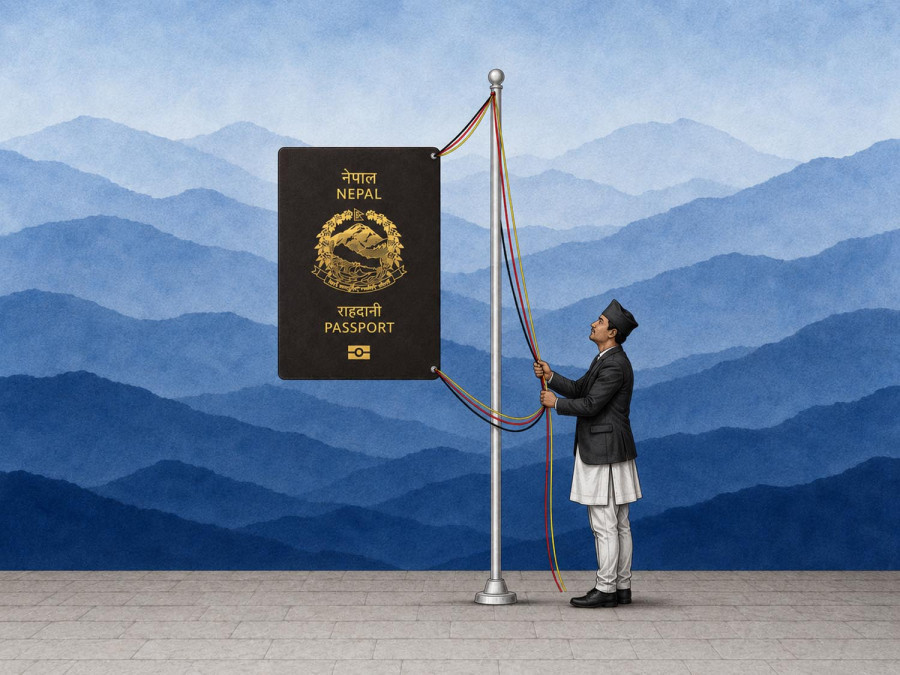
Muehlbauer ID Services gives the Department of Passports until Monday to settle outstanding milestone payment or face contract suspension.AI generated image
Muehlbauer ID Services GmbH, the German company handling Nepal’s e-passport systems, has given the Department of Passports until Monday to pay Rs300 million in outstanding dues, warning it may suspend services if payment is not made.
The company, which manages pre-enrolment, biometric enrolment, data management, and passport delivery systems, says it has received no payment since winning the contract last year. It has warned that continued non-payment is making it increasingly difficult to sustain its operations in Nepal.
Any suspension of its services could disrupt passport issuance across Nepal. Veridos GmbH, the other German company contracted to print and supply passports, depends on Muehlbauer’s systems to process applicants’ information before passports can be printed.
The dispute stems from the government’s failure to release the first payment milestone, worth around Rs300 million, under Muehlbauer’s contract. Prior to serving the Monday deadline, the company had already issued two deadlines for September 30 and October 7 to settle the payment.
“The difficulties we described on September 30 have not eased,” Muehlbauer said in a letter to the department. “Our local team remains unpaid, and the position cannot be sustained.” It demanded immediate payment of the first milestone, along with interest under the contract’s general conditions.
The company said it was entitled to withhold further performance or terminate the contract under the agreement and Nepal’s laws without further notice.
The department’s reluctance to release the payment is linked to an ongoing corruption case over the passport procurement process. On June 23, the Commission for the Investigation of Abuse of Authority (CIAA) filed a case against 18 individuals, including a former director general of the Department of Passports, other government officials, and local representatives of the two German companies.
The Special Court subsequently released the accused from custody, and the Supreme Court has also issued a verdict in favour of the German companies. However, the Special Court is yet to issue the final verdict, leaving passport officials hesitant to approve the payment.
Two Foreign Ministry officials told the Post that the department had sought clearance from the antigraft body and the Attorney General’s Office. As of Friday, it has received no response from either of the institutions.
Dipak Banjade, spokesperson for the Department of Passports, said the pending court case and non response from the CIAA and AGO have complicated the payment process.
A representative of the German firm said delay in the payment was a violation of the contract. “We were supposed to receive the first instalment of the payment, which comes to around Rs300 million, one month after commissioning,” a local representative of Muehlbauer told the Post referring to the payment terms. “How can we run the business if we fail to pay the dues to the vendors, suppliers and staff?”
Under Article 15.1 of the contract’s general conditions, the department must pay the supplier within 30 days of receiving the letter of commissioning. The contract stipulates that 85 percent of the payment be made in foreign currency and the remaining 15 percent in Nepali currency.
The agreement also provides for interest on late payments: 2 percent on the amount payable in foreign currency and 10 percent on the amount payable in Nepali currency, subject to a cap of 10 percent of the total contract amount.
Officials are now discussing whether to release the local-currency portion of the first milestone—15 percent of Rs300 million, or Rs45 million, as an initial payment.
The contract also contains provisions for retaining part of each payment. Under Clause 15.3, unless otherwise specified in the special conditions, the purchaser must retain the portion stipulated in those conditions. Half of the retained amount is to be repaid within 30 days of the completion of the supplier’s obligations, including warranty requirements, and the other half after the supplier submits evidence of filing its tax return with the concerned Inland Revenue Office.
The payment dispute is already affecting Muehlbauer’s operations. Its employees at the Department of Passports have submitted a memorandum to Director General Dipak BK, saying they have gone unpaid for an extended period and warning of a strike if their salaries are not settled before the upcoming major festivals. Internet service provider Subisu has also threatened to suspend its service because of unpaid bills from the German company.
Muehlbauer has taken the matter to the CIAA, the foreign minister, the attorney general, and other authorities, seeking payment under the contract. In separate letters to the department and the Foreign Ministry, it argued that the agreement is governed by Nepal’s laws and that the obligations of the supplier and purchaser are reciprocal.
“The supplier has performed. The purchaser has not,” the company said in its letter. “Non-payment of a milestone that has been earned and certified is a breach of contract.” It argued that a party in breach could not require the other to continue performing without payment and that continued non-payment after notice could lead to contractual and legal consequences, including termination.
The company has also reserved its rights under the contract’s dispute-resolution provisions and the 1986 bilateral investment treaty between Germany and Nepal, signalling that the dispute could extend beyond the immediate payment demand.
Last year, Veridos and Muehlbauer won the new e-passport contract, ending the 15-year dominance of French firm IDEMIA Identity and Security France SAS. The two German companies began printing and distributing passports on July 13 following delays involving legal proceedings at the Special Court and intervention by the Prime Minister’s Office.
Anil Giri is a Chief Sub Editor covering diplomacy, international relations and national politics for The Kathmandu Post. Giri has been working as a journalist for more than two decades, contributing to numerous national and international media outlets.




 16.78°C Kathmandu