



 19.62°C Kathmandu

Sat, Nov 7, 2026
Money
Nepse retreats as profit-taking slows post-Dashain rally
Turnover falls nearly 18 percent as investors turn cautious ahead of Tihar, but technical support, improving earnings prospects and the dividend season could help revive the market.
bookmark![]()
![]()
Pritam Bhattarai
Published at : November 7, 2026
Updated at : November 7, 2026 10:57
Kathmandu
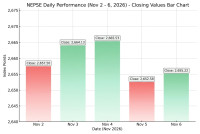
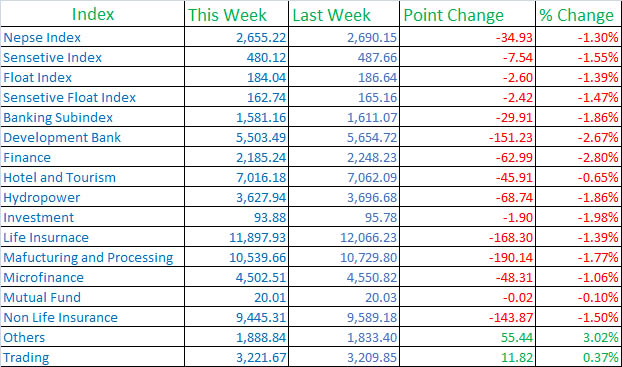
The Nepal Stock Exchange (Nepse) is entering the Tihar break with weakening momentum, but its broader upward trend remains intact. The benchmark fell 34.93 points, or 1.3 percent, to 2,655.22 points during the November 2-6 trading week as investors booked profits following the post-Dashain rally and trading activity slowed.
The decline was accompanied by a 17.88 percent drop in weekly turnover to Rs28.24 billion from Rs34.39 billion in the previous week. Average daily turnover fell to Rs5.65 billion from Rs6.88 billion, while market capitalisation contracted by around Rs60 billion to Rs4.57 trillion.
The simultaneous fall in prices and turnover points more towards reduced market participation and profit-taking than aggressive selling. Investors appear reluctant to commit fresh capital, while traders are increasingly selective about individual stocks. However, the contraction in turnover also suggests that the market lacks sufficient buying pressure to sustain another rally.
Eleven of the 13 sectoral indices ended the week lower. Finance companies recorded the steepest decline, shedding 2.8 percent, followed by development banks, down 2.67 percent. Banking and hydropower indices both fell 1.86 percent, while manufacturing and processing declined 1.77 percent. The Others index gained 3.02 percent, while Trading rose 0.37 percent.
Hydropower and banking stocks attract trading interest
Trading activity was concentrated in selected hydropower companies and commercial banks, although the overall performance of both sectors remained negative.
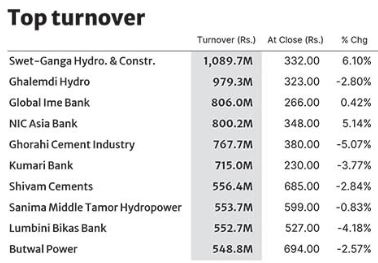
Swet-Ganga Hydropower and Construction led the turnover chart with Rs1.089 billion worth of shares traded. It also recorded the highest transaction volume, at 3.464 million shares, while its price gained 6.1 percent to Rs332. The combination of high turnover, substantial volume and rising prices makes it one of the clearest examples of concentrated buying interest during the week.
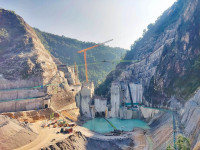
Ghalemdi Hydro followed with Rs979.3 million in turnover and 2.958 million shares traded. Sanima Middle Tamor Hydropower and Butwal Power Company also featured among the most actively traded stocks, recording turnovers of Rs553.7 million and Rs548.8 million respectively.
But the Hydropower Index’s 1.86 percent decline shows that trading interest was not broad-based. While selected companies attracted buyers, the sector continued to face selling pressure.
Commercial banks also drew substantial trading activity. Global IME Bank recorded Rs806 million in turnover, followed by NIC Asia Bank at Rs800.2 million and Kumari Bank at Rs715 million. NIC Asia stood out by gaining 5.14 percent to Rs348 despite the Banking Index declining 1.86 percent. This divergence suggests stock-specific demand rather than a sector-wide recovery.
Reinsurance companies also showed relative strength. Nepal Reinsurance gained 7.29 percent to Rs885, while Himalayan Reinsurance advanced 2.75 percent to Rs507.50. Alongside NIC Asia, they were among the notable gainers in an otherwise weak market.
Beni Hydropower Project led individual stocks with an 18.36 percent gain, followed by Crest Micro Life Insurance, up 10.78 percent, and Mandakini Hydropower, up 8.51 percent. Chirkhwa Hydropower suffered the steepest decline, losing 11.16 percent.
The divergence between individual stocks and their respective sector indices suggests that traders are pursuing selective opportunities rather than making broad bets on particular sectors. High turnover alone, however, does not establish whether activity reflects accumulation or selling.
Earnings and dividends offer potential catalysts
Investor and market analyst Subas Chandra Dhungana views the decline as a correction following profit-taking after the post-Dashain rally. He expects the market to recover after the Tihar break, provided there are no major adverse political or economic developments.
Dhungana said daily turnover of around Rs9 billion to Rs10 billion would be necessary to sustain a stronger upward trend, significantly above the current average of Rs5.65 billion. He attributed the recent decline in trading activity partly to the approaching holiday and political developments, saying investors and traders tend to adopt a wait-and-see approach when extended breaks interrupt trading.
Market analyst Jagannath Dhungel also considers the decline a profit-taking correction. He expects the market to move sideways for a few sessions before potentially recovering, supported by the dividend season and improved financial results.
The period from late October to February has traditionally been associated with dividend announcements and distributions in Nepal’s stock market. Expectations of cash dividends and bonus shares could encourage investors to return, particularly if listed companies report stronger earnings.
Improved financial results from banks and financial institutions, alongside expectations of better performance from other listed companies, could provide further support, Dhungel said.
Technical support remains intact
Technical indicators suggest that the market has cooled rather than reversed its broader upward trend. Nepse closed above its 20-day exponential moving average of 2,639.74 and 50-day average of 2,628.66. The range between 2,628 and 2,640 points therefore represents an immediate support zone.
The 14-day Relative Strength Index stood at 56.78, indicating moderating but still positive momentum. Meanwhile, declining turnover during sessions when the index fell suggests that selling pressure has not intensified significantly.
The next test will be whether the index holds above its support range and whether trading activity revives after Tihar. A recovery supported by higher turnover, broader sectoral participation and stronger corporate earnings would indicate a more sustainable improvement than isolated gains in actively traded stocks.
For now, the market appears to be consolidating after its recent rally. Dividend expectations and improved earnings provide potential catalysts, but the return of fresh capital will be essential to turn cautious optimism into a sustained recovery.




Most Read from Money

Indian national killed, New Zealander injured in mid-air chopper collision near Everest
Nepal seeks recognition for six more 8,000-metre peaks

US overtakes India as Nepal’s largest tourism source market for first time
Nepal plans temporary bridges to reopen flood-hit Rasuwagadhi border crossing
Extreme poverty has nearly disappeared in Nepal, but half remain economically vulnerable
Editor's Picks

The police chief who objects, delays—and ultimately complies

How Inam Sapkota tested the state

Beyond sushi and sukiyaki, a taste of Japanese culture in Kathmandu

How Deepak Bhatta became Nepal’s most influential power broker
Everest Base Camp trek: From self-doubt to finding my feet in the Himalayas
E-PAPER | November 07, 2026

×