In the age of AI, Nepali brands under pressure to reinvent themselves
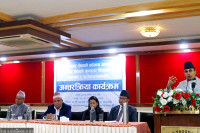
Speakers at The Himalayan Times BrandFest 2026 urge Nepali businesses to reinvent their brands in line with changing consumer expectations, embrace technology and innovation, and build on their legacy without losing the trust and human connection that distinguish them. Participants at the ninth edition of The Himalayan Times BrandFest 2026. Handout photo
As artificial intelligence (AI) transforms the way businesses operate, brands communicate and consumers make choices, companies face a growing challenge: how to embrace technology and remain relevant without losing the human connection that makes them distinctive.
With technology increasingly taking over routine tasks and reshaping marketing, businesses must rethink how they engage with consumers, build trust and differentiate themselves in an increasingly crowded marketplace.
This was a central theme at the ninth edition of The Himalayan Times (THT) BrandFest 2026, a two-day event in Kathmandu that brought together international speakers, Nepali business leaders, marketing professionals and advertising agencies to discuss the future of branding, business and leadership.
Held under the theme Reinvent: Reinventing Brands, Business and Leadership for a New Era, the event, which concluded on November 26, explored how businesses can adapt to digital disruption, evolving consumer expectations and technological changes. Around 250 participants attended this year's edition.
THT has been organising BrandFest for nearly a decade, seeking to bring international marketing and branding ideas to Nepal by providing a common platform for global speakers and leading Nepali corporate executives.
“BrandFest is an attempt to bring international and global ideas into Nepal. It provides a platform where international speakers and Nepal's top corporate decision-makers, stakeholders and marketing professionals can come together and share their experiences,” said Sanjog Pariyar, who oversees marketing and production at THT.
He said the event had evolved over the years, with each edition addressing changes in the business and marketing landscape through a different theme.
Nikhil Mohan, associate president of Ogilvy India, speaking on Relevance: Reinventing Brands for a New Generation, said relevance had become more important than disruption, creativity or innovation alone.
“Your brand may have 50 years of history. But what is your future?” he asked, pointing out that younger consumers are exposed to multiple brands, platforms and choices simultaneously. Brands that fail to understand this changing landscape risk losing their place in consumers' lives, even if they have enjoyed decades of recognition.
Drawing on his experience working with established brands including Coca-Cola, Unilever, and Amazon, Mohan presented a five-part framework for reinvention, focusing on products, consumption occasions, audiences, channels, and brand platforms.
The first approach was to reinvent products by looking beyond what they traditionally do and asking what else they could make possible.
He cited Fevikwik, an adhesive brand that built its identity around sticking and repairing broken objects. As younger consumers increasingly adopted a throwaway mentality, the brand sought to change their perception by encouraging them to repair, reuse, and create things rather than discard them.
The second approach was to reinvent consumption occasions. Mohan cited Colgate's efforts to connect oral hygiene with the everyday habit of eating sweets after dinner. Instead of relying on conventional advertisements featuring dentists and instructions to brush twice a day, the brand tapped into a familiar cultural practice and encouraged consumers to brush after eating sweets.
The third approach involved rethinking audiences. Mohan argued that brands should move beyond traditional demographic classifications and understand what consumers aspire to become, the pressures they face and what matters to them.
He illustrated this through Cadbury 5 Star, a caramel and nougat chocolate bar, whose advertising campaign, built around the slogan ‘Eat 5 Star, Do Nothing’, deliberately challenged the dominant messaging around productivity and ambition. While brands routinely encourage young people to work harder, achieve more and become successful, the chocolate brand adopted a contrasting proposition: it is acceptable to do nothing.
Mohan also cited Lakmé, an established beauty brand that had to rethink its approach as younger consumers increasingly explored newer beauty brands and trends. Its response involved changes in product innovation, pricing, distribution and communication, while recognising that younger audiences no longer subscribe to a single definition of beauty.
The fourth area was the reinvention of distribution channels. Mohan used Amazon's experience in India's rapidly expanding quick-commerce market to illustrate how businesses must respond when consumer expectations change. As competitors began promising deliveries within minutes rather than days, Amazon had to rethink its delivery proposition through Amazon Now.
The fifth approach was to reinvent the brand platform by allowing consumers to become active participants in brand-building.
Vaseline provided an example. Consumers had long shared unconventional uses and beauty hacks involving petroleum jelly on social media. Instead of merely using these trends for advertising, the company began verifying popular hacks through scientific testing and identifying the original creators behind them.
“For Nepali businesses, reinvention should not mean abandoning their identity. Brands must preserve what consumers already value while finding new ways to present themselves to changing audiences,” Mohan said.
The importance of retaining human responsibility and trust while embracing technology also emerged during a panel discussion titled What's Next? The Future of Brands, Business & Leadership.
“You can automate work, but you cannot automate responsibilities,” said Akash Jatia, co-founder of Springbase.AI. He said businesses could use AI and technology to improve efficiency but should not use them as an excuse to reduce human interaction with customers.
Ruchi Pandey, founder and CEO of Areta Public Relations, said brands must use data and technology without losing sight of the human emotions that build trust with consumers.
Emphasising that trust remained central to brand success, she said data-driven advertising would be ineffective unless brands understood the people they were trying to reach and connected with their emotions.
“While data, innovation and technology are important, brands miss the point if they fail to connect with people,” Pandey said. “The main currency of why brands succeed is trust.”
The discussion also highlighted the need for Nepali businesses to communicate their history, build confidence in domestic brands and tell their stories more effectively in international markets.
Ranjit Acharya, founder, CEO and creative head of Prisma Advertising, said many established Nepali brands had failed to communicate their legacy, despite having existed for decades.
“I have seen brands existing for 30 years or 40 years and I feel that they are missing to convey their historic existence. It's high time that our brands start talking that language of legacy,” he said.
Citing Nebico as an example, Acharya questioned whether the company was effectively communicating its more than four-decade history through its advertising.
“There are so many other brands which have that potential to connect with the consumers of every generation,” he said.
Ramila Nemkul, founder and CEO of Kathmandu-based fashion label KASA, said Nepali businesses needed to take greater ownership of their narratives rather than allow international perceptions of the country to define them.
“We are still seen through the narrative of Nepal as a least-developed country. Business leaders need to take charge of their stories and present them to international media, so that others can build credibility for Nepali businesses,” she said.
Nemkul also said Nepal had the potential to position its fashion brands in international markets, but businesses needed to work on brand positioning, infrastructure investment and confidence in locally made products.
“Nepal has everything to position our fashion brand also in the international market. The only things we have to work on are brand positioning and infrastructure investment and the confidence in the Nepali brand that we build,” she said.
Krishana Prasain is a business reporter for The Kathmandu Post covering markets. Before joining The Kathmandu Post in 2018, she spent 3 years in New Business Age magazine covering business.




 10.12°C Kathmandu