Nepal’s hopes of tapping Dailekh’s gas recede as project stalls
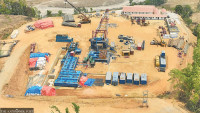
Drilling has ended, but further testing and a new agreement with China are needed to establish whether the estimated 80.7 billion cubic metres of gas can be commercially produced. The Chinese findings put the estimated value of the gas reserves at nearly $85 billion. Post file photo
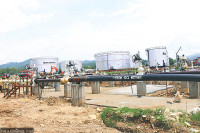
Dailekh could become a major source of domestic natural gas for Nepal, with an estimated 80.7 billion cubic metres identified at Jaljale. But commercial production remains a distant prospect. More than a year after drilling ended, no further work has begun; costly equipment and infrastructure at the site are deteriorating, and a new agreement with China is needed to move the project forward.
The China Geological Survey (CGS) submitted its technical findings to Nepal’s Department of Mines and Geology in the second week of February. But the report has not led to further exploration or preparations for commercial production. The Chinese government has also yet to formally hand Nepal the final report.
Xibu Drilling Engineering Company drilled at the site for nine months, from mid-April 2024 to mid-January 2025, while the CGS oversaw the exploration work.
The project grew out of a bilateral understanding reached by Nepal and China in March 2016 to cooperate on petroleum exploration and extraction. The two countries signed a formal agreement in February 2019, with China pledging around Rs2.5 billion in grant assistance. The exploration programme began that year and was originally expected to be completed within three years.
Drilling was conducted around Shirsthan, Nabhisthan and Paduka, within an area of roughly three kilometres. The department said compensation was paid for 45 ropani (2.29 hectares) of land acquired for the project.
The work faced repeated delays because of the Covid pandemic, difficulties importing heavy equipment, poor road access, and problems acquiring land, a department official said.
“There was an interim government when the report came, and the government has shown little interest since,” the official said. “A new agreement between the two governments is now needed to move the project forward. We wrote to the Chinese government through the Foreign Ministry about three months ago, but have received no response.”
The findings submitted by the Chinese side estimate the value of the gas at nearly $85 billion. The deposits could meet Nepal’s domestic demand for at least 50 years, said Ganesh Nath Tripathi, acting director-general of the department.
“We have completed drilling at only one location,” he said. “Similar quantities of petroleum deposits are estimated to exist at three other locations as well.”
But the discovery alone does not establish whether the gas can be extracted commercially. Dinesh Kumar Napit, director-general of the department, said further work, including well testing, was needed to determine gas-producing capacity of the exploration well and the feasibility of commercial extraction.
“Well testing determines how much gas can be extracted from an exploration well in an hour,” he said. The tests would also help assess the condition of the reservoir and the technology required for extraction. The gas’s composition must be analysed before commercial production can be considered, Napit said. Further work would require another agreement between the two governments.
The prospect of domestic production has significant implications for Nepal, which relies heavily on imported cooking gas. The country imports liquefied petroleum gas (LPG) worth around Rs28 billion annually through India, according to Department of Customs data. Nearly Rs6 billion is spent each year on transporting the fuel.
Commercial production at Dailekh could reduce the import bill and save foreign currency, said Dhan Bahadur Rawat, president of the Federation of Nepalese Chambers of Commerce and Industry’s Karnali provincial chapter.
“It would make a significant contribution to the national economy. Commercial production would also generate government revenue, attract foreign investment, and create opportunities for technology transfer,” he said.
Kamal Lamsal, an assistant professor at Mid-West University, said domestic production could help replace imports and reduce Nepal’s trade deficit. He also sees potential for petroleum processing facilities and a regional energy hub that could create opportunities for new businesses and related industries.
Chemist Vijay Sharma said methane, the main component of natural gas, could be used as an alternative to petrol and diesel. It could power vehicles, generate electricity and meet household energy needs. Hydrogen could also be extracted from methane and used to produce ammonia for fertiliser manufacturing, he said.
Unlike LPG, methane requires high-pressure storage. It could be supplied through pipelines or transported in specially designed cylinders for industrial use, Sharma said. He also sees potential for using the gas as feedstock for fertiliser plants.
The prospect of commercial production had raised expectations in Jaljale and surrounding settlements. But residents say their optimism is fading as the project remains inactive.
Rita Kumari Shahi, chair of Bhairabi Rural Municipality, said the local government had been preparing infrastructure in anticipation of the economic activity the project could generate. Jaljale is connected to the Mid-Hill Highway, and the rural municipality is building three roads to link nearby settlements. It has allocated nearly Rs20 million this year for infrastructure development around the site, she said.
“The project needs to start as soon as possible to create employment and stimulate the wider economy of Karnali,” Shahi said.
Local community leader Dhan Bahadur Budha said land prices in Jaljale had tripled following the reports of the gas discovery. Land that previously sold for Rs500,000 per ropani (508.74 sq metres) rose to as much as Rs1.5 million, he said.
“But after the project stalled, transactions came to a standstill,” he said.
Around 50 shops and hotels operate in the Jaljale area. Budha said business had also declined as activity and interest surrounding the exploration project faded.
About 70 technical personnel and 100 local workers were employed during the 19 months of work at the site. The area is now largely deserted, said Ananda Saru, chief district officer of Dailekh.
Three Chinese nationals and Armed Police Force personnel are guarding the exploration site. A Nepal Police post has also been established to provide additional security, Saru said.




 15.12°C Kathmandu