Telecom regulator and operators face minister’s ire over poor service
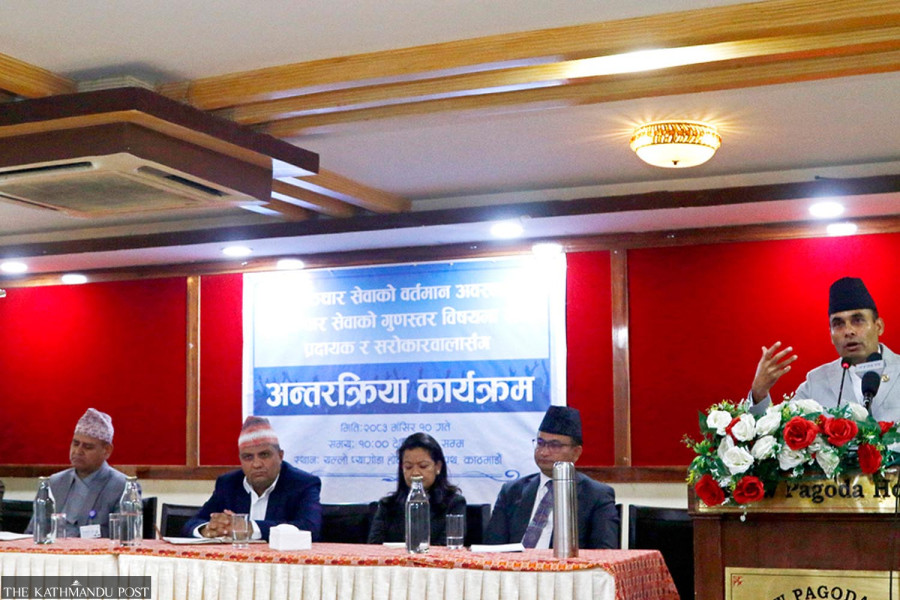
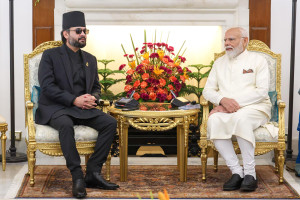
Communications Minister Bikram Timilsina warns of action against service providers that fail to meet licence conditions, and questions the need for a regulator unable to hold them accountable. Post Photo
Even in the heart of Kathmandu, a mobile phone call is no guarantee of an uninterrupted conversation. Communications Minister Bikram Timilsina says his calls drop two or three times on his journeys between his office in Singha Durbar and residence in Balaju.
A recent drive test by the telecom regulator has found similar problems across several parts of the Valley, raising fresh questions about network quality, weak enforcement and what consumers actually get for their money.
The poor performance has drawn sharp criticism from Minister Timilsina, who accuses telecom operators of prioritising profits over service quality and the Nepal Telecommunications Authority of failing to enforce standards. He warned that the regulator’s continued inability to hold operators accountable could call its very existence into question, while service providers that fail to honour their licence conditions could face legal action.
Speaking at a discussion on telecom service quality organised by the authority on Thursday, Timilsina demanded immediate improvements from both the regulator and service providers.
The minister warned that the authority would have difficulty justifying its existence if it could not ensure service standards, while operators could face legal action for failing to honour the commitments made while obtaining their licences.
“If the authority cannot ensure the quality of telecom services and fulfil its regulatory role, why do we need it? Why should its employees be paid with taxpayer money?” Timilsina said. “An institution that cannot function as a regulator should be scrapped.”
Service providers, he added, must meet the conditions and commitments they make while obtaining the licence. “The days of making money by misleading customers, cheating them or charging for services they do not deliver are over.”
The government would support businesses that operate within the law but take tough action against those that do not, he said.
“Who is stopping the authority from taking legal action, including imprisonment, against operators that obtain licences but fail to meet their obligations?” the minister asked.
“Service providers that challenge the government, the regulator and the law, and seek to influence the regulator while denying consumers quality services, will soon face consequences. You will see who is held accountable and at what level.”
Arjun Ghimire, the authority chair, said he had called the meeting after recently experiencing a failed phone connection while walking along the road, just five days before the discussion.
The authority’s latest drive test, conducted in Kathmandu Valley from September 15 to 21, also exposed poor telecom services in several areas. The test found weak signals and failure to meet minimum standards in Dhapakhel, Imadol and Budhanilkantha on Nepal Telecom’s network, and in Matatirtha, Balambu, Budhanilkantha, Imadol, Gundu and Changunarayan on Ncell’s network.
The government introduced the Telecommunications Service Quality Regulations in 2022 to ensure minimum standards across the sector. Under the rules, network uptime must be at least 99 percent in urban areas and 98 percent in rural areas. The call drop rate must not exceed 2 percent, the call setup success rate must be at least 97 percent, and the Mean Opinion Score (MOS), a measure of voice quality, must be three or higher.
For 4G data services, the average download speed in urban areas must be at least 15 to 20 Mbps. Rule 11 also requires service providers to compensate customers or extend their subscriptions by an equivalent period free of charge when network outages prevent them from using purchased data or voice packages.
Consumer rights advocates at Thursday’s discussion said poor service had left people struggling to access an essential utility. Bishnu Prasad Timilsina, general secretary of the Forum for Protection of Consumer Rights-Nepal, said telecom services were essential and their availability and quality should not be compromised. Although coverage appeared adequate in official reports, consumers continued to face problems in practice, he said.
Consumer rights advocate Subarna Prabha Khadka said people in rural areas still had to climb trees to make phone calls, while students in some places were forced to leave their homes and go out onto roads to get mobile data or voice services to work.
Khadka called for telecom services to adopt a metering system similar to those used for water and electricity, under which customers would pay only for what they consumed. She also demanded refunds for unused data packages. “People should not have to carry two SIM cards because one operator’s network does not work. That compulsion must end,” she said.
Sahadev Gautam, chair of the Citizens Judicial Consumer Forum, said mobile networks disappeared along the Ramnagar forest stretch in Chitwan and on highways in Kailali, leaving people unable to make emergency calls when accidents occurred.
Ghimire said telecom customers should not have to pay for services that fail to meet the promised standard, just as they would refuse to pay for an unsatisfactory cup of tea. “The same principle should apply to telecom services. Consumers must be able to hold providers accountable for what they deliver. The authority will not compromise on their rights,” he said.
Min Prasad Aryal, the authority’s director, said a subcommittee had been formed to require service providers found in violation during the drive test to submit progress reports every 15 days. If operators fail to meet their obligations, the authority can initiate proceedings to revoke their licences under Section 28 of the Telecommunications Act, he said.
Representing state-owned Nepal Telecom, chief operating officer Prem Prasad Silwal said the company had extended 4G services to 750 local units and was operating 4,912 base transceiver station (BTS) sites.
However, he said opposition from homeowners and neighbours, driven by misconceptions about radiation from telecom towers, had forced the company to remove even already-installed towers at some locations. More than 200 additional tower sites inside Kathmandu had faced such resistance, he added.
Nepal Telecom managing director Sangeeta Pahadi and deputy manager Dinesh Yadav said the company had initiated the procurement process for 1,600 new towers at an estimated cost of Rs12 billion to improve service quality and ease network congestion.
Ujjwal Magaiya, a technical expert representing private operator Ncell, said the company’s 4,686 sites provided 4G coverage to 95 percent of the population. He argued that power outages at the Nepal Electricity Authority accounted for 37 percent of complaints related to network quality.
“Since 90 percent of the data consumed by users goes towards video streaming platforms such as YouTube and TikTok, a speed of 3 Mbps is sufficient for mobile use,” he said. He added that access to additional spectrum in the 900 MHz band could improve network quality without requiring more towers.
Ncell plans to shut down its 3G services entirely within the 2025-26 fiscal year and redeploy the freed-up frequencies for 4G, Magaiya said. He also called for a single-window system to simplify approvals for installing telecom towers on government land.
Minister Timilsina also accused internet service providers of spreading misinformation by claiming that the government had raised internet prices after operators discontinued cheaper packages. He warned them against market manipulation and misleading public statements.
Timilsina said it was unfortunate that the telecom sector had come to be seen as a hotbed of corruption, adding that the institutions operating within it were responsible for changing that perception and putting the sector on the right track.
“Everyone in the sector, from the regulator and network service providers to ISPs and telecom operators, must take responsibility for their part,” he said.
“The government is not interested in interfering in how you run your businesses. It has just one expectation: that consumers receive quality service. The telecom sector must not be used for backroom dealings or manipulation. Such practices must end.”




 8.12°C Kathmandu