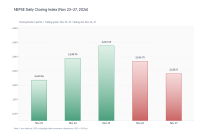
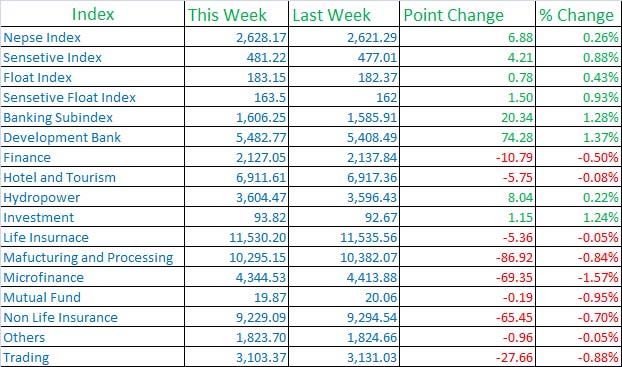
The Nepal Stock Exchange (Nepse) saw trading surge during the week of November 23–27, but its benchmark index made only a modest advance. The index gained 6.88 points, or 0.26 percent, to close at 2,628.17, from 2,621.29 a week earlier. Turnover jumped 59.04 percent to Rs25.59 billion from Rs16.09 billion, while average daily turnover rose from Rs3.22 billion to Rs5.12 billion.
Market capitalisation rose Rs20 billion, or 0.44 percent, to Rs4.53 trillion. The Sensitive Index, which tracks Class A companies, gained 0.88 percent to 481.22, more than three times Nepse’s rise. The stronger performance points to firmer demand for larger companies, particularly banks.
Only four of Nepse’s 13 sub-indices ended higher. Development banks led with a 1.37 percent gain, followed by banking, up 1.28 percent. Investment companies rose 1.24 percent and hydropower 0.22 percent.
Microfinance fell 1.57 percent, the steepest sectoral decline. Mutual funds lost 0.95 percent, trading companies 0.88 percent, manufacturing and processing 0.84 percent, and non-life insurance 0.70 percent.
Commercial and development banks advanced while microfinance fell most, suggesting investors were favouring selected lenders rather than the financial sector as a whole. With nine sub-indices in negative territory, the turnover surge does not yet signal a broad recovery.
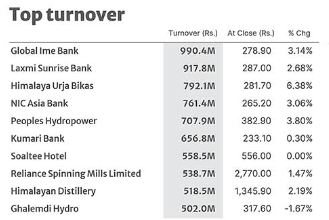
Global IME Bank topped turnover and volume rankings, with Rs990.4 million worth of shares traded, or 3.539 million units. Its price rose 3.14 percent to Rs278.90. Laxmi Sunrise Bank followed with Rs917.8 million in turnover, gaining 2.68 percent to Rs287. NIC Asia Bank recorded Rs761.4 million and rose 3.06 percent.
High turnover alongside rising prices indicates buying interest in these banks. Market participants cite relatively low price-to-earnings ratios, dividend prospects, easing interest rates and ample banking-system liquidity. They also point to improved recent financial reports at many commercial and development banks, and hope rising non-performing loans will begin to ease.
Hydropower trading centred on a few companies. Himalaya Urja Bikas recorded Rs792.1 million in turnover and gained 6.38 percent to Rs281.70. Mandu Hydropower was the week’s top gainer, up 7.19 percent to Rs880, near its 52-week high of Rs898. Saptakoshi Development Bank rose 6 percent to Rs565.
Yet the hydropower sub-index gained just 0.22 percent, pointing to stock-specific interest rather than a sector-wide rally. Microfinance stocks faced heavy selling. Unnati Sahakarya Laghubitta fell 10.25 percent, Samata Gharelu Laghubitta 9.24 percent and Swastik Laghubitta 9.21 percent.
The stronger Sensitive Index and heavy turnover in commercial banks suggest investors are returning to larger financial companies. Relatively low valuations and dividend yields may be attracting buyers, while easing rates and ample liquidity could improve banks’ operating environment.
Recent financial reports from many commercial and development banks have also shown improvement, market participants say. Investors hope rising non-performing loans, a major drag on banks’ performance, will begin to ease. That expectation may support demand, although weekly trading data cannot establish whether banks are undervalued or asset quality has improved.
Development banks recorded the strongest sectoral gain, but the available market data does not establish whether investors were responding to improved earnings prospects, expected dividends or short-term trading opportunities. Microfinance’s decline points to continued investor caution.
Nepse remains in consolidation after retreating from its late-October highs. It closed at 2,628.17, below its short- and medium-term exponential moving averages of 2,630.24 and 2,635.77, respectively. The index faces immediate resistance at 2,635-2,650, where the two moving averages are positioned. A sustained break above this range, backed by stronger turnover, could open the way towards 2,660-2,670, and potentially 2,700.
On the downside, 2,600-2,610 is the immediate support zone, with a lower support level at around 2,560-2,570. Buying interest appears near the immediate support range, but higher turnover alone does not confirm accumulation.
The 14-day Relative Strength Index stood at 48.08, just below the neutral midpoint of 50, indicating that neither buyers nor sellers have decisive control. The index needs to hold support and break resistance to signal a sustained recovery.
Investor and market analyst Subas Chandra Dhungana said Nepse could remain positive as long as it holds above the psychologically important 2,600 level. The market is currently moving sideways, but could gain momentum if it stays above that threshold, he said.
Dhungana said the market typically declines after Tihar as investors take leveraged positions before the holiday to avoid settling their trades during the festival and immediately afterwards. Once settlement deadlines approach, they often sell shares to meet their payment obligations, adding to market pressure. This time, however, the market has held up better than usual, which he sees as a positive sign.
The rise in trading volume this week has also provided some momentum, he said. But for the market to sustain its gains, daily turnover needs to exceed Rs6 billion consistently.
Market analyst Jagannath Dhungel is also optimistic about the coming week, citing gradually rising turnover and support from the banking sector. He said the market typically performs well in November and December, when companies announce dividends, and expects the index could climb towards 3,000, despite minor corrections along the way.




 22.12°C Kathmandu