Four Supreme Court nominees approved after scrutiny of judicial conduct and allegations
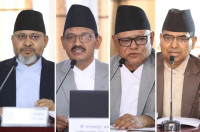
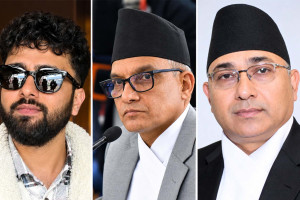
Parliamentary hearings raised concerns over alleged judicial interference, middlemen and controversial rulings, while nominees defended their records and outlined plans for reform. From left Ratna Bahadur Bagchand, Chandra Bahadur Saru, Janak Pandey and Gokarna Dangi. Nepal Photo Library
The Parliamentary Hearing Committee on Saturday unanimously approved four nominees for permanent positions on the Supreme Court, clearing the way for their appointment after the Tihar holiday.
The committee endorsed Ratna Bahadur Bagchand, Chandra Bahadur Saru, Janak Pandey and Gokarna Dangi, all of whom had been recommended by the Judicial Council from among serving High Court judges.
Committee chair Bodh Narayan Shrestha said the nominees were approved with the agreement of all lawmakers following hearings on Friday and Saturday. Their appointment and oath-taking will take place after the Tihar holiday, which began on Friday.
Lawmakers asked all four nominees similar questions over their judicial records, the influence of intermediaries in the courts, political interference and allegations raised in complaints against them.
They also raised public concerns that justice had become increasingly inaccessible and that judges themselves were meeting intermediaries at hotels over tea.
All four nominees submitted papers outlining their judicial philosophies and plans for reform.
Bagchand proposes judicial reform by 2035
Bagchand, chief judge of the Pokhara High Court, presented a “Vision 2035” aimed at making the judiciary the ultimate institution of public trust.
In his concept paper and action plan, he proposed developing the Supreme Court as the central brain of the entire judiciary.
He said the judiciary must remain firmly grounded in constitutional values and principles while adapting its thinking and working methods to changes in society, technology and citizens’ needs.
Bagchand stressed that justice should not end with the delivery of a verdict. It should also ensure effective implementation of court decisions and enable citizens to experience justice in practice.
He identified the enforcement of court rulings as a major problem, saying citizens were being denied justice because decisions remained unimplemented for years.
To address this, he proposed a judicial-executive mechanism for enforcing court decisions, with coordinated structures involving the judiciary and executive agencies.
Under his proposal, the judiciary would retain exclusive authority to interpret judgments and determine their validity and legal effect, while executive agencies would work with it to ensure implementation.
He said his proposed model was developed after a comparative study of judgment enforcement systems in the United Kingdom, the United States, Japan, India and China.
Dangi questioned over land pooling dispute
Lawmakers questioned Dangi about alleged irregularities in the judiciary, the growing influence of intermediaries, poor enforcement of court decisions and concerns about his own judicial performance.
Particular attention was given to a land pooling dispute in Tulsipur, Dang, allegations of suspicious reversals of court decisions and declining public confidence in the judiciary.
Lawmakers Padma Kumari Aryal, Barshaman Pun and Mahesh Bartaula, among others, raised questions about complaints filed against Dangi.
They sought clarification over allegations that landowners had not received the 40 percent of land promised to them under a land pooling agreement.
Lawmakers also alleged that plots had been developed by encroaching on land allocated for a public school, health post and roads, and questioned whether Dangi had been directly or indirectly involved.
“Eighty-seven landowners have filed complaints in tears. School land has been encroached on, and a Supreme Court verdict has been disregarded in favour of a Cabinet decision. What was your role in this?” lawmakers asked.
They also warned Dangi that the influence of intermediaries and alleged judicial arrangements had become alarming.
Lawmakers said lower court rulings were increasingly being overturned by the Supreme Court without clear grounds, raising serious questions about the integrity of the judicial system.
Responding to the questions and allegations, Dangi said he had always adjudicated cases based on the constitution, the law and evidence, and would continue to do so.
He presented an action plan for judicial reform, reducing delays and curbing the influence of intermediaries, while maintaining that allegations against him were baseless.
On the Tulsipur land dispute, he said decisions had been made solely on the basis of legal procedures and evidence, and denied any improper involvement.
Dangi said he would play a leading role at the Supreme Court in restoring public confidence in the judiciary and ensuring that court decisions were implemented promptly.
Pandey questioned over land and Bhutanese refugee case
Pandey was questioned about land in Baluwatar, Jhapa, that had been appealed to the Supreme Court in his wife’s name.
Rastriya Swatantra Party lawmaker Madhu Kumar Chaulagain, Nepali Communist Party lawmaker Barshaman Pun and CPN-UML lawmaker Padma Aryal raised the issue.
He was also asked about his decision to release Nepali Congress leader Balkrishna Khand on bail in the fake Bhutanese refugee case.
Pandey said political considerations became secondary once a judge entered the courtroom, and that decisions were based on evidence and case records.
He said the land in question had been purchased by his family and that he was prepared to submit all relevant documents.
Aryal asked why there had been differing opinions in the case involving Khand.
Pandey said he had given an opinion in favour of releasing Khand, but had not delivered the final verdict.
He said judges must decide cases without political bias, even though courts frequently handle politically sensitive disputes.
Pandey also referred to a case concerning the chief minister of Bagmati Province that came before him while he was serving in Hetauda.
He said he had concluded that an interim order could not be issued because the chief minister had already taken the oath of office and secured a vote of confidence.
Pandey reiterated that evidence and case records, rather than political influence, guided his decisions.
He said his recommendation to release Khand in the fake Bhutanese refugee case had been based on the evidence available at the time.
He added that he and another judge had reached different opinions, while a third judge had ultimately decided to release Khand.
Nominees’ judicial experience
Of the four nominees approved on Saturday, Bagchand is a chief judge, while the other three are High Court judges.
Bagchand entered the judicial service in 2009 and has worked in Nepalgunj, Surkhet, Patan, Tulsipur, Biratnagar and the Special Court.
He became chief judge of the Pokhara High Court in 2023.
He has published works on cybercrime, constitutional law, criminal justice, human rights, judicial reform, caste discrimination and access to justice.
Saru, who serves at the Patan High Court, is considered an expert in constitutional law and civil cases.
Pandey and Dangi have generally faced fewer controversies during their service in the High Courts.
Disagreement over judicial appointments
The Supreme Court has five vacancies for judges, but the Judicial Council recommended only four candidates, leaving one position unfilled.
The Judicial Council Act requires recommendations to be made one month before a vacancy occurs.
The recommendations drew objections from two council members and the Nepal Bar Association, who said the selection process had bypassed seniority and amounted to selective appointments.




 12.8°C Kathmandu