



 18.82°C Kathmandu
Mon, Oct 19, 2026
Money
Nepal’s broken supply chain: Farmers earn less, consumers pay more
Agricultural goods in Nepal pass through up to seven layers of middlemen and this drives consumer prices up to seven times higher than the farmgate price, government report says.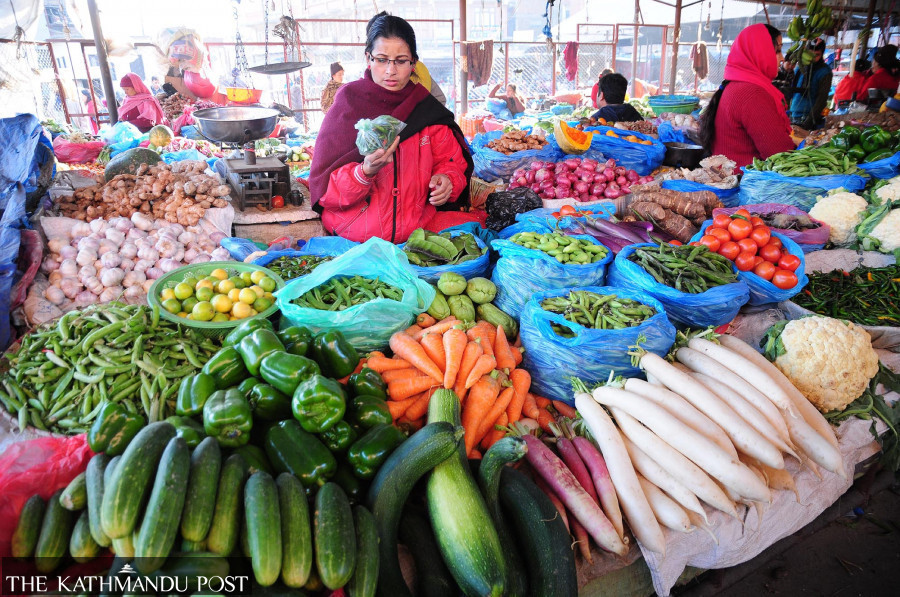
bookmark
Krishana Prasain
Published at : September 28, 2026
Updated at : September 28, 2026 21:29
Kathmandu
The farmgate price—the net amount paid to farmers for their produce directly at the farm—has risen to its lowest growth rate in eight years, even as consumers continue to pay multiple times more for the same products, according to a report that shows how layers of middlemen profit while farmers are left with little return.
The Agricultural Product Price Index report published by the National Statistics Office, the country’s official statistics agency, shows that in the last quarter [mid-April to mid-July] of the last fiscal year 2025-26, farmgate prices increased by a marginal 2.04 percent.
“This growth is the lowest of eight years,” according to the report.
But what consumers feel in the market is a stark contrast.
The growth rate of agricultural products at the farmgate was 3.06 percent in the last quarter of the fiscal year 2024-25. In the years before that, the growth rate had hovered between 5 and 10 percent on average, according to the report.
The Agricultural Product Price Index measures changes in the prices farmers receive at their farms when they sell their produce to traders before it reaches the market or collection centres.
“It indicates that the farmgate price has been stable, which kept the overall food inflation under control,” the report said.
But consumers, however, continue to face high prices.
Dhundi Raj Lamichhane, deputy chief statistician at the statistics office, said consumers are compelled to pay much higher while farmers are getting a small amount.
Agricultural goods in Nepal pass through up to seven layers of middlemen, driving consumer prices up to seven times higher than the original farmgate price, according to the government report.
For instance, a product with a farmgate price of Rs10 can cost Rs70 by the time it reaches the final consumer.
Produce typically moves through manufacturers, dealers, main distributors, national distributors, local distributors, wholesalers and retailers, according to the government report.
Studies by the Department of Commerce, Supplies and Consumer Protection show that farmers in districts such as Makawanpur and Dhading receive Rs25–35 per kg for vegetables that sell for up to Rs125 per kg at retail in the Kathmandu Valley.
“The gap between farmgate price and market price has been ballooning as the middlemen are more powerful and are being encouraged…” said Lamichhane.
The report said that farmers receive lower prices for food grains and potatoes. But once these products reach consumers, their prices surge, according to the price index.
According to Nepal Rastra Bank, the consumer price index for vegetables in mid-August 2026 increased by 6.9 percent, meat and fish by 8.65 percent and fruit by 15.39 percent.
Farmers have on several occasions dumped vegetables such as tomatoes and cabbage on the streets to protest low prices. But on the other hand, there is hardly any instance when consumers feel the benefit of such price drops, according to experts.
In July, vegetable farmers dumped tomatoes at Maitighar Mandala in Kathmandu, saying they were receiving extremely low prices and accusing the government of failing to provide adequate subsidies and support while pursuing import-oriented policies.
At the time, the Kalimati Fruit and Vegetable Market Development Board, the country’s largest vegetable market, which supplies around 800 tonnes of vegetables to the market, had fixed the wholesale price of small local tomatoes at just Rs8 per kg, while the maximum price stood at Rs12 per kg. The average wholesale price for small local tomatoes was Rs9.50 per kg.
At the time, the retail price was Rs40 per kg.
This is not the first case. Farmers have repeatedly taken to the streets to dump their fruits and vegetables after failing to secure a fair value for their produce.
“Essentially, the farmer price is low and consumer price is high as there are different layers in the market that involve processors, traders, wholesalers and retailers, each of whom keep a certain margin,” said Arjun Dev Gyawali, senior agri-economist at the Department of Agriculture. “When supply and demand does not match, farmers bear the losses.”
For instance, if each layer keeps a 10 percent margin, excluding transportation costs, the cost already rises substantially by the time the product passes through multiple layers.
But experts say Nepal’s market and supply chain are different, as low margins can discourage traders from buying farmers’ goods and may lead to artificial shortages in the market. Even when prices rise, opportunistic traders can hide products to create artificial shortages.
“There are undefined layers in the market, which sometimes reach up to six or seven or more. One trader buys and sells it to another. Another trader buys and sells it to another. There are countless layers involved, which ultimately increase the price when it reaches consumers,” said Gyawali.
Last year, the Department of Commerce, Supplies and Consumer Protection formed a committee led by its director general, with representatives from the private sector and other stakeholders, to prepare a study report to establish standards for determining market structures and pricing systems.
Through these standards, the department planned to clearly define the roles of producers, wholesalers, retailers, and service providers. But the initiative never materialised.
Recently, another committee has been formed in coordination with the deputy director general of the Department of Agriculture and to study the number of market layers required for major agricultural products, said Gyawali.
“When there are no unnecessary layers, the price does not increase when it reaches consumers. This will also ensure that farmers will get a genuine price,” he said.
Prem Lal Maharjan, president of the National Consumer Forum, said their study suggests that the difference between farmers’ prices and consumer prices can be as much as tenfold.
“For instance, cauliflower and cabbage that are sold for Rs10 per kg in Chitlang [in Makawanpur] sell for Rs100 per kg by the time they reach consumers’ kitchens in the Kathmandu Valley. This shows the price increases more than tenfold. It is the middlemen who profit the most,” he said.
Middlemen, transporters and traders increase prices as they do not come under clear legal boundaries, said Maharjan. He said some are also politically protected.
“The multiple layers of middlemen are the key reason why the farm sector has no charm among the youths. When farmers struggle to cover even the cost of production and household expenses, no one wants to take up farming as a profession.”
Insiders say allegations of political protection for middlemen emerge time and again, but the issue is quickly swept under the rug.
For instance, in September 2018, the Kalimati Fruits and Vegetables Market Development Board revoked the permits of 51 traders operating stalls at the vegetable market, in a move aimed at eliminating middlemen from the trade.
What the traders used to do was subcontract the stalls to others, and the sequence would continue. That made rental charges higher and the burden was ultimately passed on to consumers through inflated food prices.
The investigation revealed that a syndicate of middlemen had a vice-like grip on the supply chain, resulting in high prices for consumers and low returns for farmers. During the inspection, the regulator found that many vegetable traders were not issuing sales invoices as required by law.
Middlemen in the lucrative vegetable trade had become so emboldened that in August 2018 they even manhandled members of a government team during an inspection visit at the Kalimati Fruits and Vegetables Market. The country’s largest vegetable and fruit market had to partially shut down in protest against the market inspection.
Krishana Prasain
Krishana Prasain is a business reporter for The Kathmandu Post covering markets. Before joining The Kathmandu Post in 2018, she spent 3 years in New Business Age magazine covering business.



Most Read from Money

Nepal travel agents threaten to stop selling Thailand trips over visa rules

Why does an hour long flight to Dhangadhi cost more than a flight to New Delhi?

Malaysia rejects Nepal’s demand to open recruitment to all manpower agencies

No school, but a graduation cap for women dairy farmers

Nepal arrests four medical service providers as Malaysia recruitment row deepens
Editor's Picks




E-PAPER | October 19, 2026

×