



 14.58°C Kathmandu

Mon, Oct 19, 2026
Money
Dashain sales move from shopfronts to social media
Retailers are using TikTok, Facebook and Instagram to clear old stock and draw shoppers into stores.
bookmark![]()
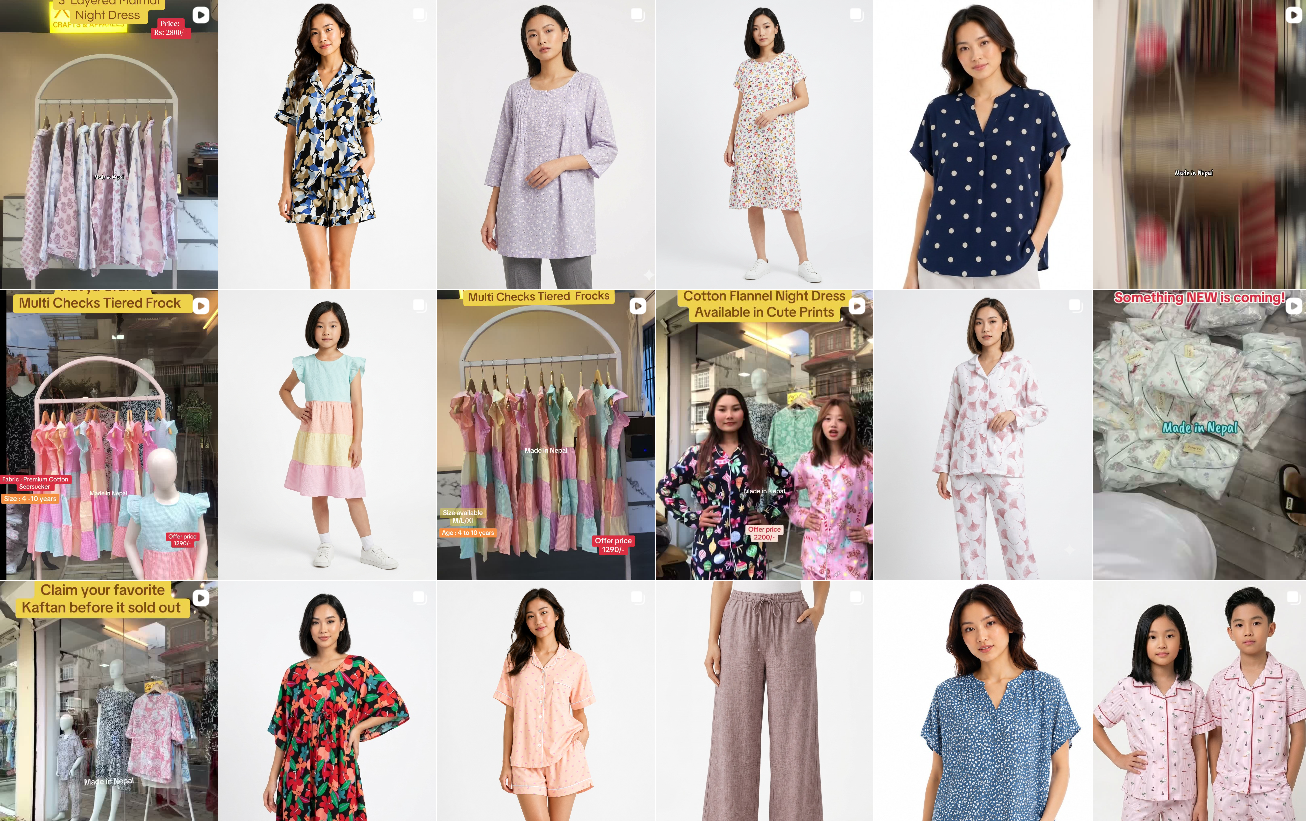
Instagram posts of models picked from the Instagram page of Aavya Craft and Apparels in Old Baneshwar. Post Photo
Prakriti Dahal
Published at : September 28, 2026
Updated at : September 28, 2026 11:49
Kathmandu
For Koteshwar resident Sushmita Katuwal, shopping no longer necessarily means walking through crowded markets. From clothes and earrings to handbags, she increasingly browses TikTok and Facebook, checks prices and places orders from her phone.
“Now you can find out on TikTok and Facebook what is available in the market and what’s coming in,” Katuwal said. “Ordering online is easy and quick. I feel like I’m wasting the whole day when I have to walk around the market.”
She says social media has also made it easier to keep track of new products and compare what is on offer. As long as she checks the seller’s page carefully before ordering, she believes the chances of being cheated online are lower.
The market has seen a massive change nowadays.
‘Sale, sale.’ ‘Dashain offer.’ ‘Up to 70 percent off.’ ‘Buy one, get one free.’
Nepali shoppers are used to seeing such offers pasted on shop windows or hung from storefronts as the country’s biggest festival approaches.
But in the digital era, the same offers are increasingly appearing on social media. TikTok, Facebook and Instagram are filled with short videos and photos promising discounts, special offers and bargains, drawing shoppers into markets they may not otherwise have planned to visit.
Watch a video, check the price, ask about the size and, in some cases, place an order—all without leaving the app.
Retailers say customers are increasingly discovering their offers online before walking into their shops, while social media has become an important tool for clearing old stock ahead of the festive season.
“Once we put up a sale, we also post it on social media. Once the photos and videos are posted, everyone knows about it,” said Kopila Pujara, a salesperson at Aavya Craft and Apparels in Old Baneshwar.
The shop is offering discounts of up to 50 percent on its products, with stickers advertising ‘sale’, ‘50 percent off’ and ‘special sale offer’ displayed around the store.
Discounts are available on women’s and children’s clothing, including kurta-suruwal, tops, kurta sets and T-shirts. The offers are also being promoted on Facebook and Instagram.
Pujara said some customers come to the shop after seeing the videos online and show screenshots of the offers.
“Some customers message us after seeing the posts to ask about the size and price. Some even order the products from there,” she said.
Retailers put their goods on sale every year as Dashain and Tihar approach, mainly to clear old stock before bringing in new merchandise, Pujara said.
The company has four Made in Nepal Craft outlets in Kathmandu, all of which are currently running sales. Selling at a discount does not bring retailers much profit, she said, but it helps them make room for new goods.
“Dashain is around the corner, so we’ve put the older stock on sale. We don’t make much profit from these sales,” Pujara said. “We’re selling goods from the shop and items that have been sitting in the warehouse at lower prices.”
For retailers, social media has made it easier to get information about sales to customers quickly. Discounts are also a way to draw shoppers at a time when spending typically increases around the festive season.
Suruchi Pradhan found out about a sale at a fixed-price shop in New Road through TikTok. She went to the shop after seeing the offer and bought two T-shirts for Rs750. They had previously been priced at Rs1,200.
“I saw the sale in New Road on TikTok. That’s why I thought, let’s go and see,” said Pradhan, who works in finance. “It also seemed cheaper than at other times.”
She said she uses TikTok to find out about products and prices in the market.
The shop is running a ‘Festive Season Sale’ targeting Dashain. The store, which normally sells products at fixed prices, is now offering discounts on jeans, skirts, T-shirts, kurta sets and one-piece dresses.
The current sale is mainly aimed at clearing stock, said shop staff member Khagendra Pun.
“We have also posted information about the sale on social media. People who come here have also made videos and posted them,” Pun said.
The number of customers has increased since the sale began, he said. The discounts are not based on a fixed percentage but on the price of individual items, with Rs200 to Rs500 knocked off.
Sonam Gear, a well-known Nepali brand, is also running a ‘Summer Sale’ at its New Road outlet targeting Dashain. The brand is offering discounts ranging from 15 to 60 percent.
Jackets, trousers, shirts, pants, gloves, gym vests and sweaters are among the products being sold at discounted prices.
Some products are put on sale because only certain sizes or designs are in stock, said staff member Gautam Magar.
“Sometimes a size is not available, and sometimes only a small quantity or a few designs arrive,” he said. “We put limited items on sale so customers can use them according to their needs.”
The brand also posts videos about the sale on TikTok and Facebook.
“We also post information on social media about the products we have put on sale at the outlet,” Magar said. “There are customers who see the products online and then come to the outlet to look at them.”
Shops selling shoes, slippers and bags are also offering discounts and special deals as Dashain approaches.
Retailers say they are putting goods on sale to clear stock ahead of the festival. They use discounts and special offers to sell older products at lower prices and make room for new merchandise.
Goldstar, a Nepali footwear brand, is offering discounts and special deals on shoes and slippers at its outlets. At its Old Baneshwar outlet, customers can buy two pairs of shoes for Rs1,500 and two pairs of slippers for Rs500.
The outlet is also offering discounts of up to 15 percent on sports shoes, said salesperson Sirjana Sunar.
Products with unsuitable sizes, less-preferred colours or only a small quantity of remaining stock are put on sale and sold at lower prices, she said.
Goldstar outlets are also promoting their sales through digital platforms. Customers often learn about the sales through Facebook and TikTok, Sunar said.
“Nowadays, we also give customers information about our sales through social media,” Sunar said. “Customers ask about products after seeing the photos or videos. Some come to the shop to look at them, while others order online.”
Sunar said sales do not necessarily mean greater profits for traders.
“Sale obviously means selling at a lower price,” she said. “There may be a size available but not the colour. Such products are also put on sale. We offer discounts to make room for new goods.”




Most Read from Money
Nepal travel agents threaten to stop selling Thailand trips over visa rules

Why does an hour long flight to Dhangadhi cost more than a flight to New Delhi?

Malaysia rejects Nepal’s demand to open recruitment to all manpower agencies

No school, but a graduation cap for women dairy farmers
Nepal arrests four medical service providers as Malaysia recruitment row deepens
Editor's Picks




E-PAPER | October 19, 2026

×