Will flood-damaged highways be travel-ready by Dashain?
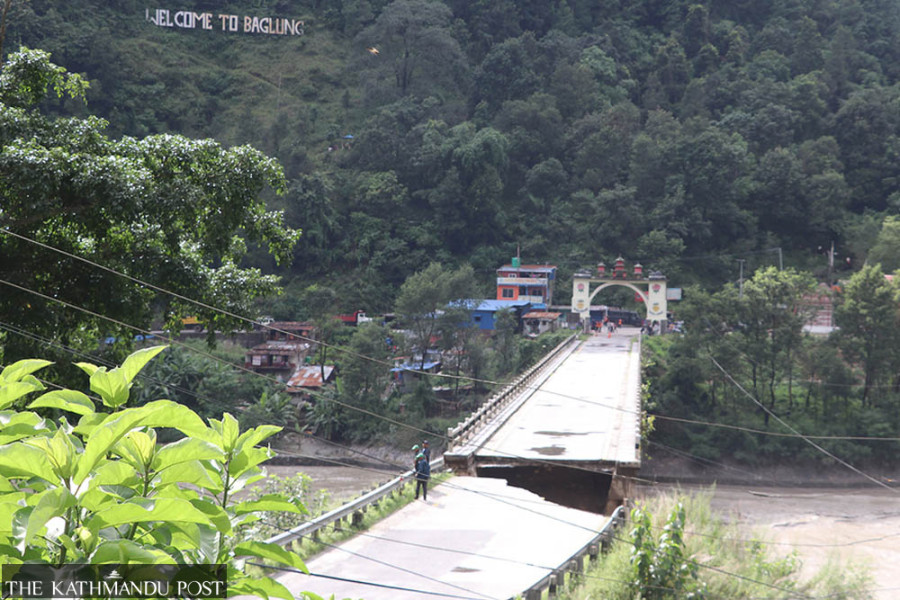
Road links between Lamjung-Manang, Parbat-Baglung and Myagdi-Mustang severed after rain since Saturday night. The flood-swollen Kali Gandaki river damaged a concrete bridge linking Parbat and Baglung districts at Maldhunga in Kushma Municipality-1, Parbat. Sumanjung Thapa/TKP
Floods and landslides triggered by incessant rainfall over the past few days have caused extensive damage to the country’s major highways, severing direct road links with several district headquarters and important destinations.
Rain that began on Saturday night has severed road connections between Lamjung and Manang, Parbat and Baglung, and Myagdi and Mustang. Vehicle movement has come to a halt after floods washed away approach roads to bridges in these sections. The Department of Roads said it would take several more days to build temporary access roads and resume traffic.
The concrete bridge at Maldhunga connecting Parbat and Baglung can be brought back into operation only after the flow of the Kaligandaki river subsides, said Hari Prasad Subedi, chief of the Baglung Road Division Office.
“We are preparing to place gabions from below the river and allow vehicles to pass temporarily,” Subedi said. “We will build a permanent structure later, but the flood level needs to fall significantly first.”
The flood has washed away about 10 metres of the approach road on the Parbat side, he said.
“Road connectivity between Parbat and Baglung district headquarters has currently been cut off,” he said. “We will work to resume traffic as soon as possible and make the road passable by Dashain.”
On the Pokhara-Baglung road, traffic has also been halted after floods washed away a section of road at Sahasradhara in Parbat, said Krishna Raj Adhikari, chief of the Pokhara Road Division Office.
The flood in the Kaligandaki has washed away the approach road to the concrete bridge connecting Pokharebagar and Naulibagar along the Beni-Jomsom-Korala road, he said. “At the Sahasradhara section in Parbat, around 150 metres of road has also been washed away, leaving not even a footpath for pedestrians.”
Adhikari said water levels at many locations rose above the levels for which bridges had been designed during this year's floods.
“We generally designed bridges keeping in mind floods that could occur once in 100 years,” he said. “Going forward, it appears we will have to design bridges based on projections for floods with even longer return periods.”
He said work would be expedited to ensure that roads and bridges are made passable before the approaching Dashain festival.
Meanwhile, the flood has severed road connectivity between Lamjung and Manang, said Satish Subedi, planning chief of the Dumre-Besisahar-Chame Road Project in Lamjung.
“Three temporary wooden bridges used by vehicles in Chame have been washed away by the flood,” he said. “At Bagarachhap, 60 metres of road has been washed away. A landslide at Khotro has blocked the road, while river erosion has undermined 50 metres of road at Rambazar.”
There is currently no way to travel beyond Rambazar towards Manang from the Lamjung side, he said. Vehicle movement is not possible at present.
“Rambazar is 20 km from Besisahar, the headquarters of Lamjung,” Subedi said. “Myardi, which is 15 km from Rambazar, lies on the Lamjung-Manang border.”
Work to restore the road will begin on Monday, he said.
“Once the rain stops, it will take another one or two days to reopen the road,” he said. “The festive season is approaching, and many people travel to tourist destinations in Manang and Lamjung during this period. The road will be made passable by then.”
A one-way lane has already been opened from Nagdhunga to Muglin, said Suresh Paudel, senior divisional engineer at the Development Assistance Implementation Division.
“One-way traffic has resumed, but opening the road for two-way traffic will take time,” he said. “It can be opened in both directions only if there is no more rainfall.”
The risk remains high at the Krishnabhir section, so authorities will conduct a thorough inspection after the rain stops before allowing traffic to operate, Paudel said.
Areas at risk of landslides include Shitalbazar, Gomati Khola, Krishnabhir, Jamireghat, Chaukibhir, from Hugdi Khola to Jawang Khola, Fishling, Chumlingtar, Dharapani, Ghoptebhir and Simaldhara.
Traffic along this section has repeatedly been affected by road subsidence and landslides.
“We are currently working to restore connectivity by clearing landslides and repairing sections where the road has subsided,” Paudel said. “We will prepare a separate plan targeting the festive season to make the road easier to travel.”
He said the work would begin shortly.
Meanwhile, traffic along the BP Highway, where floods in October 2024 damaged 30.5 km of the road, has come to a complete halt. Vehicle movement along the highway has been suspended since Friday.
Traffic had been operating along the affected section through a temporary diversion built across the Roshi Khola, while permanent road construction was also underway. The latest floods have washed away temporary diversions at Mamti, Piple, Daunne-Kalopul, Charsaybesi, Katunje and Chaukidanda.
Suman Yogesh, chief of the Bhaktapur Road Division Office, said a temporary diversion built after clearing a landslide at Chaukidanda on Saturday was washed away by Sunday's flood.
“We could not reopen the road on Sunday, and the flood level has still not fallen,” he said. “If the rain continues, the problem will persist. In the section where JICA is responsible for construction, traffic can be resumed only from Tuesday after another diversion is built.”
He said the road could not be reopened because heavy rain continued from Saturday evening despite relatively light rainfall in the morning.
“There is a problem now, but it will be resolved in a few days,” he said. “It will not have much impact on Dashain as the road will be made passable by then.”
Of the 30.5-km section, work has yet to begin on 3.2 km of the Piple-Barkhekhola section, which is to be rebuilt by the Japan International Cooperation Agency (JICA). A contract has been awarded to complete the section by mid-December 2027 with a Rs2.6 billion grant from Japan.
Despite the current disruption, Yogesh said the road would be made passable by Dashain.
The BP Highway connects Kathmandu with the eastern Tarai. Around 4,000 to 5,000 vehicles normally ply the highway each day. During Dashain, traffic is expected to rise to around 9,000 to 10,000 vehicles a day, and the Bhaktapur Road Division said it would take this additional pressure into account while restoring the road.
Bijay Jaisi, director general of the Department of Roads, said crews were clearing landslides and reopening roads wherever floods and landslides had disrupted traffic.
“The bridges themselves have not been washed away; only the approach roads connecting to the bridges have been damaged,” he said. “Road connectivity to Mustang and Manang has been severed, and many people travel to these areas during Dashain. We will repair the roads and bridges damaged by the floods by Dashain.”
Elsewhere, a concrete bridge connecting Mirmi in Kaligandaki Rural Municipality-7 of Syangja with Harmichaur in Kaligandaki Rural Municipality-1 of Gulmi was washed away by the Kaligandaki flood.
The approximately 50-metre concrete bridge was built in 1996 during the construction of the Kaligandaki ‘A’ Hydropower Project. Its collapse has severed road connectivity between rural areas of the two districts.
The Department of Roads said landslides triggered by floods and heavy rainfall have also affected traffic at various locations along the Kanti Rajmarg, Siddhicharan Highway, Kaligandaki Corridor, Baglung-Beni road, Tamor Corridor (Mulghat-Phidim), Rapti Highway, Karnali Highway and the Bhalubang-Chakchake-Liwang road section.




 22.39°C Kathmandu