India renews Nepal’s power import permit but leaves export approvals pending
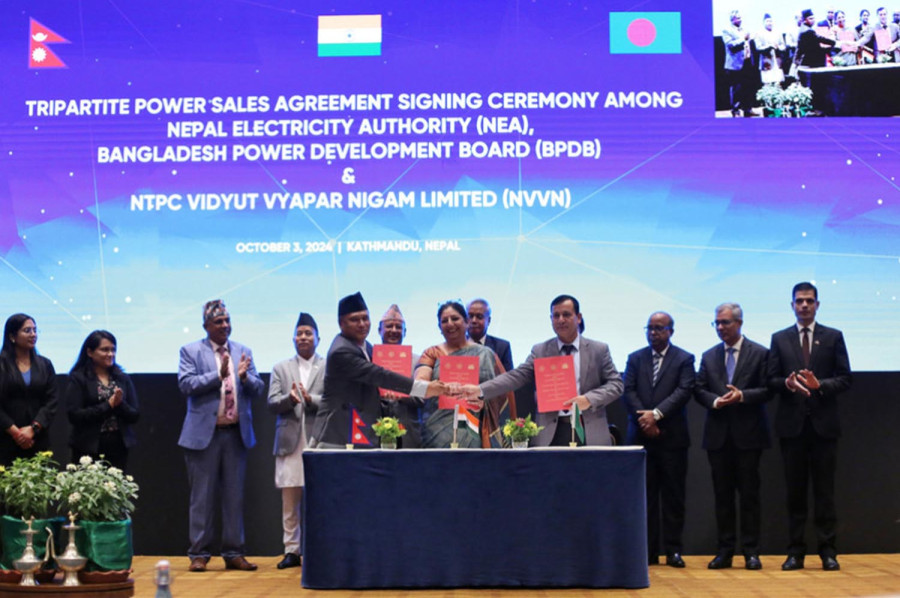
Three hydropower projects have lost their export permits as Nepal seeks to sell surplus monsoon electricity while relying on India for winter supplies. Nepal, India and Bangladesh sign a trilateral power trade agreement in this file photo. Post File Photo
India has renewed approval for Nepal to import up to 654 megawatts of electricity, but has yet to renew export permits for three hydropower projects whose approvals expired while Nepal was selling power to India.
The export permit for the 38.8MW Upper Chameliya Hydropower Project expired on June 30, while those for the 24.25MW Seti River and 10.7MW Upper Tadi Khola projects expired on July 31.
Nepal exports surplus electricity to India and Bangladesh during the monsoon but relies on imports from India in the dry winter months, when hydropower generation falls.
India’s Ministry of Power said on Monday that it had approved electricity imports by Nepal’s power utility, the Nepal Electricity Authority, for 18 hours a day, from midnight to 6pm, from September 13 through December 31.
But the recent Bhotekoshi floods have caused a power shortfall of 350MW to 400MW, and it remains uncertain when the damaged plants will be restored. India has also not renewed permits for the three projects that were already exporting electricity.
Nepal is currently exporting an average of about 600MW to India each day, according to the Nepal Electricity Authority.
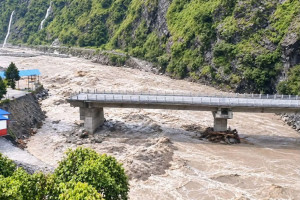
The situation has been further complicated by floods in the Bhotekoshi River, which damaged the Trishuli and Chilime hydropower projects that had been approved to export electricity to India and Bangladesh. Exports to Bangladesh have been halted for nearly a month.
The authority has also sought India’s approval to sell electricity from the 9.94MW Kabeli B-1 and 82MW Solu Khola projects to Bangladesh. Both have approval to sell power in India’s Day-Ahead Market and Real-Time Market, but India has yet to approve their use for exports to Bangladesh, said Dhirghayu Kumar Shrestha, acting managing director of the authority.
“We have sent the name of another project for approval to export electricity to Bangladesh, but we have not received approval yet,” Shrestha said. “We have also asked India to renew the permits for projects whose export approvals have expired, but we have not received them yet.”
The 14.1MW Devighat Hydropower Project also had approval to export electricity to India but was damaged by the Bhotekoshi floods. The authority has sought permission to sell power from the Lower Modi project in the bilateral market as a replacement. Lower Modi already has approval to sell electricity through the Indian Energy Exchange, but India has yet to approve its sale in the bilateral market.
An authority source said officials check with their Indian counterparts about the approval every day but are repeatedly told that the process is “underway”.
Nepal must renew export approvals for authorised hydropower projects every year, while India must also extend permission for electricity imports. The arrangement leaves Nepal dependent on Indian policy for both buying and selling power.
The restrictions come as floods have already shut down 431.1MW of generating capacity during the monsoon, when Nepal normally has surplus electricity to sell. Another 134.85MW that Nepal is authorised to export to India and Bangladesh remains unsold because the required approvals have not been granted.
Nepal has so far secured approval to export about 1,200MW generated by 37 hydropower projects to India and Bangladesh.
The authority trades electricity through the Indian Energy Exchange’s Day-Ahead Market, selling surplus monsoon power and buying electricity when domestic generation falls during the dry season.
Nepal can also trade through India’s Real-Time Market, allowing it to buy or sell electricity at short notice, typically with about an hour’s notice. The mechanism helps the authority respond to sudden changes in generation or demand. Nepal also uses India’s transmission network to send electricity to Bangladesh.
Although India has allowed Nepal to continue importing electricity while it is still exporting power, approval for the dry season remains uncertain, said Rajan Dhakal, spokesperson for the authority.
“We need electricity in the winter months. We will continue exporting until December, and we will need imports after that,” Dhakal said. “India has told us it will review the matter later. We are still exporting around 600MW a day.”
India has also not allowed Nepal to import electricity during the evening peak, when demand is highest in the dry season. Nepal is currently authorised to import electricity only until 6pm.




 12.97°C Kathmandu