



 17.47°C Kathmandu

Sat, Oct 31, 2026
Money
Nepse rebounds after Dashain as trading picks up
The benchmark index gains 2.13 percent to 2,690.15, while weekly turnover jumps 53 percent to Rs34.39 billion.
bookmark![]()
![]()
Pritam Bhattarai
Published at : October 31, 2026
Updated at : October 31, 2026 14:44
Kathmandu
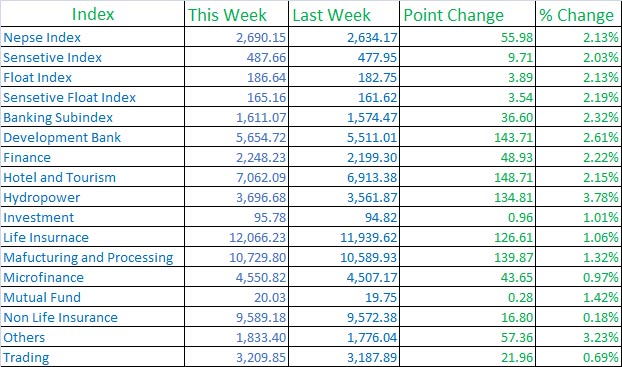
Nepal’s stock market returned from the Dashain holiday with renewed buying interest. Gains across all major sectors lifted the Nepal Stock Exchange (Nepse) index by 55.98 points, or 2.13 percent, to 2,690.15 during the October 26-30 trading week, as trading volumes also increased.
Weekly turnover jumped 52.64 percent to Rs34.39 billion from Rs22.53 billion in the preceding trading week, suggesting that the rally was accompanied by increased market participation. Average daily turnover reached Rs6.88 billion.
Market capitalisation expanded by Rs100 billion to Rs4.63 trillion from Rs4.53 trillion a week earlier. The Sensitive Index, which tracks Class A stocks, gained 2.03 percent to 487.66, while the Float and Sensitive Float indices rose 2.13 percent and 2.19 percent respectively.
The strong opening after the festive break has revived optimism, but questions remain over whether returning liquidity and buying interest can sustain the rally in the absence of stronger economic and corporate fundamentals.
Hydropower leads gains, banks attract trading
Hydropower was the week's best-performing sector, with its sub-index rising 3.78 percent to 3,696.68. The Others sub-index gained 3.23 percent, followed by development banks at 2.61 percent and commercial banks at 2.32 percent.
At the other end, non-life insurance recorded the smallest gain, at just 0.18 percent. Microfinance rose 0.97 percent and life insurance 1.06 percent, both underperforming the broader market.
Investor sentiment towards non-life insurers has been affected by expectations that flood and landslide claims will weaken their financial results and leave little room for dividend distribution this year. Microfinance companies, meanwhile, are facing rising non-performing loans, which have further weakened their financial performance. Many are therefore unlikely to distribute dividends this year.
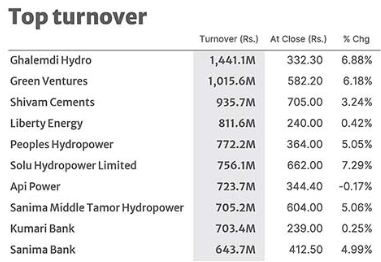
The figures reveal different patterns of market interest. Hydropower stocks led in price appreciation, while commercial banks attracted substantial trading volumes, indicating continued interest in larger and more liquid companies.
Ghalemdi Hydro topped both turnover and volume charts, with Rs1.44 billion worth of shares traded across 4.39 million units. Green Ventures followed with Rs1.01 billion in turnover, while Shivam Cements recorded Rs935.7 million.
Commercial banks also featured prominently by volume. Kumari Bank recorded 2.93 million shares traded, followed by Nepal Investment Mega Bank with 2.48 million, Laxmi Sunrise Bank with 2.14 million and Global IME Bank with 1.81 million.
Beni Hydropower Project was the week's biggest gainer, surging 101.05 percent to Rs709.70. Mathillo Mailun Khola Hydropower rose 14.51 percent to Rs393.90, while Lumbini Bikas Bank gained 13.31 percent to Rs550.
Chirkhwa Hydropower was the biggest loser, shedding 15.15 percent to Rs493. Unilever Nepal fell 3.91 percent to Rs48,001, while Bottlers Nepal (Balaju) declined 3 percent to Rs14,186.20.
The sharp gains in some hydropower shares, alongside substantial trading in smaller companies, suggest that speculative activity remains part of the rally. High trading volumes, however, do not establish whether the buying came from institutional or retail investors.
Liquidity lifts sentiment, but fundamentals remain weak
Market analyst Manish Aryal said the simultaneous rise in the index and trading volume indicated improving investor sentiment. He attributed the higher turnover during Dashain and the period between Dashain and Tihar partly to institutional investors entering the market.
According to Aryal, these investors appear to be accumulating fundamentally stronger companies, particularly commercial banks and selected hydropower stocks. He also cited aggressive margin lending by brokers as a factor supporting the rally.
Expectations of stronger first-quarter results and a return of liquidity after Dashain have also revived interest in banking stocks. However, rising share prices may reflect increased market liquidity and investor borrowing rather than any improvement in companies’ underlying financial performance.
Aryal expects retail participation to increase after Tihar, providing further momentum. He sees the index approaching 3,000 during the current upward movement, although he expects periodic corrections as investors book profits.
Market analyst Ajay Singh Thapa offered a more cautious assessment, describing the rise as a routine rebound after the market had fallen to a low level. He said corporate financial performance had improved but remained weak, while the broader economy was also underperforming.
Thapa expects the index to gain around another 200 points before declining, arguing that current economic and corporate fundamentals do not provide enough support for a sustained rally.
Technical outlook points to further gains, but correction risk remains
Technical indicators point to strengthening short-term momentum. The Nepse index has moved above its 20-day and 50-day exponential moving averages, which stood around 2,621-2,627 points, suggesting an improvement in the near-term trend.
The index faces immediate resistance around 2,689-2,690 points, close to its current level. A sustained break above this range could pave the way for further gains.
On the downside, the 2,621-2,627 range is the immediate support zone, supported by the moving averages and recent consolidation levels. If the index falls below this range, the next support is around 2,580 points.
The Relative Strength Index stood at 69.54, approaching the commonly used overbought threshold of 70. This indicates strong buying momentum but also raises the possibility of short-term consolidation or profit-taking.
The rise in turnover supports the rally, but the market's ability to hold above immediate support and break through resistance will help determine whether the gains can be sustained.





Most Read from Money

Nepal seeks recognition for six more 8,000-metre peaks
Dashain shopping picks up, but livestock sales lag in Chitwan

Kathmandu Valley to consume 5.18 million flower garlands this Tihar
Nepal plans temporary bridges to reopen flood-hit Rasuwagadhi border crossing

Banks and government agencies take websites offline over PHP security flaws
Editor's Picks

The police chief who objects, delays—and ultimately complies

Who is Inam Sapkota, the man linked to Cholendra Rana and top police officials?

Ani Choying’s new role brings old controversies to the fore

Xtreme is betting on Nepali sport. It’s helping both — for now

UN’s historic loss and damage allocation falls short of Nepal’s needs
E-PAPER | October 31, 2026

×