PM Shah floated the idea of Nepal-India-China cooperation on climate. Why is the government slow to reach out to the neighbours?
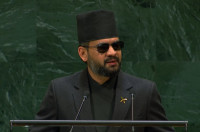
Nepal’s foreign and environment ministries are working on a proposal to be sent to the two neighbours. Beijing has signalled openness to sharing climate data while Delhi has signed up to a regional mechanism. Prime Minister Balendra Shah addresses the UN General Assembly in New York in September. Photo: Prime Minister’s Secretariat
A month after Prime Minister Balendra Shah proposed establishing a Himalayan Climate Resilience Mechanism (HCRM) involving Nepal, India and China, the initiative has made little diplomatic headway, with the two ministries concerned still working on a concept note and no formal proposal submitted yet to either neighbour.
The Ministry of Foreign Affairs and the Ministry of Agriculture, Forest and Environment are consulting relevant agencies to develop the proposal, but the initiative has yet to move beyond the preparatory stage.
Shah floated the proposal in his address to the 81st session of the United Nations General Assembly in New York on September 24. The idea received a positive response from several quarters, albeit with cautious optimism given the volatile and unpredictable relationship between India and China. Nepal, meanwhile, has comparatively fewer bilateral issues with its immediate neighbours.
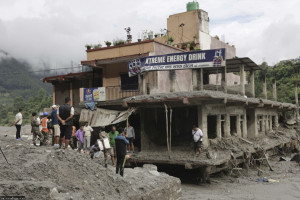
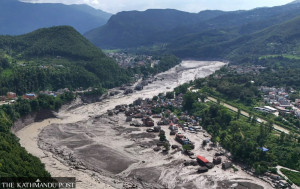
The proposal followed the devastating Bhotekoshi flood in the Nepal-Tibet region on August 26, which killed 1,550 people, with more than 5,500 others still unaccounted for. The disaster also caused property damage estimated by the government at $4.7 billion.
The Hindu Kush Himalaya is home to nearly two billion people, Shah said while presenting the idea of the HCRM. The mountain range provides water, sustains ecosystems and agriculture, and supports livelihoods far beyond Nepal.
“The Himalayas are not peripheral to the planet. They are part of the planet's life-support system. That is why, as an urgent first step, we propose that we establish a Himalayan Climate Resilience Mechanism, led by Nepal, India and China. Through this mechanism, let us share satellite data and expertise. Let us monitor dangerous glacial lakes. Let us strengthen joint early-warning systems,” Shah said in his address, which received considerable attention and was widely praised as one of the most powerful speeches delivered by a Nepali prime minister in recent years.
He also called for cross-border coordination and assistance during disasters, proposing that the Himalayas become a laboratory for international cooperation rather than a frontier marked by fragmented information.
However, nearly a month after the proposal was formally presented at the General Assembly, there has been little progress in bilateral engagement with India and China.
A senior foreign ministry official said that the Ministry of Agriculture, Forest and Environment was preparing a concept note and consulting relevant agencies on how to establish the mechanism.
“We have received correspondence just this week from the foreign ministry. We will consult with various agencies and will get back to them,” a joint secretary at the environment ministry told the Post. The foreign ministry, referring to the prime minister’s statement in New York, had asked the ministry to prepare a concept note, the official added.
The environment ministry has been asked to develop a proposal for establishing the mechanism and seek technical inputs.
New Delhi has not officially commented on Nepal's proposal. However, two former Indian diplomats familiar with the thinking within India's establishment told the Post that Delhi was positive about establishing a mechanism focused on sharing information, particularly for early-warning systems.
Despite the initial optimism, Nepal has yet to formally approach either New Delhi or Beijing with a detailed proposal for establishing the mechanism.
“We do not know whether the idea was discussed with India and China before the prime minister's address at the UNGA. It could come up during Prime Minister Shah's upcoming visit to India,” said a former Indian ambassador to Kathmandu.
A Nepali diplomat questioned how any of the neighbours could be expected to respond formally without first receiving an official proposal from Kathmandu.
“The prime minister made the proposal during his statement at the United Nations General Assembly, which is a multilateral forum. On the basis of that statement, Nepal needs to formally write to both Delhi and Beijing, explaining the rationale, objectives and other details of the proposed mechanism,” the diplomat said. “Only then can we receive official feedback. Without submitting a formal proposal, how can we ask for their comments and reactions?”
China, meanwhile, has expressed a general willingness to cooperate on climate change and disaster management, without explicitly endorsing the proposed trilateral mechanism.
On September 2, Chinese foreign ministry spokesperson Guo Jiakun said at a press conference in Beijing: “Climate change is a common challenge facing all humanity. No country can stay immune from such risks. China will continue to work with the international community to strengthen exchanges and cooperation and effectively prevent and mitigate the negative impact of climate change.”
Former chief secretary and foreign secretary Shanker Das Bairagi said he knows little about the proposed mechanism's operational framework, structure, objectives or other practical details.
“Now the onus is on us to determine what kind of mechanism we need to establish. Accordingly, we have to make a proposal to India and China. However, I do not think there has been much inter-agency coordination and cooperation in this regard,” Bairagi said. “This is an issue related to access to water, lives and livelihoods.”
Bairagi also warned that the mechanism could trigger a geopolitical debate because its scope includes Tibet. China considers Tibet a sensitive region and places restrictions on access for foreign scientists, researchers and experts conducting geological studies.
India, on the other hand, could be more receptive to the idea, Bairagi said, noting that New Delhi had already agreed to establish a BIMSTEC Himalayan Science Council.
In 2017, a meeting of the BIMSTEC expert group on the security implications of ecological and environmental degradation in the Himalayan region decided to establish the council to comprehensively study the health of the Himalayan ecosystem and promote scientific cooperation among institutions in member states.
The meeting also decided to establish a BIMSTEC expert group to prepare a concept paper and plan of action. Experts subsequently met in 2021 and 2023, but the council has yet to be institutionalised.
An official at the Ministry of Agriculture, Forest and Environment, where the idea of establishing the HCRM is being considered, said India and China had demonstrated a degree of convergence on climate change issues at international forums despite their differences on other matters. This, the official said, could provide an opportunity for greater cooperation under Nepal's proposal.
Indian media outlets, including The Indian Express, have highlighted the proposal and its implications for India's regional climate diplomacy. India has experience sharing hydrological information with China and providing disaster relief to Nepal. However, sharing real-time river-flow data, satellite imagery and glacier-monitoring information could raise strategic and national-security concerns, particularly amid unresolved border tensions between India and China.
On September 2, the Chinese foreign ministry said Beijing had shared satellite imagery, hydrological information and early-warning information with Nepal following the August disaster. It also expressed its willingness to continue cooperating with Nepal on disaster prevention and mitigation.
The statement indicated China's support for bilateral disaster cooperation with Nepal, but it did not amount to a formal acceptance of the proposed three-country mechanism.
A senior foreign ministry official told the Post that the proposal might need to be developed by the Ministry of Agriculture, Forest and Environment, rather than the foreign ministry taking the lead.
A climate change expert said the mechanism would need a clear framework for funding, data sharing, scientific monitoring and emergency coordination, particularly given the geopolitical sensitivities surrounding access to information on shared rivers and glaciers.
A senior foreign ministry official said the environment ministry was preparing a proposal in consultation with relevant stakeholders.
“Some internal discussions have already been held. The Ministry of Forests and Environment has taken the lead. Once the proposal is ready, it will be forwarded to both neighbours for their consideration and consent,” the official said.
Anil Giri is a Chief Sub Editor covering diplomacy, international relations and national politics for The Kathmandu Post. Giri has been working as a journalist for more than two decades, contributing to numerous national and international media outlets.




 14.37°C Kathmandu