No bridge, no market: Vegetables rot in fields after Bhotekoshi floods
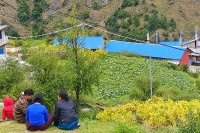
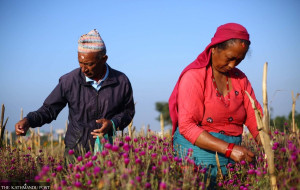
Farmers in Rasuwa’s Aamachhodingmo struggle to sell their produce as damaged roads, costly transport and the lack of a bridge at Syafrubesi leave millions of rupees’ worth of vegetables stranded. Post Photo
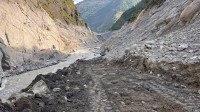
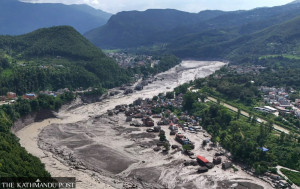
Farmers in Aamachhodingmo Rural Municipality of Rasuwa district are struggling to get their vegetables to market more than two months after the August 26 Bhotekoshi floods washed away roads and bridges. With no bridge at Syafrubesi, vegetables worth tens of millions of rupees are piling up in fields, with some already rotting. Farmers say transport costs have become so high that even selling small quantities is often unprofitable.
The loss of road links has disrupted the supply chain. Of the eight trucks stranded in the area after the floods, some have been brought back into operation to carry limited quantities of vegetables to Syafrubesi. But from there, the produce must be carried by hand across the Bhotekoshi river before it can be loaded onto vehicles again. Farmers say this makes it difficult to transport their entire harvest and are waiting for a Bailey bridge to be built at Syafrubesi.
High truck fares within Aamachhodingmo, the need to carry vegetables across the river, and the additional cost of transporting them by road from the other side of Syafrubesi to Kathmandu and Chitwan have compounded farmers’ difficulties. The produce must also be loaded and unloaded twice, while poor road conditions add to the expense. Farmers say the prices they receive are often insufficient to cover these costs.
Wards 2, 3, 4 and 5 of Aamachhodingmo exported vegetables worth around Rs40 million last year. With subsidies from the rural municipality, farmers had doubled the area under vegetable cultivation this year.
Kasang Tamang, a vegetable farmer and trader from Galtang in Ward 3, said around 25 percent of the vegetables in farmers’ fields had already rotted. He bought 250 sacks, or about 10,000 kilogrammes, of cabbage from local farmers and transported them to Kathmandu, but failed to secure a price that covered his costs.
“I tried transporting vegetables by truck from the village to Syafrubesi. From there, I had to hire people to carry them across the Bhotekoshi before loading them onto another vehicle to Kathmandu. The transport costs were enormous. Freight alone came to Rs16 per kg by the time the vegetables reached Kathmandu,” he said. “Even there, I could get only Rs30 per kg at most.”
Farmers in Aamachhodingmo are now selling cabbage for as little as Rs9 per kg.
“I bought vegetables from the village at Rs9 per kg. When I tried taking them to Kathmandu as a trial, I incurred losses mainly because of the high transport costs,” Tamang said. “Traders at Kalimati market in Kathmandu did not offer a fair price, saying the vegetables were not fresh.”
He said it takes three to four days to transport vegetables from Galtang to Kathmandu, increasing the risk of spoilage.
Although Galtang is just 16 kilometres from Syafrubesi, truck operators charge Rs15,000 for a single trip, Tamang said.
“This is an extremely high fare. Previously, we could have transported vegetables all the way to Kathmandu or Chitwan for that amount. The cost has soared because the floods washed away roads and bridges,” he said.
Chandika Tamang, vice-chair of Aamachhodingmo Rural Municipality, said farmers had started feeding unsold vegetables to their cattle because they could not find buyers.
“All the vegetables should have been sold by this time of the year. Around 25 percent have already rotted, and the rest are also at risk. If they cannot be sold within the next 20 to 25 days, the entire harvest will be lost,” she said.
Amar Tamang, a farmer from Galtang who had planned to sell vegetables worth around Rs3 million this year, said farmers were struggling even to recover their investment because of poor prices.
“Without a bridge at Syafrubesi, we cannot sell cabbage even at Rs8 per kg. We would rather sell it at whatever price we can get than watch it rot in the fields, but there are no buyers,” he said. “Temperatures in this cold region are also causing the vegetables to deteriorate.”
The rural municipality’s vice-chair said farmers would face even greater losses if a bridge was not built at Syafrubesi within three weeks.
“Vegetable farming is the main source of income for people here. If they cannot sell their produce, they will face serious financial hardship,” she said, calling for the swift construction of a Bailey bridge at Syafrubesi. She added that although local roads had been repaired and vehicles within the municipality brought back into operation, the area remained disconnected from the main road network.
With vegetables worth tens of millions of rupees ready for sale in four wards but at risk of rotting, the World Food Programme stepped in to help with transportation. In the first phase, it used helicopters to transport 8,000 kg of vegetables grown by farmers in Galtang to Bidur in Nuwakot district, where they could be sold. However, the agency has not provided further transport assistance since then.
The WFP said it had supported the transportation from Galtang to Bidur on October 9 as a pilot initiative. The programme was intended to connect farmers with buyers and ensure the availability of nutritious food in local markets, said Riaz Lodhi, the WFP’s country director in Nepal.




 17.91°C Kathmandu