The police chief who objects, delays—and ultimately complies
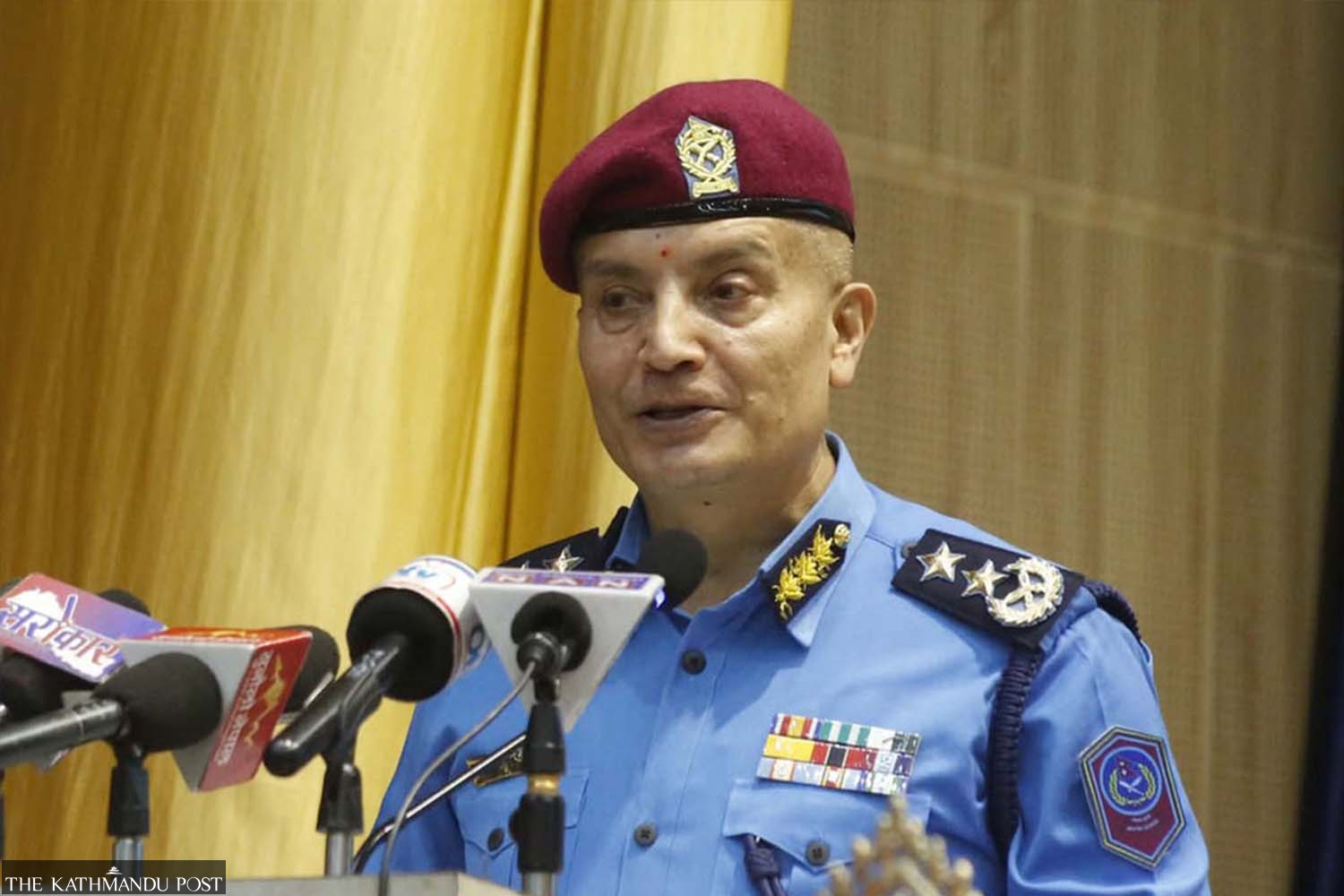
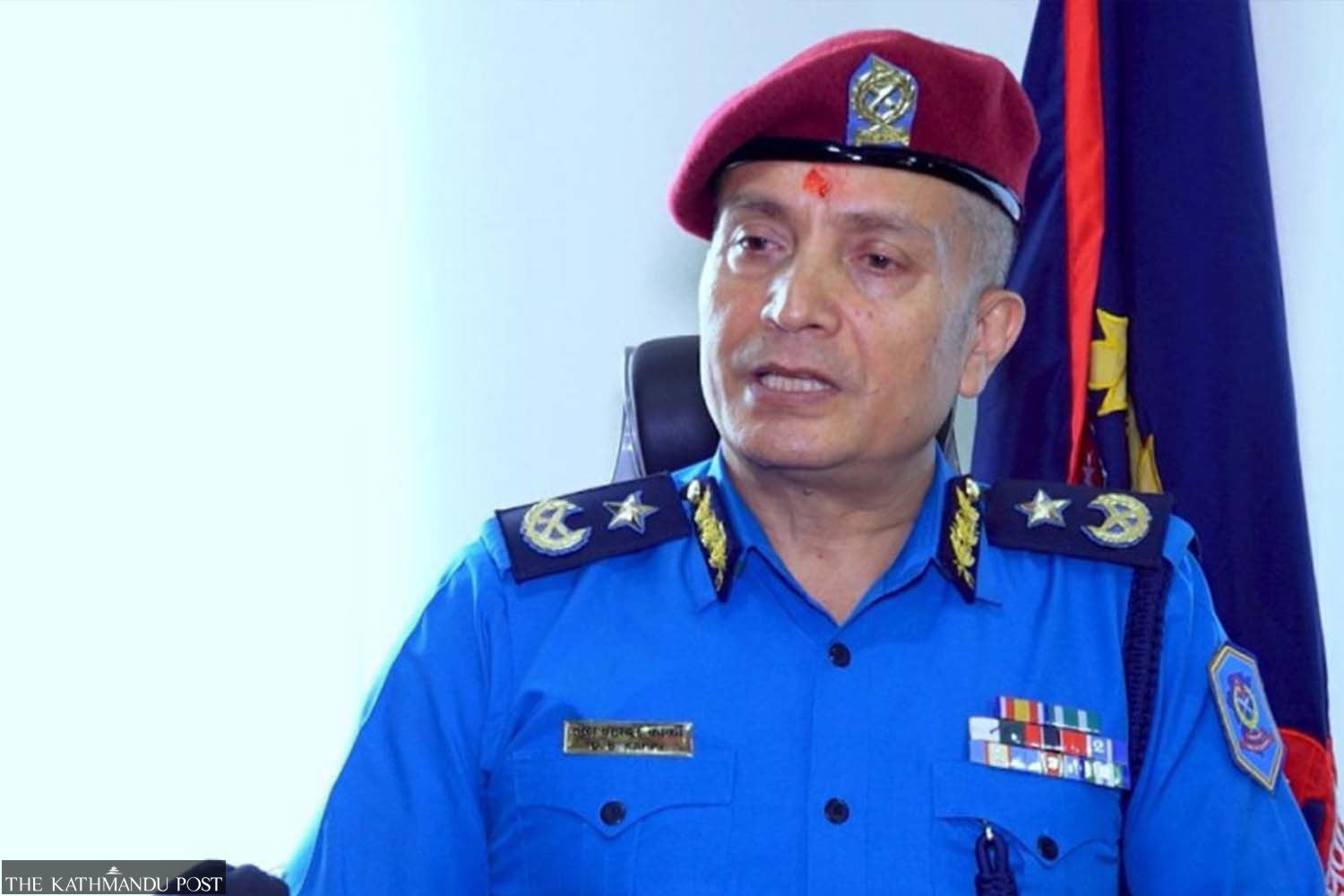
IGP Dan Bahadur Karki has sought to defend the police’s operational autonomy, but his attempts to hold the line have often ended in accommodation. Karki’s challenge is whether he can preserve the force’s professional judgment when pressure comes from multiple centres of political power. Post file photo
When IGP Dan Bahadur Karki attended a meeting of the Public Accounts Committee last month, he was not in the mood to mince his words. After patiently listening to members of parliament for a couple of hours, he finally broke his silence.
“Thirteen honourable members spoke, and frankly, it felt like sitting next to someone who’d just had a bath in milk,” he said, invoking a familiar Nepali expression used sarcastically for those who present themselves as completely honest and morally spotless. “I came here to answer questions on the substance of the matter, not to be dressed down.”
For an incumbent chief of Nepal Police, this was uncharacteristically blunt. In the past, security chiefs who appeared before parliamentary committees to answer questions tended to stay calm—they’d respond to the substance, clarify and leave. But that day, IGP Karki didn’t hesitate to voice his displeasure, going so far as to lecture the committee on parliamentary decorum. “Even by the standards of parliamentary practice, this didn’t sit well with me,” he said.
After 28 years in service, Karki is in uncharted territory. He has to tread carefully to strike a balance between the police’s professional judgment and the direction from the new political leadership. For someone who has moved up the ranks within the Nepal Police to become its top officer, that balancing act is not new. What is new is the extent to which he has to go to preserve the force’s operational autonomy amid a changed political landscape. After all, directives these days come not just from traditional command structures but also directly from political intermediaries. Karki’s legacy, and the future of Nepal Police, will depend on how well he can navigate the political pressures while protecting the institution’s integrity.
At the meeting that day, Karki’s frustration was directed at Khagendra Sunar, a lawmaker from the ruling Rastriya Swatantra Party. Sunar had accused the police of irregularities in the procurement of term-police uniforms. He had done so in a tone that treated the accusation as already proven. “If there’s corruption in buying tear gas—then who’s supposed to get hit with that tear gas?” Sunar said, implying that the police should be at the receiving end of punishment. Sunar further demanded that those implicated, including IGP Karki, should be immediately removed from their posts, suspended and investigated.
Karki’s troubles weren’t confined to the allegations of irregularities in the procurement of uniforms for term police recruited for the election held on March 5. He was also accused of failing to secure his own property, having more than Rs30 million stolen from his own home, and of subjecting those allegedly involved to torture at a special bureau. Police have not made public the findings of that inquiry.
In response, Karki said he was willing to take the lesson if there was one to learn. “Policing is a thankless job, hoping for respect in it is a mistake in itself,” he said. “But there is a baseline respect due to any citizen.”
The exchange drew protest from former police associations, and Home Minister Sudan Gurung—whose own ministry has repeatedly overridden Karki—came to his defence. “Just because an accusation can be leveled against someone doesn’t mean their character can be assassinated,” Gurung said four days later, appearing before the Law Committee. “This was not right.”
Post File Photo
Karki’s own manner of speaking also drew questions in the committee. When he said “actually, it seems easier to just stage a revolution,” former Maoist leader Barshaman Pun immediately objected. Karki tried to walk it back, saying that wasn’t what he meant.
Senior police officers say Karki’s anger that day was not really about Sunar. It was about a bind that has tightened over recent months: whether to carry out political leadership’s directives, or give priority to the police’s own professional judgment.
“The truth is the police have long felt looked down upon by political leadership,” a Deputy Inspector General of Nepal Police told Kantipur on the condition of anonymity. “We thought that with a new government, the police would be free of political interference. But in practice, things are, in some ways, harder for the police than before.”
What has changed is where the pressure lands. The routine trade in transfers and promotions has largely eased, officials say. Instead, police leadership is pushed on matters that should fall to investigating officers—from reopening old case files to decisions on individual arrests. And the Home Ministry is not the only one calling the shots.
“Even personal secretaries employed at the Prime Minister’s Office and other ministries try to direct the police around,” a Senior Superintendent of Police told Kantipur. “It’s not that this pressure never existed before. But in the past, those giving direction at least understood how the police actually worked… Now directions come to the police even from people who don’t know whether a matter falls within police jurisdiction at all.”
Officials say this kind of indiscriminate direction to police from all quarters was most apparent during the campaign to clear informal settlements in the Valley, a special priority for Prime Minister Balendra Shah. James Karki—the private secretary to Home Minister Sudan Gurung, who had then resigned from his post amid calls for investigation into his wealth—had himself told the media that he was giving orders to the police.
Even as Gurung was under investigation, James Karki continued working with the Home Ministry’s bureaucratic apparatus and reporting to the ministry regularly. When flooding hit an informal settlement in Kirtipur, Ojaswi Thapa, acting on behalf of the Prime Minister’s Office, arrived to direct the police—a move that drew protest even from Gen Z activists present.
The exception is when the government has a stake in a particular investigation. At the end of the last fiscal year, political leadership directed IGP Karki to remove, all at once, 408 police personnel assigned to the Commission for the Investigation of Abuse of Authority. Such transfers had traditionally been coordinated with the commission, because abrupt changes can disrupt long-running investigations.
Post File Photo
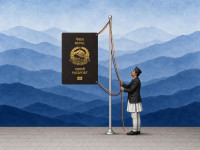
The government, unhappy with the investigation into the passport case, ordered everyone moved at once. Karki warned this could have a negative effect and suggested using the regular transfer process, according to sources. But the Prime Minister’s Office had an interest in the matter.
In the end, police headquarters—citing personnel who had exceeded a year in the post—removed 18 police officers at once on July 6, including DIG Shekhar Khanal, who also headed the CIAA’s police unit.
Several police officials say they have experienced undue political interference even in purely criminal investigations. After the election on March 5, the very first Cabinet meeting under Prime Minister Balendra Shah decided to implement the report of the Gauri Bahadur Karki Commission—and police leadership had to grapple with the interference immediately.
After the Cabinet made its decision on March 27, Home Minister Sudan Gurung summoned IGP Karki to the ministry and immediately ordered the arrest of former Prime Minister KP Sharma Oli and Ramesh Lekhak, who had served as home minister in Oli’s Cabinet. Karki was thrown off by the order, which came the same evening Gurung took office. According to a senior ministry official, Karki had argued that arresting the leadership of a national party with a huge base required careful advance assessment of the challenges that might follow the next day, and that studying the report itself would take time.
Home Minister Gurung, however, remained insistent that the arrests be carried out even if it meant staying up all night. Law Ministry Secretary Parashwar Dhungana was summoned there that same night. When told that studying the report would take time, Gurung reportedly said he’d just “put the report into ChatGPT” and get the details that way. “That was something that had never happened before,” said one police official present at the meeting. “After that, it became clear there was nothing more that could be said to the IGP.” Karki ultimately insisted he needed a written order from the ministry.
He got it. A letter went to police headquarters that night, passed through the Crime Investigation Department to district police offices in Kathmandu and Bhaktapur, and Oli and Lekhak were arrested in the early hours of March 28. An official at the IGP’s Secretariat said the consequences of such orders would land later, in court.
“Investigations should be allowed to reach their conclusion under the authority of the concerned investigating officer. Otherwise, it can have adverse consequences,” the official said. “That is also one of the reasons why courts have been releasing suspects soon after the police arrest them.”
Police officers have long wanted “operational autonomy” in their work. IGP Karki appears to have tried to hold his ground at the start of several such episodes. But it doesn’t appear that his position has actually changed how decisions were ultimately made. “It’s not that the home minister or other levels of political leadership should interfere in criminal investigations or law-and-order matters,” said former Additional IGP Bhim Prasad Dhakal, on the relationship between political and police leadership. “Rather, they should make policy-level decisions on important security matters and let [police] work independently within that framework.”
IGP Karki’s initial position also differed on the matter of arresting journalist Kishor Shrestha. Amid pressure to arrest him over news coverage related to Home Minister Gurung, police leadership had initially advised against rushing to make the arrest, suggesting the matter be resolved instead through the Press Council or a defamation case. However, after Gurung became home minister for a second time, Shrestha was arrested on August 12.
Police accused Shrestha of violating the Privacy Act, 2075, for publicising an intimate photograph of a lawmaker and a woman—an image Shrestha says the woman had already posted on her Facebook page. Police then raided his home at night repeatedly and seized his electronic devices, raising questions about the motive behind the case.
IGP Karki found himself in a similarly difficult position when an order came from the Prime Minister’s Office to arrest a sitting minister—the Industry, Commerce and Supplies Minister Gauri Kumari Yadav—on allegations that she had arbitrarily cut petroleum prices and leaked related information.
A team from the Valley Crime Investigation Office had already been mobilised to make the arrest. But after the matter reached party chair Rabi Lamichhane, police were directed to stand down.
Gurung’s decision to push forward the investigation into the palace killings case on June 9 also caught police officials off guard. According to officials, the decision was made without any coordination with police beforehand. Only after the decision was made did Gurung ask IGP Karki how the investigation could be moved forward.
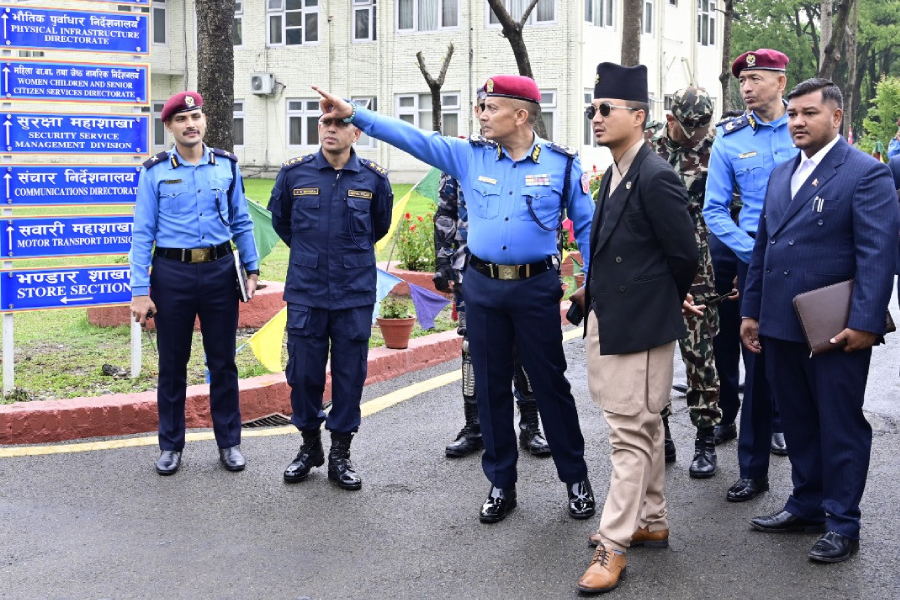
IGP Dan Bahadur Karki with Home Minister Sudan Gurung.
At that point, Karki explained that since a fact-finding commission had already investigated the matter, police could not, under current circumstances, advance the investigation further.
***
Dan Bahadur Karki was born in Ghamir village in Gulmi on July 30, 1972, into a family that ran a small clothing shop.
Karki had a rebellious streak even before joining the police service.
“In those days, it was customary for the eldest son in a family to choose the clothes, and everyone else wore what he picked,” he told Kantipur before becoming IGP. “I was the second son, and I used to ask, ‘Why should only the eldest get to choose?’”
His family wanted him to study in the village itself. But Karki was eager to study in the city. While still in Grade 9, he left home and headed for Kathmandu without his family’s consent.
All he had was a torn bag, which a nearby tailor, Bhote Damai, had stitched for him.
Years later, as a deputy inspector general heading Lumbini Province Police, Karki turned up unannounced in the village on Damai's 84th birthday. He gave the old tailor Rs20,000 in cash.
When Bhote Damai died on January 14, 2026, Karki paid tribute to him on social media.
“My relationship with Bhote Damai dai was never a formal one, but his contribution to the journey that brought me this far is immeasurable and unforgettable,” he said. “When I left for Kathmandu as a young boy, I carried with me the torn bag he had stitched for me. I can never forget how that small act of kindness played such a significant role in my education and in the journey of my life.”
He was schooled at Lalitpur Secondary School and studied at RR Campus, eventually taking degrees in humanities, education, and law. Because his English was strong, his well-wishers pointed him toward the foreign service, and he was preparing for the Public Service Commission with that in mind. But a friend studying for the police examinations talked him out of it—and paid the fee on his application form.
Karki joined the police service on March 31, 1998, and was soon deployed to conflict-affected areas.
“As soon as we finished training, we were asked who was willing to go to the conflict-affected area. Nobody raised their hand,” Karki said. “I felt ashamed, so I raised my hand and said I would go.”
He then headed alone towards Bhalubang in Dang during the state of emergency, carrying a pistol and a baton in his bag.
He was later deployed to Rolpa, a district that was then a stronghold of the Maoist rebels.
Karki had entered the police force as an inspector. As SSP, he headed the district police office in Kathmandu, where a case involving Nepali youths trafficked to the US posing as Bhutanese refugees was taken to the courts under his command. As DIG, he served as central police spokesperson and headed Lumbini Province police. After the unrest of September 8, the government sent him to command Valley police, and on November 10, 2025, the government led by Sushila Karki appointed him IGP.
While with the Kathmandu police, Karki paraded Sanu Bhai, alias Yuvraj Gurung—known as a ‘gundagiri’ figure, a gang leader—through Thamel in handcuffs. The point, in Karki’s view, was to break a gang leader’s standing in the neighbourhood he ruled by fear. It earned him a reputation as a hard-edged officer.
Karki is also a lyricist. While demoralised following the Gen Z movement, he wrote a song with the line ‘Mother, I have risen from the ashes.’ Before that, he had also written a song with the line ‘Every village, every town, Nepal Police.’ At the ceremony held to pin on his IGP insignia on November 13, he choked up. He began, “You are the first to attain martyrdom in service of the nation and citizens…” then stopped mid-sentence and reached for a tissue.
When Sudan Gurung, in his first stint as home minister, visited police headquarters on March 30 for an inspection, Karki grew emotional again while describing the police’s problems to him. “I call this police uniform black, more than blue. That black uniform—I just wish it looked better than what a paddy-storehouse watchman wears,” Karki said, and choked up as he finished the line. Home Minister Gurung rose abruptly from his seat, urged others to stand too, and applauded. On that occasion, Gurung also announced plans to open a garment factory in Nepal to supply uniforms to the police. That plan, however, has not moved forward since.
Karki, who appears tough toward criminals and doesn’t back down when the organisation comes under criticism, shows unusual emotion when it comes to the police uniform, his colleagues, and fallen officers. “He teared up twice; some made a joke of it, but what he expressed reflects problems the police have carried, bottled up, for a long time,” said Hemanta Malla Thakuri, a former DIG of Nepal Police.
Ultimately, bridging his deep personal investment in the force with the harsh realities of governance reveals the core dilemma he faces. That may be Karki’s balancing act in its starkest form: he can object, he can delay, he can ask for the order in writing. But when the pressure comes from above, the police uniform still has to move. And that is where Karki’s attempt to hold the line has repeatedly ended—in accommodation rather than outright defiance.




 13.44°C Kathmandu