Rinku Thakur turned her fight against child marriage into a mission
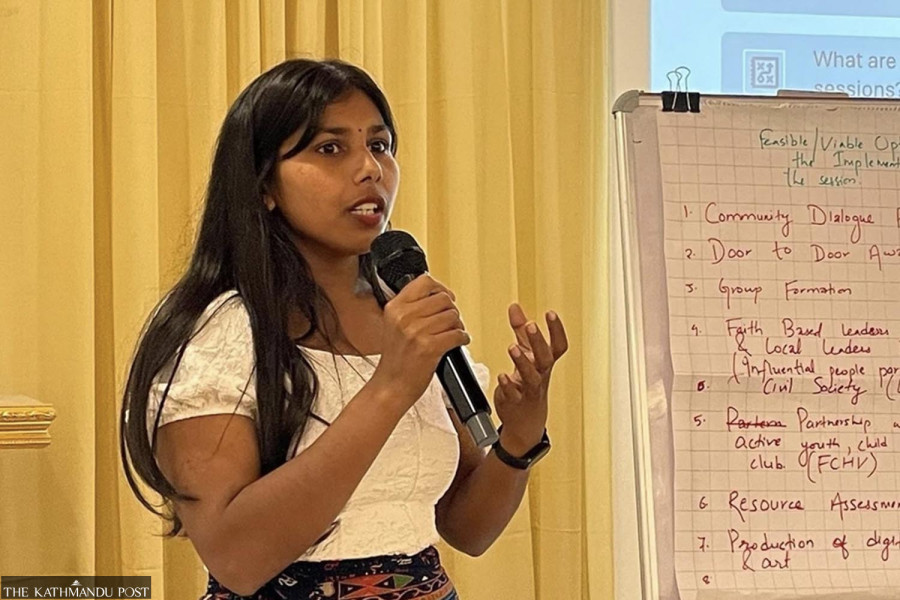
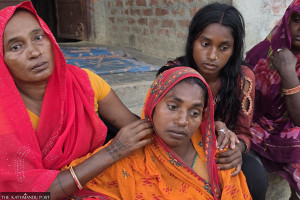
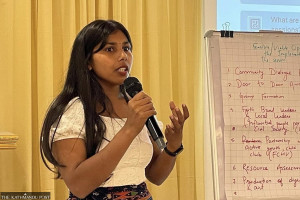
After refusing an arranged marriage at 17 and leaving home, the Birgunj woman has spent over a decade raising awareness about child marriage, dowry, and women’s rights across Madhesh villages. Rinku Thakur Post photo
When her family arranged her marriage at the age of 17 against her wishes, Rinku Thakur made a decision that would redefine the course of her life. Defying family and societal pressure, she rejected the wedding and left her home in Birgunj.
Now 28, Thakur travels to remote villages in Madhesh province, raising awareness among girls and women about child marriage, nutritional health, dowry-related violence, and their legal rights.
Her own experience of resisting a forced marriage has driven her decade-long campaign to protect other girls from the same fate.
In April 2016, Thakur walked away from her family home at Chhapkaiya in ward 1 of Birgunj Metropolitan City. Her parents had arranged her marriage to a young man from Ghorasahan across the border in neighbouring Bihar, India. They had fixed the wedding date and paid Rs130,000 in cash to the groom’s family as a dowry. Despite her repeated pleas that she was underage, did not want to marry, and wished to continue her education, her family insisted on proceeding with the nuptials.
“Even today, remembering that afternoon brings a heavy feeling to my heart, but I know the decision I took for my future was completely right,” said Thakur. “It proved to be a necessary lesson for society as well. Today, I am dedicating my efforts to ensuring that no other girl is forced to endure the same trauma.”
For the past three months, Thakur has been working in Katahariya Municipality in Rautahat district with Protection Nepal, a non-governmental organisation. As part of a community nutrition project, she visits villages and schools to assess women's health and nutritional status. She also raises awareness about the negative impacts of child marriage and the dowry system, encourages girls to speak out against gender-based violence, and conducts community sessions on issues including cybercrime and online harassment targeting young women.
According to Thakur, many girls in rural Madhesh are still married off before they reach adulthood and become mothers at an early age. From what she has seen, child marriage severely restricts a girl's access to formal education, health, economic independence, and overall development. Early pregnancy also puts both mothers and babies at serious health risks and this makes education on reproductive health and nutrition vital, she said.
“In the villages, the practice of marrying off daughters before they reach the legal age of 20 has not been eliminated,” Thakur said. “Many parents continue to prioritise social pressure and tradition over their daughters’ aspirations. Parents need to focus on educating their daughters, helping them become self-reliant, and allowing them to make their own decisions. Until child marriage and dowry are eradicated, women in Madhesh will remain vulnerable to severe abuse.”
Official statistics point to the scale of the problem in Madhesh province, where physical violence, dowry demands, and forced marriages are among major factors contributing to mental distress and suicide among women.
Police records show that between the fiscal years 2023-24 and 2024-25, Madhesh province registered 2,531 cases of suicide. Women and girls accounted for over 55 percent of the deaths. Authorities cite domestic abuse, dowry harassment, and child marriage among the underlying causes.
Senior Superintendent of Police Sitaram Rijal, chief of the Rautahat District Police Office, said poverty and illiteracy remain the major reasons for child marriage and dowry-related violence in Madhesh. “Impoverished families struggle to finance their daughters’ weddings, and dowry expectations add immense financial stress. Consequently, poor families often resort to marrying off their daughters early in the hope of reducing dowry demands,” said Rijal. “We are launching targeted district-wide awareness drives to curb these social problems, and plan to involve campaigners like Rinku Thakur in our outreach programmes.”
Hobindra Bogati, who is now a senior superintendent of police, remembers Thakur arriving at the Parsa District Police Office in Birgunj in 2016 seeking protection. He was then a deputy superintendent of police at the office.
“I personally assisted in rescuing Rinku from her home and arranged for Maiti Nepal to provide her shelter,” Bogati recalled. “Seeing that the young girl who rebelled against child marriage 10 years ago is still actively leading social campaigns across the region brings immense satisfaction.”
Leaving her home came at a cost. Thakur faced public scrutiny, familial alienation, and social criticism. She spent nearly a year at Maiti Nepal’s shelter in Birgunj before moving to a private hostel to resume her studies. She eventually earned a bachelor's degree and began working with non-profit organisations on child rights and female empowerment.
Her courage to rebel did not emerge in a vacuum. From the age of 13, Thakur had been an active member of local child clubs in Birgunj and took part in campaigns against child marriage and children’s rights. She also worked as a news presenter for the Birgunj-based Tarai FM, where she learnt more about social issues and gained experience in public speaking.
While staying at the shelter and later at the hostel, Thakur visited schools and villages across Parsa district to share her story and educate young girls. In recent years, she has expanded her work to collaborate directly with local governments, mediating with families planning underage weddings to stop child marriages.
Debaki Nepal, a leading women’s rights activist in Madhesh, said Thakur's decision to resist her marriage had shown parents the importance of respecting their daughters’ choices. “She transformed her personal hardship into a platform for bringing positive social change into the lives of other women,” said Nepal. “Whether discussing the physical impacts of early pregnancy, the financial ruin caused by dowry demands, or legal protections against domestic violence, Rinku’s work in rural Rautahat is exemplary. Activists across the country stand firmly behind individuals like her.”
Women’s nutrition is another focus of Thakur’s current work. In many rural households, women prioritise the nutritional and healthcare needs of male family members before their own. Thakur encourages them to pay attention to their own health, eat balanced diets, and seek reproductive healthcare.
Ajay Prakash, mayor of Katahariya Municipality in Rautahat, praised Thakur’s determination. “Her decision to resist her own child marriage caused immediate familial strain and severe social hardship, but she did not give up her education or her commitment to public service,” said Prakash. “Her willingness to use her own experience to help protect others is inspiring.”
Reflecting on the past, Thakur’s mother Meena Devi admitted that the family had been deeply distressed when her daughter left home, but she now takes pride in her accomplishments. “We have put the painful events of the past behind us,” said Meena Devi. “While we miss her presence at home, she visits us whenever her campaign schedule allows. We only hope that her mission to protect young girls achieves complete success.”




 21.99°C Kathmandu