



 22.73°C Kathmandu
Thu, Oct 22, 2026
National
Fresh royal massacre probe hits roadblock before it begins
Home Minister Gurung’s pledge for a new investigation has made little progress amid questions over evidence, legal authority and the way forward.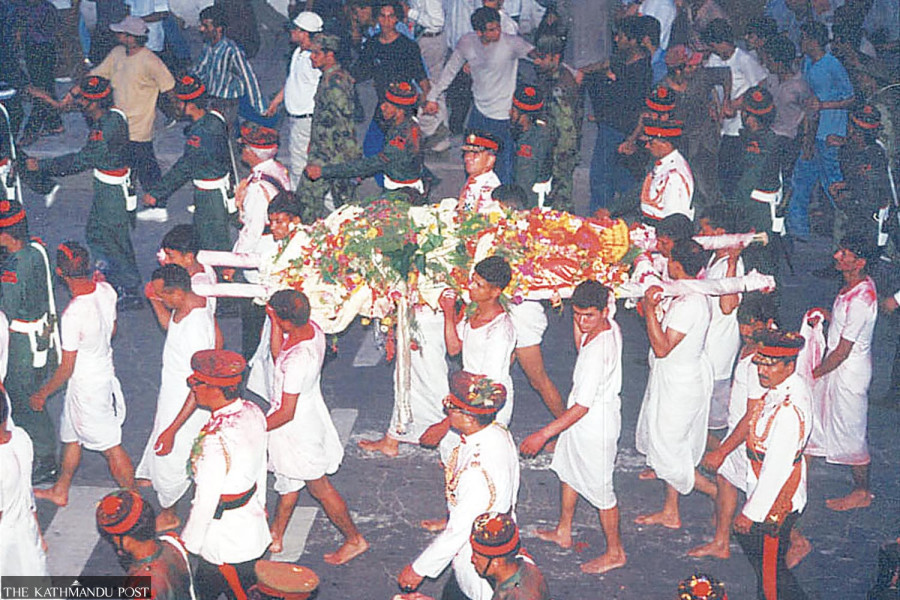
bookmark![]()
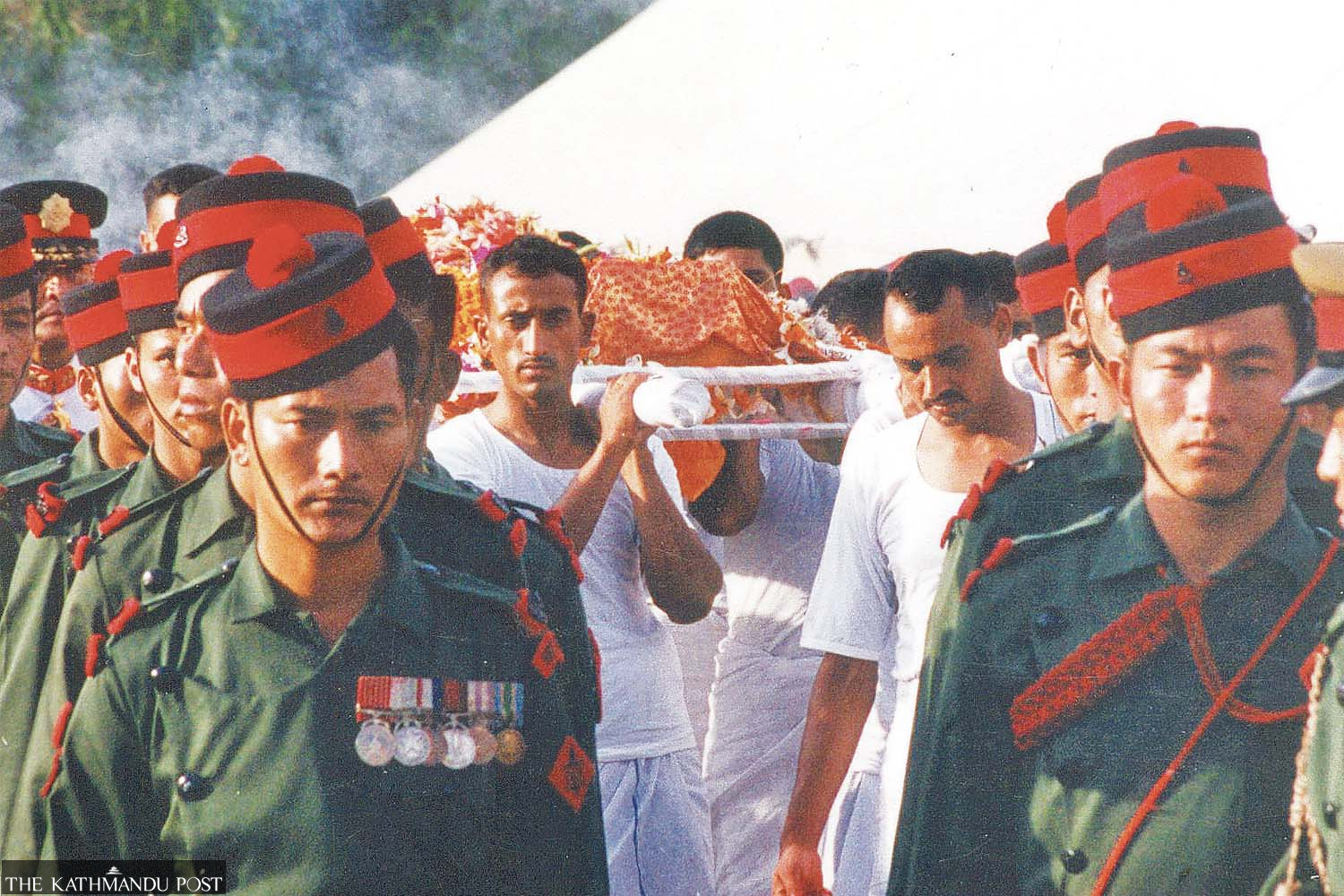
An official investigation in June 2001 concluded that Crown Prince Dipendra was responsible for the killings of members of the royal family. This photo from June 2, 2001 shows a body of a member of the royal family being carried on a bier by pallbearers, accompanied by military personnel. Post file photo
Gaurav Pokharel
Published at : August 11, 2026
Updated at : August 11, 2026 06:56
Kathmandu
The government’s announcement to reopen the investigation into Nepal’s 25-year-old royal massacre has failed to move forward as authorities remain undecided on how the inquiry should be conducted.
Home Minister Sudan Gurung announced a fresh investigation immediately after taking office for the second time. But the government has yet to decide whether Nepal Police should handle the probe or a separate commission should be formed.
The uncertainty over the investigation model has stalled the process.
A day after assuming office on June 9, Gurung held discussions with Nepal Police Inspector General Dan Bahadur Karki, security chiefs and senior officials at the Ministry of Home Affairs. During the meeting, Gurung instructed officials to explore ways to investigate the massacre through Nepal Police.
However, police officials advised that a Cabinet-level decision would be more appropriate because the massacre had already been investigated by a commission led by then chief justice Keshav Prasad Upadhyaya, with then speaker Taranath Ranabhat and opposition leader Madhav Kumar Nepal as members.
“Since a judicial inquiry commission had already investigated the incident and submitted a report, the police view was that simply forming another committee would not necessarily lead to a conclusion,” a senior home ministry official said. “A decision has still not been made on whether to assign the investigation to police or set up a separate commission.”
Home Minister Gurung, however, refused to disclose details about the progress of the probe. In a recent interview with Kantipur he said, “Home Ministry cannot disclose sensitive information,” he said.
“The Home Ministry is not really a place for providing sensitive information; some things can only be discussed at the surface level,” he said.
Officials from specialised crime investigation units, including the Central Investigation Bureau (CIB) and Kathmandu Valley Crime Investigation Office, also said no investigation had begun so far.
According to senior officials at the ministry, police leadership had already briefed the home minister about three major obstacles in reopening the case.
“During the meeting with security chiefs after the minister’s decision, police officials explained that the absence of crime scene records and postmortem reports would create difficulties,” a ministry official said. “Another challenge is that there was no ballistic examination to determine what weapons were used.”
Investigators who spoke to Kantipur also said a fresh probe would face major scientific challenges because crucial evidence, including the type of weapons and bullets used, the nature of injuries and whether wounds were consistent with the official account, was not available.
“Police investigations are conducted with the purpose of prosecution. What matters is whether facts and evidence can support a case in court,” an official familiar with the police briefing said. “Based on the evidence currently available, it appears difficult to reach any conclusion. That makes a police-led investigation complicated.”
Nepal Police former superintendent Sher Bahadur Karki, who was assigned to photograph the crime scene after the June 2001 massacre, said even documenting the scene had been delayed.
He recalled reaching the site only five days after the incident and said conducting an investigation now would be extremely difficult.
“I don’t think photographs alone will provide much assistance today. Many things would have to be based on assumptions,” Karki told Kantipur. “However, some eyewitnesses are still alive, and their statements could reveal new information.”
Karki said that if the original structure of the palace had remained unchanged, investigators might have been able to understand the scene more easily through photographs, but major changes over the years would make the process harder.
A senior police official familiar with discussions between police and the home minister said the original report was the only substantial basis currently available for a new investigation.
“The key question is whether the people who prepared that report reached their conclusions objectively or under pressure or influence,” the official said. “If they provide new facts, that could change things. Otherwise, there does not appear to be much basis for taking the investigation much further.”
On June 4, 2001, then king, Gyanendra, formed a three-member panel to investigate the massacre. However, then opposition leader Madhav Kumar Nepal resigned from the panel.
“We were at the Birendra Military Hospital in Chhauni when the decision to form the committee was announced,” recalled Deviram Sharma, who was then chief of the National Investigation Department.
“Initially, opposition leader Nepal himself had asked to be included in the committee. Later, for reasons unknown, he decided to withdraw.”
After Nepal’s withdrawal, the two-member panel submitted a report suggesting that Crown Prince Dipendra had carried out the massacre by opening fire on members of the royal family.
Statements from most members of the royal family who were present at the palace that night also claimed that Dipendra was responsible for the shooting.
According to the report, a total of at least 24 members of the royal family and relatives had gathered for a dinner at the Tribhuvan Sadan building inside Narayanhiti Royal Palace on June 1, 2001.
The report said Dipendra spent some time alone playing billiards in the billiards room at around 7:30pm. It also cited statements that he had consumed whisky neat before joining the gathering
“Before King Birendra arrived at the hall, it appeared that Dipendra was unable to control his body, and Prince Nirajan, Prince Paras, Kumar Gorakh Shamsher Jang Bahadur Rana [the king’s son-in-law], and Dr Rajiv Shah had taken Dipendra to his private quarters,” the report stated.
The report said that while Dipendra was in his room, he called his aide Gajendra Bohara at 8:19pm and ordered him to bring cigarettes. According to the inquiry, royal attendant Ram Krishna KC prepared a special cigarette containing cannabis and another unidentified black substance and handed it to Paras through the eastern door of the billiards room.
The investigation also examined telephone records obtained from then Nepal Telecommunications Corporation. The records showed that Dipendra had three conversations with Devyani Rana before the shooting.
Rana, who was receiving treatment in India at the time, told investigators that she noticed Dipendra’s speech was slurred and asked his aides Gajendra Bohara and Raju Karki to check on him.
According to attendant Ram Krishna KC’s statement cited in the report, Dipendra changed into camouflage fatigues after speaking with Rana and came out of his private quarters carrying weapons.
When an attendant offered to bring his emergency bag, Dipendra reportedly replied that it was not needed at the time.
The report said Dipendra then entered the billiards room carrying a rifle and a 12-bore shotgun.
According to the commission’s account, Dipendra first fired at the ceiling and western wall of the room with a black-coloured gun. He then opened fire on his father, King Birendra, who was talking with other guests, before moving outside and throwing the weapon near bushes beside the inner garden.
The report stated that Dipendra then returned to the billiards room carrying a rifle equipped with a light and telescope and opened fire again.
The inquiry report described a series of shootings that killed or injured members of the royal family, including King Birendra, Queen Aishwarya, Prince Nirajan, Princess Shruti, Princess Shanti, Princess Sharada, Princess Jayanti Shah, Dhirendra Shah (the king’s brother who no longer held the title of prince), Kumar Khadga Bikram Shah (king’s brother-in-law), and others.
The commission said its account was based on statements from people present at the scene, including Princess Shobha, then prince Paras, Kumar Gorakh Shamsher, Ketaki Chester, Rabi Shumsher, Dr Rajiv Shah and Maheshwar Kumar Singh.
Despite the official inquiry’s conclusion, public speculation and conspiracy theories surrounding the incident have continued for more than two decades, prompting periodic calls for a fresh investigation.
Gaurav Pokharel
Pokharel is a journalist at Kantipur Media Group covering national security, defence, and good governance.

Most Read from National

Flood sweeps away houses, bridges in Gorkha

What to know about the US trial over Mamta Kafle’s disappearance
Torrent of black mud and rocks engulfs settlements along Budhigandaki

From blankets to handmade dolls, two foreign women bring comfort to flood survivors

Budhi Gandaki flood washes away three bridges in Gorkha
Editor's Picks




E-PAPER | October 22, 2026

×