The arrest of Kishor Shrestha, journalist and editor of Jana Aastha weekly, on Wednesday, has triggered a sharp debate, with opinions divided over two difficult but closely connected questions: the freedom to publish and the right to personal privacy.
While one side, largely from the media fraternity, argues that criminal charges should not be brought over the subject matter of a news report, the other side, including media consumers and observers, has questioned the nature of the report itself.
Shrestha was taken into custody after a woman filed a complaint alleging an offence against personal privacy.
The arrest has its roots in a Jana Aastha report published on August 5 headlined “Honourable’s ‘Lip Kiss’ with Another Woman”. The report carried a photograph showing Amarkant Chaudhary, a member of the House of Representatives elected from Saptari Constituency-3 on behalf of the Rastriya Swatantra Party (RSP), kissing a woman.
The report claimed that the woman who filed the complaint had shared the photograph on her Facebook wall, stating, “...the young woman has shared the photograph on her Facebook wall.”
The fact that Shrestha was arrested on the basis of the woman’s complaint is also mentioned in the detention warrant. The letter, signed by investigating officer Police Inspector Lok Krishna Dahal, states: “...on the complaint filed by [name omitted], in the case relating to an offence against personal privacy in which the Government of Nepal is the plaintiff and you are the defendant, it being necessary to keep you in police custody for investigation, you are hereby given this detention warrant and shall be kept in police custody from today’s date.”
The dispute the arrest has triggered, however, is not simply about whether the report was responsible journalism. It raises a broader question about the route the state should take when published material is alleged to violate privacy: when does such a complaint remain a matter of media regulation, and when can it become a matter for the criminal justice system?
The Federation of Nepali Journalists, the umbrella organisation of journalists in Nepal, has described the arrest as an attack on press freedom, basing its argument on Nepal’s existing laws, including the Journalists’ Code of Conduct, 2016, the Press Council Act, 1992, and the Constitution of Nepal, 2015, which guarantees press freedom.
The code of conduct provides guidance on what journalists should or should not publish. The Council Act, 1992 provides the Press Council Nepal with mechanisms to deal with violations of the code, including requiring media organisations to publish a response or correction, issue an apology or publish a comment from an aggrieved party. In cases of repeated violations, the council can recommend the withdrawal of government facilities or benefits and can publicly express its disapproval.
The federation argues that if published material was found to have breached an individual’s privacy, the aggrieved party should first have approached the Press Council Nepal, and that the police action was therefore unwarranted.
“The jurisdiction to deal with issues that are not satisfactory in a news report lies with the Press Council Nepal. The federation’s position is that using government machinery in this manner against journalist Shrestha, while misusing that jurisdiction, is against press and freedom of expression, the journalists’ code of conduct and the Constitution,” the umbrella body of Nepali journalists said in a statement.
But the legal framework does not necessarily require the council process to be exhausted before the criminal justice system can be invoked. The council’s role is primarily tied to violations of journalistic standards and the code of conduct. Where published material is alleged to constitute a criminal offence under a separate law, such as the Privacy Act, the matter can fall outside the council’s jurisdiction.
Umesh Shrestha, the council’s chair, said it can order a media organisation to publish its decision when it finds a violation of the code. He said that if such an order is repeatedly ignored, it can also recommend further action under existing provisions.
“For example, after repeated non-compliance, the council can recommend suspension of a press pass to the relevant authority,” Umesh told Kantipur. “But the council itself does not have the authority to suspend a press pass. That power rests with the Department of Information and Broadcasting.”
According to Umesh, the department has not implemented such recommendations, saying its own rules do not provide for suspension. “There is a legal obstacle in this,” he said. “The council’s role is therefore primarily tied to questions of journalistic conduct and professional responsibility.”
The debate also raises a broader question about how press freedom is understood in Nepal. While it is often invoked in terms of the freedom of journalists and media organisations to publish, observers say that freedom also carries questions of responsibility, including how the public can assess the information it receives and how media organisations are held accountable for what they publish.
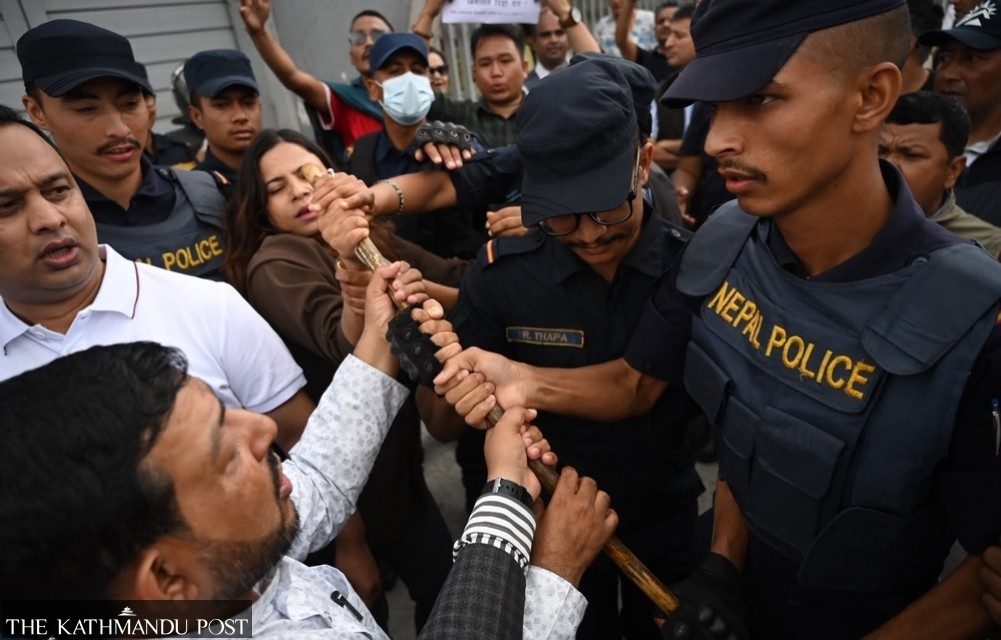
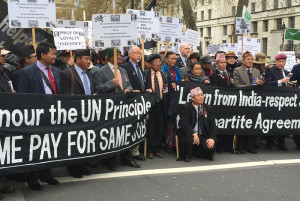
Federation of Nepali Journalists called a protest on Thursday against the arrest of editor Kishor Shrestha. Angad Dhakal/TKP
National Women Commission chair Kamala Parajuli has also cautioned against using press freedom as a justification for violating privacy.
Speaking to Kantipur after raising the issue in a social media post, Parajuli said journalists should not treat press freedom as a licence to publish anything they want.
“Press freedom does not give anyone the right to attack or violate an individual’s privacy at will by taking shelter under the notion that journalists are not required to disclose their sources,” she said. “Women have only recently begun to enter public life in greater numbers. They should not be subjected to this kind of mental harassment, and the media and social media platforms need to take this issue seriously.”
Nepal’s legal framework therefore provides different routes for different kinds of complaints. A violation of the journalistic code can be taken to the council, while certain violations of privacy can trigger criminal investigation by the police. Other privacy-related claims can be pursued directly through the courts, while defamation has a separate legal route.
That distinction is important in Shrestha’s case. The central legal question is not simply whether the complainant should have approached the council first, but what exactly was alleged against Shrestha, under which provision of law, and whether that alleged conduct constitutes a criminal offence.
Nepal’s Privacy Act provides specific protections for personal privacy. It defines personal information to include, among other things, information relating to a person’s identity, address and contact details, documents, biometric information, criminal history and certain professional opinions.
The Act also protects a person’s private life. It prohibits making matters relating to a person public in a manner that affects the person’s private life, causes harm or brings the person into disrepute, subject to the exceptions and conditions set out in the law.
The Act provides criminal penalties for specified violations of its privacy provisions. Under Section 29(2), a person convicted of the relevant offence can face imprisonment of up to three years, a fine of up to Rs. 30,000, or both.
The police say Shrestha was arrested under this provision.
The detention warrant records the legal basis cited by police for taking Shrestha into custody. But it does not, by itself, answer a more fundamental question: what specific conduct in the published material is alleged to have constituted a criminal offence under the Privacy Act?
That question assumes importance because the report involved both a private individual and a sitting lawmaker. It also presented the photograph as something the woman herself had shared publicly on Facebook. Whether that fact has any bearing on the alleged privacy violation — and whether publication of material that has already been made public can itself constitute an offence — requires examination of the specific provisions of the Act and the circumstances in which the material was originally shared.
That is where the competing principles become harder to reconcile. A free press does not give journalists an unrestricted licence to publish private information. At the same time, the existence of privacy protections does not mean that every publication concerning a person’s private life is beyond legitimate journalism. The distinction depends on what was published, why it was published, whose privacy was affected, whether there was a legitimate public interest and what the law permits.
According to Tribhuvan University assistant professor Shree Ram Paudel, the freedom to publish and the right to privacy are subjects that invariably come up for debate. He argues that both public figures and journalists must be responsible in their respective roles.
“The fact that there is a right to privacy does not mean that nothing can be written at all,” Paudel told Kantipur. “But while exercising press freedom, journalists should not violate someone’s personal privacy and cross into the realm of a criminal offence.”
According to him, the conduct of public office holders such as ministers or MPs should also be dignified. If their activities fall within the public sphere, they must be responsible for their conduct.
“‘I have privacy’ cannot be a reason for them to escape becoming the subject of press coverage. But journalism should not seize only one side of an incident and engage in ‘clickbait’ or ‘news-selling’ journalism — journalism that is cheap and designed to sell,” assistant professor Paudel said. “When reporting news, the press must be conscious and responsible so that sensitive groups requiring protection, such as women, children or minorities, are not harmed.”
Santosh Sigdel, a lawyer and executive director of Digital Rights Nepal, argues that journalists’ conduct also comes into the discussion alongside journalistic freedom and privacy.
“One important aspect in determining whether a news report has violated privacy is whether the subject is a matter of public importance or public interest,” Sigdel said.
According to Sigdel, the character of an elected representative can become a matter of public interest and therefore can be a subject of news.
“But, in doing so, journalists must not forget the legal provisions protecting an individual’s privacy or the code of conduct, and must maintain a balance between the two,” he said.
The circumstances of the police action raise a further question. Police also searched the Jana Aastha office the following morning and seized computers and a mobile phone. The legal basis for that search and seizure, and whether police obtained the necessary authorisation, therefore become relevant to assessing the state’s response to the publication.
While Shrestha’s journalism is not free of controversy, his paper has in the past been credited with scoops. Yet Jana Aastha has also often been criticised for prying into people’s private lives and for publishing sensational material. Every time Shrestha, also a former chairperson of the council, lands in controversy, a 23-year-old news report resurfaces. Actor Shreeha Karki died by suicide after Jana Aastha published nude photographs of her, an incident that observers and journalists have cited as an example of journalism crossing ethical boundaries.
Lately, some of Jana Aastha’s reporting has been critical of the current administration, and those opposing Shrestha’s arrest have questioned whether the state machinery may have been mobilised against the journalist for that reason. The federation has described the arrest as part of a broader attempt to intimidate the media.
The arrest has put some in the media fraternity in a difficult position. While supporting the freedom to publish, some have also stressed journalistic accountability, arguing that no one, including journalists, is above the law. Their concern, however, is that legitimate accountability mechanisms should not be used to target journalists or restrict legitimate journalism, and that due process is followed when such mechanisms are invoked, including in Shrestha’s case.
Journalists speaking privately also pointed to a responsibility that extends beyond the formal code of conduct: individual journalists and media organisations must define their own standards for deciding what should and should not be published. For them, self-regulation remains an essential part of a healthy media environment.
Umesh, the council’s chair, said the council draws a distinction between a violation of journalistic ethics and a violation of criminal law.
“A complaint over a publication alleged to have violated privacy could fall within the council’s jurisdiction to the extent that it raises questions about compliance with the journalists’ code of conduct,” Umesh told Kantipur. “The code requires journalists to respect personal and professional privacy except where doing so would adversely affect the public interest.”
He acknowledged that the question of journalistic ethics and the question of a legal offence can arise separately from the same incident.
“Which process applies depends on the nature of the alleged conduct, the applicable law and the relevant legal procedure,” Umesh said. “While the council examines the ethical dimension within its jurisdiction, determining criminal liability or other legal liability rests with the competent legal authorities or courts.”
For the Nepali media, the issue now goes beyond the Shrestha arrest, leaving it with a difficult question: how can journalistic freedom and the right to privacy be protected at the same time, without either becoming a shield against accountability?




 23.32°C Kathmandu