Hearing committee rejects two ambassadorial nominees, puts Japan pick on hold
Despite vetting thousands, the government’s ambassadorial picks face scrutiny over harassment, financial irregularities and foreign residency. Lawmakers at the Parliamentary Hearing Committee meeting at Singha Durbar, Kathmandu, on Wednesday. RSS
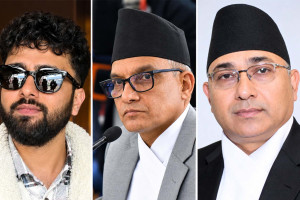
The Parliamentary Hearing Committee, dominated by lawmakers from the ruling Rastriya Swatantra Party, on Wednesday rejected two of the government’s ambassadorial nominees and deferred a decision on a third.
The committee unanimously rejected Giri Bahadur Sunar, nominated for Saudi Arabia, and Chudamani Kharel, nominated for Malaysia, citing concerns about their conduct and alleged financial irregularities.
The decisions mark a rare instance of a parliamentary committee rejecting ambassadorial nominees recommended by the government. The rejection of nominees put forward by its own government also raises questions about possible differences between the ruling party and the government. The RSP commands a majority in the 15-member committee, with eight lawmakers representing the party.
The committee deferred a decision on Jigyan Kumar Thapa, nominated for Japan, amid questions about his permanent residency status.
The government recommended 13 ambassadors on September 18 after the Ministry of Foreign Affairs opened the selection process to the public in May. Thousands of people applied for the vacant positions, which underwent months of screening and consultations before the recommendations were submitted.
Ten nominees, however, cleared the parliamentary hearings.
The committee’s decisions followed three days of hearings, from Monday to Wednesday, during which lawmakers questioned the nominees about their backgrounds and suitability for diplomatic assignments.
Sunar’s nomination was put to a vote after RSP lawmaker Samim Miya Mikrani questioned his suitability for the post. RSP chief whip Kabindra Burlakoti also argued that the allegations against Sunar raised concerns about the ethical standards expected of an ambassador.
Sunar faced allegations of having an extramarital affair and subjecting a former partner to torture and threats, as well as pressuring her to take her own life even after they had reconciled and ended their relationship.
He was also reportedly detained, handcuffed, and deported from Germany to Nepal by German authorities. Additionally, he was accused of collecting Rs3.3 million in collusion with RSP lawmaker Khagendra Sunar during police promotions, as well as raising and managing money.
A woman’s complaint describes incidents spanning more than two decades. She said she first met Giri Bahadur Sunar and his wife at Osho Tapoban in Kathmandu in 2004, and that she and Sunar continued to meet at the spiritual centre from 2009. According to the complaint, Sunar told her he was unhappy in his marriage and that his wife mistreated him.
The complaint alleges that Sunar began a relationship with the woman after 2010 and urged her to divorce her husband, who was living abroad, and be with him.
Sunar, however, denied the harassment allegations, saying he had disagreements with the woman but that nothing beyond that had occurred.
The committee also unanimously rejected Kharel’s nomination after lawmakers from the RSP, Nepali Congress, CPN-UML and the Nepali Communist Party raised concerns about his conduct. Complaints against him included alleged financial irregularities, land dealings, and conflicts of interest involving recruitment agencies.
Kharel denied wrongdoing, saying fabricated information had been circulated about him.
Committee chair Bodh Narayan Shrestha said Sunar’s nomination was rejected after a woman filed complaints against him and presented her account to the committee via video conference from abroad, alleging violence against women.
“The allegations are serious,” Shrestha said.
Kharel faced allegations of taking money from people on the promise of facilitating work and getting projects included in government plans. The committee also received complaints about financial irregularities linked to a manpower company associated with him, as well as audio recordings allegedly related to the collection of money.
“Money was taken on the promise of getting work done, but neither the work was completed nor the money returned,” Shrestha said, adding that Kharel had begun returning the money after his nomination as ambassador.
The committee failed to reach a decision on Thapa’s nomination for Japan after lawmakers disagreed over whether to reject it or defer a decision.
When committee chair Shrestha put the nomination to a decision, Nepali Communist Party lawmaker Barshaman Pun argued that it should be rejected, citing concerns including Thapa’s permanent residency status in Japan. Burlakoti insisted that the committee defer the decision, although some RSP lawmakers called for an immediate vote. Shrestha eventually adjourned the meeting until after Dashain.
“The committee put its decision on Japan’s nominee, Thapa, on hold because members could not reach a unanimous agreement,” Shrestha said. “We had discussed whether he would withdraw his name on the grounds of a conflict of interest. He had also asked us to give him some time to consider whether to withdraw his nomination.”
The approved nominees must complete the remaining appointment procedures, including obtaining consent from their respective host countries, before formally assuming their posts.
Experts on parliamentary affairs said the hearing committee was right to reject the controversial nominees.
Ishwari Devi Neupane, a former chairperson of the Parliamentary Hearing Committee, said Parliament had traditionally endorsed candidates recommended by the government.
“Sometimes, the government recommends someone for a position based solely on their certificates. But during parliamentary hearings, complaints are invited from the public. Lawmakers must then call right right and wrong wrong,” she said.
“If there are sufficient grounds to conclude that someone is unsuitable for a position based on the standards of conduct expected of the office, it is the committee’s duty to reject the nomination,” she said.
A former career ambassador, however, said the rejections had not reflected well on the government. “This raises questions about the government’s choice of nominees,” he said.
The committee approved 10 other ambassadorial nominees: Nishchal Nath Pandey for India, Kalyan Raj Sharma for China, Chiran Jung Thapa for the United States, Gaurav Shumsher Jung Bahadur Rana for the United Kingdom, Suresh Kumar Karna for Israel, Padmakshi Rana for Oman, Sangam Shrestha for South Korea, Prapti Sherchan for Spain, Sharu Joshi for Germany and Manchala Jha for Sri Lanka.
Committee chair Shrestha directed the committee secretary to inform the Ministry of Foreign Affairs of the decisions.




 20.02°C Kathmandu