Contractor builds 268-metre suspension bridge in a month after floods cut off communities
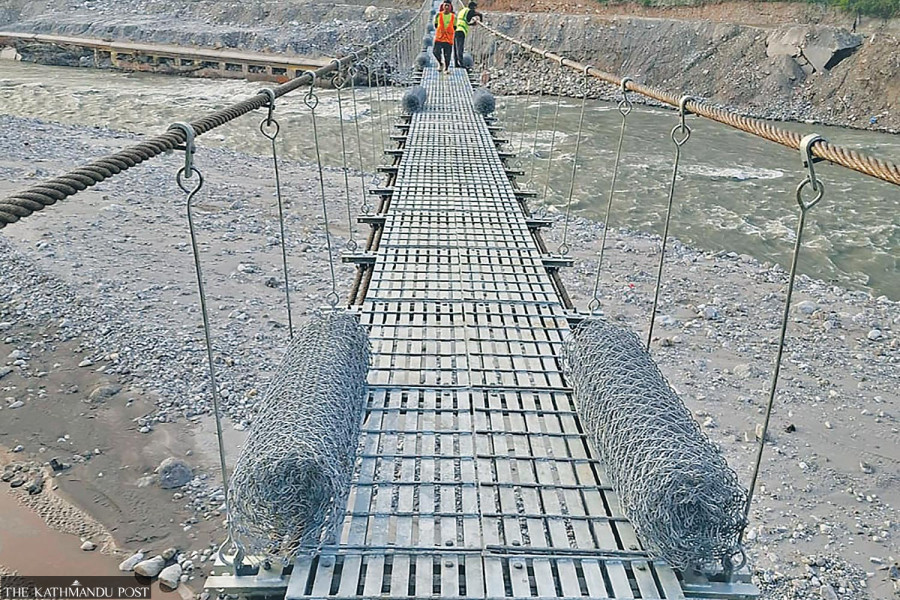
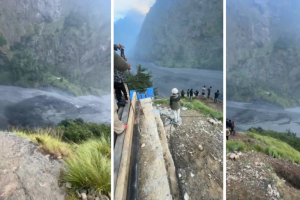
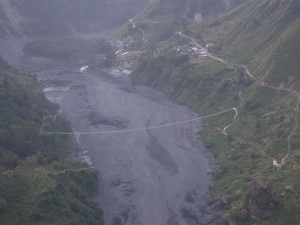
Shailendra Raj Pyakurel tapped the construction industry’s own fund to build a vital crossing over the Trishuli river for Rs17.5 million, nearly half the government’s estimate.Newly built footbridge across the Trishuli River connects Dhunge with Intake in Nuwakot. Post Photo
When the Bhotekoshi flood tore through Nuwakot on August 26, construction contractor Shailendra Raj Pyakurel was at the district office of the Federation of Contractors’ Associations of Nepal in Bidur. As reports came in that the torrent had swept through Trishuli Bazar and Dhunge, he tried to call home. No one could be reached.
The flood destroyed his concrete house and swept away 23 ropanis of land, turning his neighbourhood into a wasteland. His uncle’s daughter-in-law and granddaughter remain missing. He no longer knows how many people from his village were swept away, and has stopped counting.
“For the first day or two, I was at a loss about what to do,” said Pyakurel, who heads the federation’s Nuwakot chapter. “Thousands were missing, and I saw thousands of relatives overcome with grief. The situation was so dire that people even needed a helicopter to reach Trishuli Hospital across the river. Organisations were bringing rice, beaten rice and instant noodles. I felt we needed to do something more substantial, so I began working to build a bridge.”
Within a month, Pyakurel had turned that resolve into a 268-metre suspension bridge linking Dhunge and Intake across the Trishuli river. The bridge is due to open to the public on October 16, restoring a crucial crossing for communities cut off by the floods.
Pyakurel, himself a suspension-bridge contractor, called Nicholas Pandey, the federation’s national president, with an urgent proposal: build a bridge across the river without delay. The absence of a crossing had left residents struggling to reach Trishuli Hospital. Even those with routine health problems faced a difficult choice: travel to Kathmandu for treatment or stay home and endure their illness.
The floods severed links between the district headquarters and several densely populated areas, including Meghang and Kispang, some wards of Uttargaya Rural Municipality in neighbouring Rasuwa, and Tupté, Angutar and Bhairamkot in Bidur municipality. Deurali, Samari, Deudi and Taksar in Nuwakot were also cut off. Residents of Satyadevi in Dhading, who rely on the same route, faced similar hardship.
Pandey backed the idea and called a meeting of the federation’s steering committee that night. The committee unanimously endorsed the proposal and asked Pyakurel to get the project moving.
“After the federation agreed, I contacted officials at the Suspension Bridge Division and spoke to engineers,” Pyakurel said. “They prepared a detailed project report for an immediate start, estimating the cost at more than Rs31.8 million.”
With the federation committed to financing the bridge itself, there was no need to wait for the usual government procedures. Contractors already contribute 0.01 percent of their contract amount to a construction-industry fund when they receive their final payment. The federation agreed to draw on that fund, and work began on September 17.
The government supplies the cables and bulldog grips required for suspension bridges, materials contractors are not permitted to buy and use independently. Pyakurel mobilised workers from his own company and got construction under way.
The project was a social undertaking, not a commercial venture. Pyakurel paid workers their daily wages and turned up at the site himself from 7am each morning to oversee the work. He also bought steel worth Rs6.5 million from a factory for the bridge.
“People can now walk across it,” he said. “We are preparing for the federation’s president to inaugurate it on October 16. The bridge will end the need for dangerous journeys on a tuiin, help patients reach hospitals, ease the transport of goods and make it easier for people to get to market.”
Some work remains. Structures to allow motorcycles to cross, sections of the deck and wind-guide cables on both sides of the bridge, intended to limit swaying, will be completed after Dashain.
The total cost is expected to reach Rs17.5 million, far below the government’s estimate. Pyakurel claims the project is the first in Nepal in which a 268-metre suspension bridge has been built and made ready for use in just one month.
“The bridge at Dhunge will bring enormous relief to a large population at a time when people need it most,” said Uddhav Rijal, head of the Nuwakot district chapter of the Nepal Red Cross Society. “It would not have been possible to build it so quickly without Shailendra Raj Pyakurel’s initiative.”
Pyakurel’s company also holds contracts to build suspension bridges in Sindhupalchok, Syangja and Rukum. Work on those projects should already have started, but government agencies have been occupied with the disaster response. Construction is now expected to begin after Dashain.
At 50, Pyakurel says he never imagined he would witness a disaster of such scale, let alone suffer its losses firsthand.
“I am 50 years old. I never thought I would have to see and endure a disaster like this,” he said. “Almost everything around us has been destroyed. We need bridges at other locations, too, so people can move around more easily. The state must act immediately.”
He says reconstruction and rehabilitation should not be delayed simply because entire settlements cannot be rebuilt at once. Work should begin wherever it is feasible.
With floods repeatedly devastating communities across Nepal, Pyakurel fears the destruction is becoming normalised. Many towns and settlements remain exposed, he says, and the government must address the risks before the next disaster strikes.
“People in the most vulnerable areas must be relocated. The state needs to allocate funds for embankments every year and ensure the work is done on time,” he said. “This year it is the Bhotekoshi, Kali Gandaki and Budhi Gandaki rivers. Next year, it will be somewhere else. The state must take this far more seriously.”
Arjun Poudel is a health reporter for The Kathmandu Post. Before joining the Post, he worked for Sagarmatha Television, Naya Patrika, Republica and The Himalayan Times.




 18.53°C Kathmandu