How Deepak Bhatta became Nepal’s most influential power broker
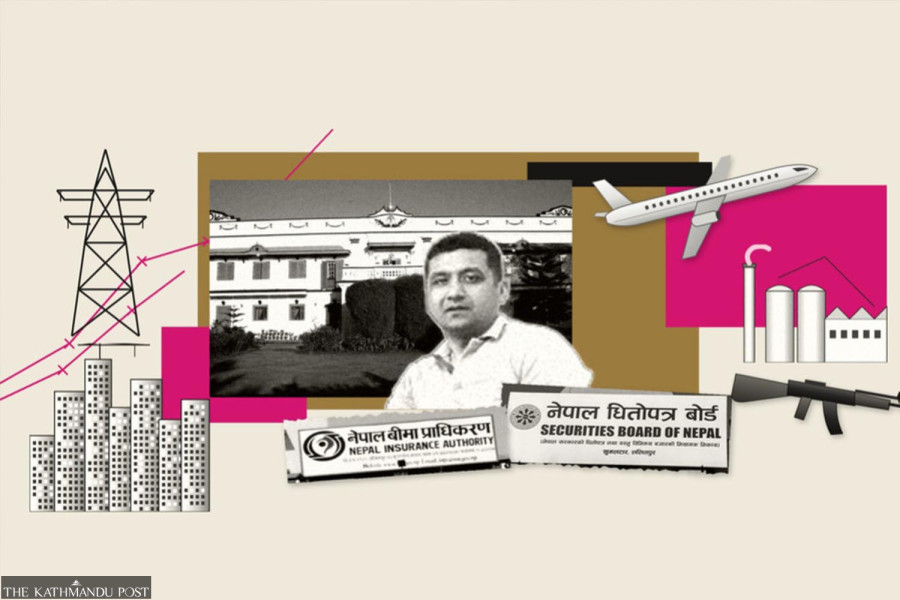
For two decades, Bhatta cultivated extraordinary access to Nepal’s political and bureaucratic elite while keeping himself largely out of public view. A money-laundering investigation has now exposed the networks around him. Deepak Bhatta has been linked to deals involving various sectors of state power. Post Illustration
One day in April 2024, the then Prime Minister Pushpa Kamal Dahal summoned the then home secretary to discuss what the latter described as “administrative issues and procurement matters, including arms and weapons.”
The meeting ran past 11 that night. When the secretary finally left, he was ushered through an alternative door that opened into another room.
A man was sitting there. The man was Deepak Bhatta.
“He was waiting,” the secretary, who has since retired, told Kantipur, recalling events from that night.
The secretary, Ek Narayan Aryal, did not say why Bhatta was there. But the scene itself was familiar. On several occasions, he said he had seen ministers and senior government officials wait outside while Bhatta was inside meeting the prime minister. Several former ministers told Kantipur that they had themselves been kept waiting while Bhatta was in a meeting with the prime minister.
One former minister who served in the KP Sharma Oli government in 2020 recalled urgently going to Baluwatar to see the prime minister, only to wait outside for a considerable time. The reason, he later realised, was that Bhatta was already in a meeting with Oli.
“Other ministers have also told me that they had similar experiences,” the minister told Kantipur.
Bhatta has never held elected office. He has not been a minister, a senior civil servant or the head of a major political organisation. There is no formal position that explains his proximity to the people who have occupied Nepal’s highest offices. Yet over two decades, he became a familiar presence around them.
Politicians across the Nepali Congress, CPN-UML and Maoist Centre knew him. Bureaucrats encountered him when decisions were being made. Security officials sought him out. Businesspeople treated his access to government as a form of capital.
Over the past six months, Kantipur spoke to 50 people, from former ministers to law enforcement officials, bureaucrats and businessmen who met Bhatta at one point or another. Almost everyone who agreed to speak asked not to be named because they were concerned about their safety and privacy. What they told Kantipur describes how a young man who started casually accompanying politicians built direct relationships with senior political, bureaucratic and security officials—and ultimately accumulated enough power and confidence to change the highest office in the country.
One retired bureaucrat offered a metaphor in striking terms.
In the three pockets in his coat, he said, Bhatta carried a former prime minister in each. “He shuffled them at will — just like playing cards,” he said.
From a fertilizer case to the corridors of power
Bhatta was born on February 4, 1981, in what was then Bhadrapur VDC of Dadeldhura, in Nepal’s far west. He received his early education in Dhangadhi at Aishwarya Vidya Niketan before moving to Kathmandu and later to India, where he completed his 10+2 education.
His family had already been close to political and administrative power. His father’s elder brother, Ganesh Prasad Bhatta, was a member of the Rastriya Panchayat from Dadeldhura and became assistant minister for forest in Marich Man Singh Shrestha’s cabinet in 1986, the last government before the fall of the Panchayat system.
His father, Chaturbhuj Bhatta, joined Krishi Samagri Sansthan as a junior officer and rose through the civil service ranks. He became zonal chief for Seti and later general manager of the organisation during Sher Bahadur Deuba’s prime ministership in 2001-02. It was during his father’s tenure as general manager that he first appeared in the official record — not as a government employee but as an agent of an Israeli company bidding for a government fertilizer contract.
On January 19, 2005, the Commission for Investigation of Abuse of Authority (CIAA) filed a corruption case alleging more than Rs120 million in irregularities in a deal to import 12,500 metric tonnes of chemical fertilizer from Clan Port International, an Israeli company.
The CIAA alleged that the company was fictitious, and that Chaturbhuj had abused his position to secure its tender. Bhatta was accused of acting as the company’s agent and facilitating approval of the tender through his father. Both were eventually acquitted by the Special Court.
Bhatta was just 24. For most people, that would have been an early and potentially defining encounter with the state. For Bhatta, it appears to have been the beginning of a different kind of career.
“He started as an agent, procuring weapons and other equipment for various government agencies,” said a former Deputy Inspector General who worked in Kathmandu at the time.
The people who knew him say his greatest asset was never the product he was selling. It was access.
Bhatta’s early business activities extended beyond security equipment. Around 2007, he was involved in the travel industry as executive chairman of Gorkha Travels, which brought China Southern Airlines to Nepal for the first time.
For the airline’s launch, he arranged a visit to China for a large group of Nepali journalists. The trip expanded his network. Travel was one business; the relationships it generated were another.
A company called ICTC then had a strong hold on government contracts, working with institutions including the Nepal Army, Nepal Telecom and the Nepal Electricity Authority. Bhatta wanted to establish himself in the same market.
“ICTC is currently working with the Nepal Army, Nepal Telecom, the Nepal Electricity Authority and others,” Bhatta said, according to a senior official who worked closely with the private sector at the time. “One day, they will be working with me.”
In 2008, Bhatta registered Infinity Holdings in Sanepa, Lalitpur. The holding company had interests across sectors including hydropower, arms and helicopters. Its subsidiaries registered in the names of employees and associates, making the ownership structure less immediately visible.
Bhatta’s business interests extended into travel and tourism, hotels, real estate, consultancy, insurance and microinsurance. He also acted as a Nepali agent for companies from countries including China, Singapore, Hong Kong and Israel.
His entry into the electricity sector appears to have begun when he became the Nepali agent of China Gezhouba, the Chinese contractor for the Trishuli A hydropower project. The 60-megawatt project was nearing completion at a time when Nepal was experiencing severe load-shedding—power outages lasting 18 hours a day. Then a proposal emerged to increase its capacity to 90 megawatts. The proposal was controversial: expanding the project would have extended the construction period and reduced electricity generation during the dry season, when the country needed power most.
Despite considerable lobbying, the group associated with Bhatta could not push the expansion through. The original 60-megawatt project was completed on time.
But Bhatta’s family’s access to power predated his birth. Sher Bahadur Deuba’s father, Prasad Singh Deuba, and Chaturbhuj were mit—a traditional Nepali relationship that carries the weight of familial kinship despite the absence of a blood relationship. That connection gave Bhatta an unusual entry point into the circle around one of Nepal’s most consequential political families.
He addressed Sher Bahadur Deuba as dai, elder brother. A relative of the family said Bhatta also financially supported Deuba at one point, although this account could not be independently verified.
“Close connections with the Deubas helped Deepak gain access to other political figures as well,” the relative said.
The timing mattered. The political upheavals of 2005-06 were remaking Nepal. The monarchy was on its way out. The Maoists were entering the political mainstream. The Nepali Congress and UML were competing for influence in a rapidly changing state.
After the 2008 Constituent Assembly elections, governments changed hands repeatedly. For someone like Bhatta, who could move between political camps, instability was not necessarily a problem, but a boon.
People familiar with Bhatta’s rise say UML leaders Ganesh Singh Thagunna and Hari Parajuli helped introduce him to Bamdev Gautam through Gautam’s son, Haris.
From Gautam, Bhatta gained access to Oli. A former minister from the Madhav Kumar Nepal government recalled seeing Bhatta accompanying Gautam through Singha Durbar around 2009. Gautam would discuss proposals involving security equipment, weapons procurement, or the possible use of public land for business ventures. At the time, Bhatta was still relatively quiet. “He barely spoke then,” the former minister said.
Over time, the picture changed.
“Earlier, he would talk about changing a director general,” a former minister said. “Later he was involved in changing prime ministers.”
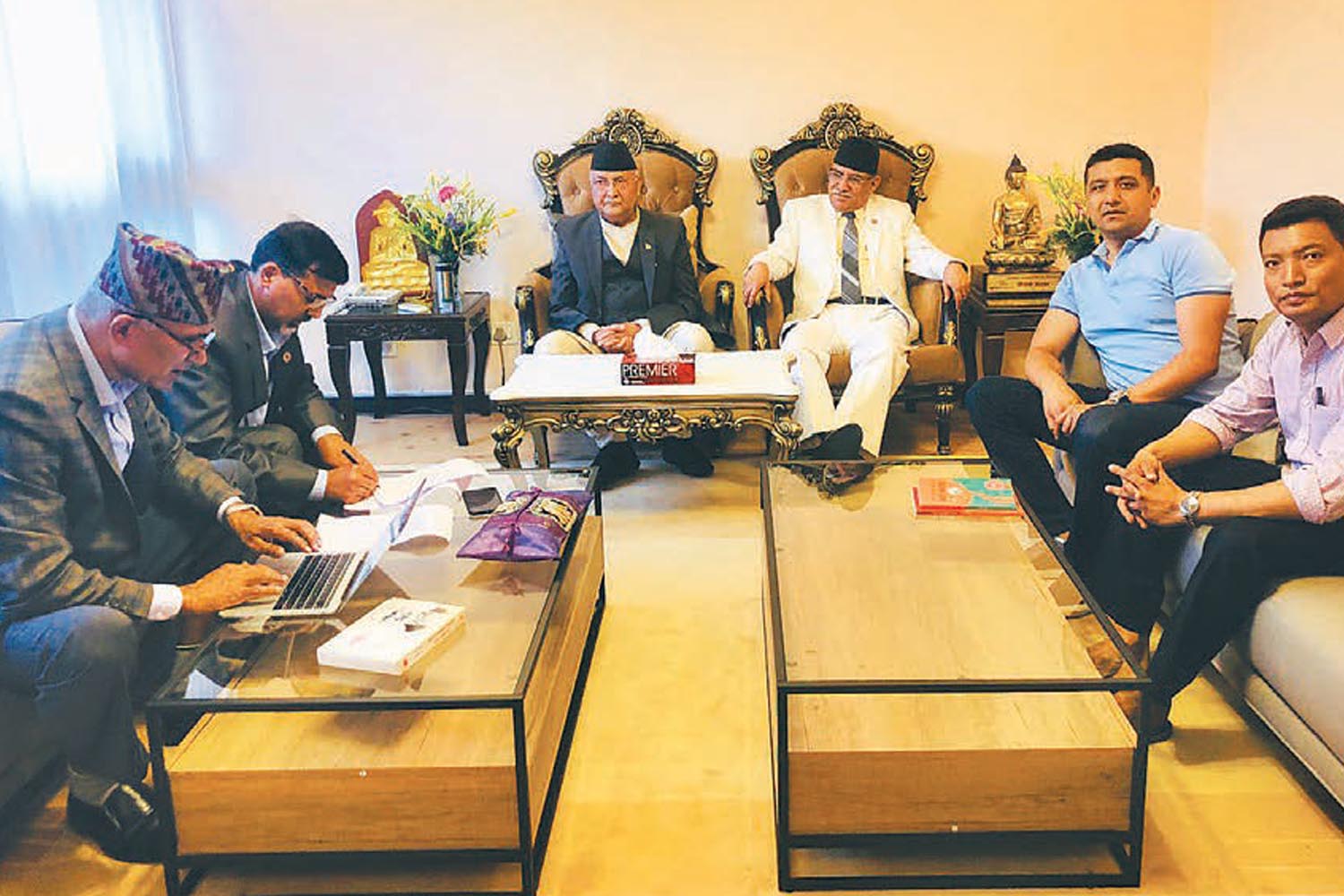
Deepak Bhatta (in a blue T-shirt) in a meeting of Nepal’s communist politicians led by ex-prime ministers KP Sharma Oli and Pushpa Kamal Dahal. Photo: Courtesy of Roshan Khadka/Kathmandupati
Bhatta’s central advantage was that he did not appear to belong exclusively to any one faction. He cultivated relationships with Deuba of the Nepali Congress, Oli of the UML, and Dahal of the then Maoist Party. That ability to cross political boundaries became particularly valuable after the 2015 constitution, when successive governments were formed through shifting alliances.
By then, Bhatta was no longer simply an intermediary seeking access. He had become part of the access.
One of the clearest windows into how Bhatta operated came in 2013, when Nepal Police was preparing a major modernisation programme.
The force had identified its own priorities, including equipment for policing, investigation and crowd control. But officials involved in the process say the Home Ministry pushed for a separate, much larger allocation for weapons and ammunition. The Finance Ministry eventually approved Rs 1.45 billion for the purchase.
By then, firms associated with Bhatta or his employees were among those shortlisted to supply the weapons.
The procurement stalled after senior police officers questioned the sudden shift in priorities. In late 2013, then Inspector General Upendra Kant Aryal and DIG Rajendra Singh Bhandari took their concerns to the CIAA. According to people familiar with the meeting, then CIAA chief Lok Man Singh Karki told them that Bhatta had been repeatedly pressing for the procurement and had spoken to Finance Minister Shankar Koirala about securing the money.
When the process was revived the following year, Bhatta approached Bhandari personally. What followed was an unusually revealing account of the leverage Bhatta claimed to possess. According to Bhandari, Bhatta said he could manage the parliamentary Public Accounts and State Affairs committees, deal with both the ruling parties and opposition, and even handle concerns from India and China. He suggested that those who helped move the deal could expect favours — a party ticket for one person, admission for someone's child for another.
Bhandari did not agree. The procurement was eventually cancelled.
Aryal later recalled that police officials believed some of the proposed weapons were substantially overpriced. “We felt another Sudan scandal was developing,” he said, referring to the earlier corruption case involving the purchase of armoured personnel carriers for Nepal Police peacekeepers in Sudan.
Bhandari says his resistance came at a cost. He was transferred from the police administration department and later assigned to the National Security Council Secretariat, where there was no established position matching his rank.
“That was the price I had to pay,” he recalled.
The episode was not isolated. Bhatta subsequently appeared as a local agent in other security procurements, including Russian helicopters for the Nepal Army, Israeli Galil rifles and a communications project for Nepal Police. In one case, a contract with Hong Kong-based Eris Technology was cancelled after the work was not completed within the contracted period; Bhatta’s company had acted as the local agent. The dispute eventually reached the Supreme Court.
Years later, during the Sher Bahadur Deuba government, the pattern resurfaced. Security agencies again sought equipment, including non-lethal gear for crowd control, but large purchases of lethal weapons moved forward instead. Officials involved in the process say Bhatta was again active in lobbying around the procurement. Some of the deals were eventually cancelled or stalled amid questions over intermediaries and the procurement process.
The significance of the weapons saga is not simply that Bhatta was associated with a series of government contracts. It is that the episodes offer a rare glimpse of how his influence appears to have worked. He did not need formal authority over a ministry or security agency; he needed access to the people who could approve, alter, or halt decisions.
The same approach became increasingly relevant as his business interests expanded beyond procurement into infrastructure, insurance and financial markets.
Bhatta’s entry into the electricity sector and his efforts to compete for government contracts were part of a broader expansion. Over time, he developed interests in businesses whose fortunes expanded not only on commercial performance but also on regulatory approvals, government policy and access to capital.
His association with Sulav Agrawal from Shanker Group further accelerated this process, according to people familiar with their business activities. The two allegedly developed substantial influence over the Nepal Insurance Authority and the Securities Board of Nepal—institutions whose decisions can affect companies seeking regulatory approval and access to capital. People they chose were said to have been appointed to leadership positions in these bodies.
Santosh Narayan Shrestha was appointed chairperson of the Securities Board. A senior board official said files associated with the group generally received priority there. Businesspeople also alleged that those seeking approvals had to obtain permission from Bhatta and Agrawal.
One hydropower entrepreneur described an attempt to secure approval for an initial public offering that had been stalled for a long time. “My hydropower company’s IPO had been held up for a long time,” said the entrepreneur. “When nothing worked, I was taken to Sulav, and he openly negotiated a deal for money. I could not meet his demands. And the matter remained stalled.”
Similar accounts from businesspeople and officials point to concerns about the influence that private networks may have exercised over decisions formally entrusted to public bodies.
The group had also sought to establish a privately funded stock exchange, a proposal that became the subject of intense political pressure.
According to accounts from people familiar with the process, then prime minister Oli pushed for the proposal to move forward, while then finance minister Bishnu Poudel appeared unable to resolve the dispute. When Ek Narayana Aryal, who had since been promoted to chief secretary, could no longer withstand the pressure, he sent a letter stating that the Securities Board’s board of directors itself could make the decision.
The issue had remained entangled since the time Pushpa Kamal Dahal was prime minister and had been halted during his tenure. Former finance minister Barshman Pun later publicly stated that the issue of a new stock exchange was among the factors that led to the collapse of the government at the time.
Even after that, sustained pressure was exerted on the Securities Board’s board of directors to move the process forward; however, it was halted after some board members walked out of a meeting.
The issue was left unresolved after the Gen Z protest movement last year. A proposed stock exchange was not simply another business venture; it involved decisions by a financial regulator, political pressure at the highest levels, and the reshaping of Nepal’s capital market.
The scale of Bhatta’s financial dealings became clearer after the money laundering investigation began earlier this year. Charge sheets filed in June 2026 describe transactions involving corporate loans, personal bank accounts, Infinity Holdings, and investments in insurance companies. Investigators allege that some transactions were structured to disguise the origin and movement of funds. Bhatta and others who have been made defendants have denied wrongdoing, and the allegations remain subject to judicial scrutiny.
One transaction identified by investigators began in September 2022, when Rs 545 million was transferred from the account of Jagdamba Steels, a Shanker Group subsidiary, to Bhatta’s personal account at Siddhartha Bank.
According to the charge sheets, Bhatta said the money was an advance payment for the purchase of a 54-aana plot of land in Sanepa. Investigators, however, questioned whether the proposed land transaction was genuine. The money was subsequently transferred to Infinity Holdings, which is wholly owned by Bhatta, and invested in Himalayan Insurance as share capital. Prosecutors allege that the arrangement disguised the nature of the original transfer and that the proposed land development project in Lubhu, known as Mega City, never materialised.
The charge sheets describe another unusual sequence several months later. Bhatta returned Rs 752.6 million to Jagdamba Steels, explaining that the company had abandoned the proposed land purchase because of financial difficulties and that he had refunded the advance with interest. In his deposition, Bhatta claimed that he was simply returning the principal amount with accrued interest after Jagdamba Steels said it could no longer purchase the said property citing financial difficulties.
Investigators questioned why a company would transfer more than half a billion rupees to a private individual without a legally registered agreement, complete the transaction over several years without transferring ownership, and then receive repayment through a series of cheques. They also examined where the money from the payment had come from.
According to a bank inspection report cited in the investigation, Rs 679 million of the Rs 752.6 million originated from entities linked to Shanker Group and members of the Agrawal family. The records show transfers into Bhatta’s account from several members of the Agrawal family, including Sahil and Sulav Agrawal, as well as from Shanker Lal Agrawal. Bhatta’s wife and Infinity Holdings also contributed funds.
Investigators characterise the sequence as a possible case of round-tipping: money initially transferred from a corporate account was routed through other accounts before returning to the original company. Prosecutors argue that the sequence made the repayment appear to be the settlement of a failed deal while obscuring the underlying movement of funds.
The investigation subsequently expanded into securities trading. According to charge sheets, Bhatta purchased shares worth Rs 3.8 billion through Bhrikuti Stock Broking Company between July 2025 and March 2026 without depositing the mandatory advance margin of at least 25 percent. During the same period, Bhatta sold shares worth Rs 930.5 million through the brokerage. After adjusting the sales against the purchases, prosecutors say he still owed the brokerage approximately Rs 2.89 billion for shares acquired on credit.
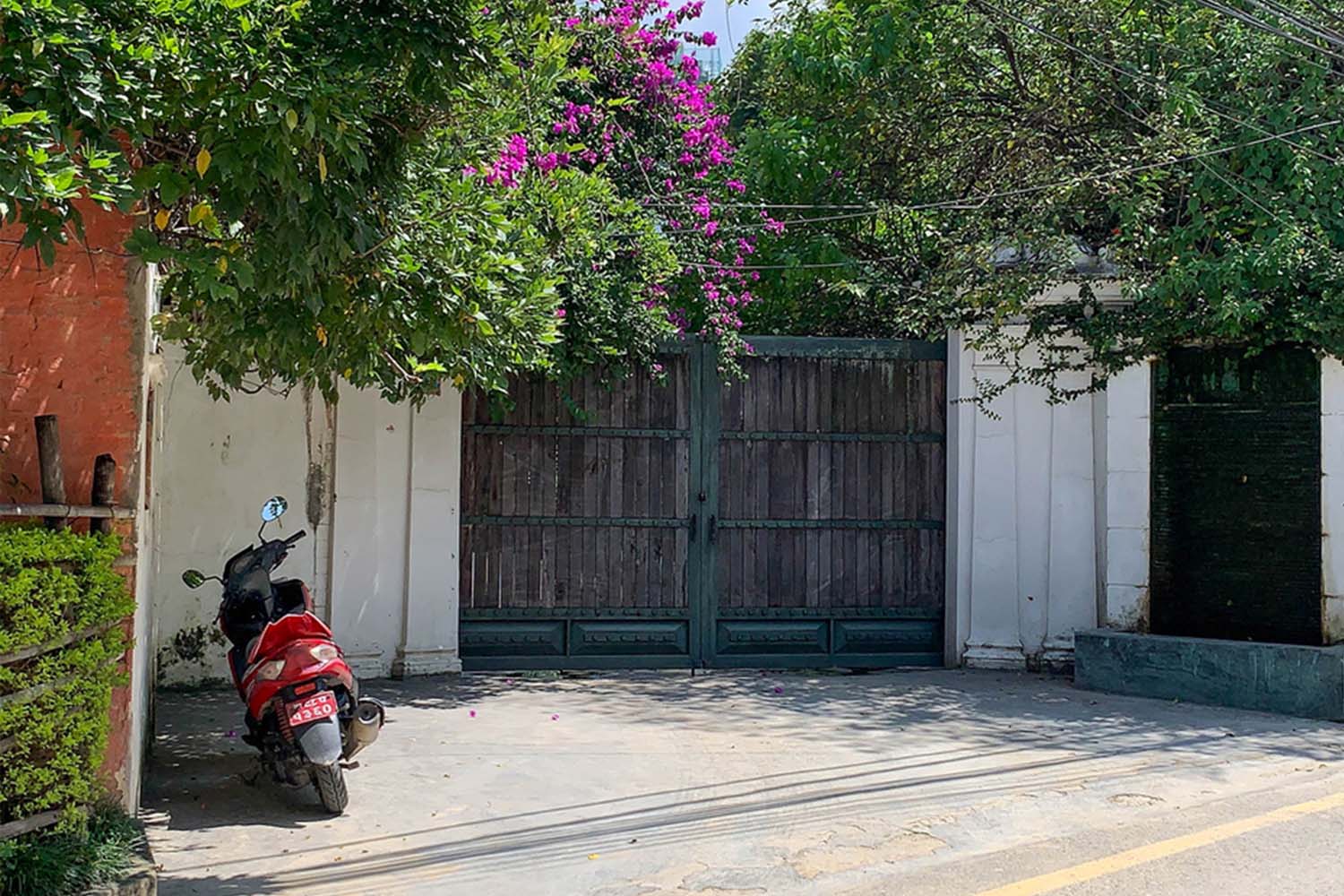
Kiran Bhawan, Deepak Bhatta’s residence in Sanepa, Lalitpur. Dipesh Darshandhari/TKP
Investigators allege that the credit-based transactions helped create artificial demand and drive up the share price of Nepal Reinsurance Company. According to the charge sheet, the stock rose from Rs 1,461 on July 21, 2025, to Rs 1,686 on August 26, an increase of 15.5 percent in just over five weeks.
The prosecution alleges that the rise was not the result of normal market activity but part of a coordinated effort to manipulate the stock price. The charge sheet identifies several companies and businesspeople whose transactions investigators believe were connected to the alleged operation, including Himalayan Reinsurance, Himalayan Capital and Nepal Micro Insurance Company. Bhatta holds a 15 percent stake in Nepal Micro Insurance.
According to the charge sheets, funds were channelled into Bhrikuti Stock Broking through a network of business figures. Shekhar Golchha, a renowned businessman and then chairman of Himalayan Reinsurance, acknowledged transferring Rs 525 million to the brokerage on multiple occasions, although he told investigators that he had no personal relationship with the brokerage’s chairman and did not maintain a trading account with the firm.
When Kantipur asked Golchha about his relationship with Bhatta, he declined to comment. He maintained that he met Bhatta only twice: once in December 2023, when he was mourning his mother’s death, and once at a social occasion.
Bhatta’s influence became particularly visible during the internal struggle between Oli and Dahal after the formation of the Nepal Communist Party in 2018.
A party leader told Kantipur in 2020 that Bhatta’s influence inside the newly merged party was “an open secret.”
According to that account, Bishnu Poudel, Janardan Sharma and Bhatta would discuss ways of bringing leaders together. Poudel would communicate with Oli, while Sharma would communicate with Dahal.
“Everyone knows that Deepak has direct access to the prime minister,” the leader said at the time.
Bhatta himself was said to claim that he had played a role in bringing about the UML-Maoist unification. Photographs that surfaced after his 2026 arrest offer a rare visual record of that proximity. One shows Bhatta alongside Oli and Dahal during the period of negotiations between the UML and Maoist Centre. Another shows him taking a selfie with Oli, both smiling.
One former finance minister shared something about this clothing. When he first began appearing in Singha Durbar, he dressed formally. Later, the minister said, he increasingly appeared at political leaders’ homes in T-shirts, trousers and a cap, while the leaders around him remained in traditional or formal attire.
The difference was especially striking during one agreement between the UML and Maoist Centre. Oli, Dahal, Bishnu Poudel, Bishnu Rimal and Janardan Sharma were dressed formally. Bhatta wore a T-shirt and cap.
“He was placed in the middle for photographs, like the bride and groom at a wedding,” the former minister said.
“To me, it suggested that he was becoming increasingly comfortable — and increasingly influential — around the political leaders themselves,” the former minister said.
He remembered Bhatta as physically imposing, direct and increasingly confident.
“He would say, without hesitation, ‘Do this and I will get you that. I will bring these leaders together. Just make the decision,’” the minister recalled.
According to the minister, the Bhatta of ten years earlier had rarely spoken in front of senior politicians.
The invisible broker
By 2020, stories about Bhatta’s reach had become common in Kathmandu’s political and bureaucratic circles. A former Home Ministry secretary said Bhatta took an active interest in appointments, transfers and promotions in agencies connected to his business interests.
“He would use all available influence to place officials of his choosing in key positions,” the former secretary said. “When officials resisted, he would try to have them transferred and replaced.”
Several former bureaucrats separately recalled Bhatta approaching senior political leaders — including Deuba, Oli and Dahal — to complain about officials who were obstructing his interests.
A former employee at Infinity Holdings described the same pattern from inside Bhatta’s business world.
“The phrase ‘not possible’ does not exist in his dictionary,” the employee said. “He could influence anyone, whether a junior employee, a politician or an administrator.”
Another former secretary who met him at the Home Ministry more than a decade ago remembered a much less imposing figure.
“He would get things done through people above him, exert pressure, and stay out of the spotlight himself,” Yadav Koirala, who retired as a secretary, recalled. “In fact, much of his influence came from the political forces that protected and backed him.”
Bhatta’s influence was particularly visible during periods of political uncertainty.
According to a former Maoist leader, after the 2022 elections produced a hung parliament, Bhatta played an important role in subsequent efforts to form or bring down governments.
At the time, media reports often described him as a bichauliya — an intermediary or broker. Bhatta disliked the term, and would complain that the media should call him a “controversial businessman” instead. He objected to the label “broker,” the Maoist leader said, but not to being called controversial.
Yet the same leader said Bhatta enjoyed seeing reports about his influence. That contradiction captures something central to his public persona. He wanted his power to be known. He did not necessarily want the mechanism behind it to be known.
The arrest
On April 2, 2026, Nepal Police’s Central Investigation Bureau (CIB) arrested Bhatta on money-laundering charges. The Department of Money Laundering Investigation subsequently filed four separate criminal cases involving allegations including money laundering, banking offences, securities-related fraud and insurance violations. The largest financial claim against him stands at nearly Rs27 billion.
In October, prosecutors filed a sixth insurance-related case against him and other defendants. The charge sheet alleges Rs 423 million reached Bhatta’s account through two transfers; prosecutors are seeking recovery of approximately Rs 450.7 million.
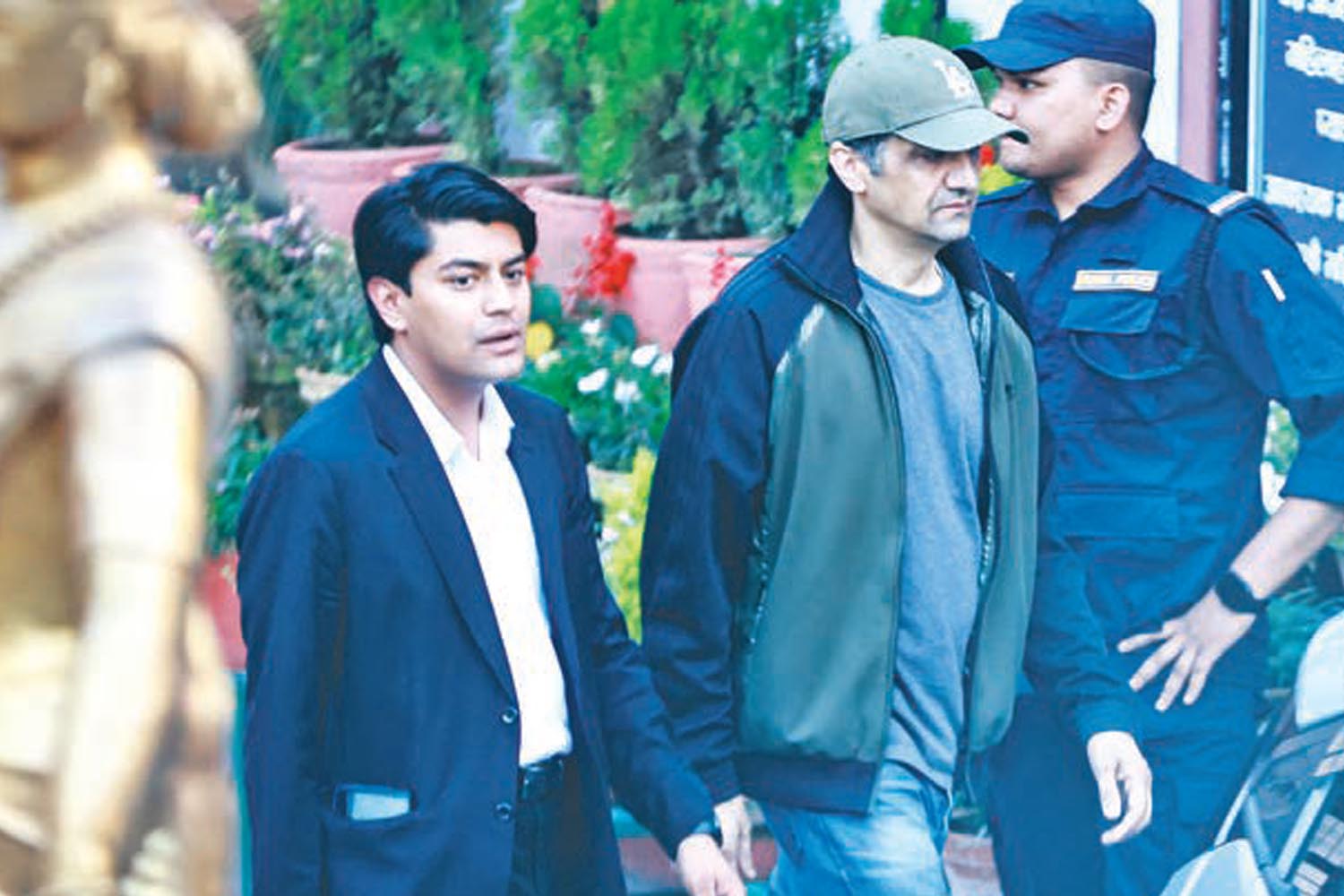
Deepak Bhatta was caught for a money laundering investigation. Nepal Photo Library
According to police, Bhatta had gone into hiding as soon as the money-laundering investigation began. Suspecting that he might leave the country, the DMLI had already written to the Department of Immigration, asking it to place a hold on his passport.
Police deployed plainclothes officers to watch Bhatta’s residence in Sanepa and three or four other places he was likely to visit. They eventually located him at an office near Gairidhara. “As he was leaving, a team led by a CIB deputy superintendent of police spotted him,” a CIB official said.
According to the police account, Bhatta expressed his desire to drive to the CIB office in his own vehicle. A member of Bhatta’s family offered a different version.
“Even though he drove himself there, the police were giving a false impression that he was arrested in Gairidhara,” the Bhatta family member said. “After rumours spread that he was about to be arrested, he called the police himself and said he would come in. When the police told him they would arrest him, he drove to the CIB office.”
The arrest brought Bhatta inside the very state machinery whose corridors he had spent two decades navigating.
Shortly before the legal proceedings intensified, an entire detention area at a police facility in Pulchowk was cleared for him. He was comfortably seated on a bench in the visitors’ room, in a T-shirt, track pants and slippers. He began the conversation himself.
“So, what’s the news?” he asked a group of visitors.
For someone who had spent years cultivating access to the highest levels of the state, the casualness was familiar. He did not present himself as defeated. Instead, he said he was almost relieved that the old files had finally been opened.
“At least now nobody can say again that they will open my files,” he said.
Then he offered an analogy: it was better, he suggested, to suffer an injury to the leg than to die in a major accident. Then he took off his cap and sat silently for a moment.
“I am being targeted for revenge. I will be released by the court,” he said.
As cases against him remained pending, events in October brought another set of alleged connections to light — this time involving Inam Sapkota, a previously little-known figure; former chief justice Cholendra Shumsher Rana; sitting Supreme Court justices; and senior security officials.
Phone records and WhatsApp conversations, according to investigators, showed Sapkota in contact with Bhatta. Investigators suspect he had acted as an intermediary connecting people in business, politics, the police and the judiciary. In September, Bhatta’s father, Chaturbhuj, had filed a habeas corpus petition in the Supreme Court. Conversations between Sapkota—arrested on October 14 and currently in custody—former chief justice Rana, Bhatta, and some sitting Supreme Court justices raised further questions. Bhatta was transferred from Nakkhu Prison to Sindhupalchok. Investigating officials say the move was made out of concern that he was attempting to exert influence from Nakkhu.
Whether the allegations survive judicial scrutiny is for the courts to determine. But for those who had watched Bhatta operate for two decades, the arc was familiar: a network built through accumulation—family relationships, political friendships, business intermediaries, government contracts—that extended further than anyone outside it fully understood, until investigators began pulling at the threads.
A senior former Nepal Investigation Department official described him simply as a “mysterious man.” Someone who seemed to have access to everyone while remaining largely unknown to the public.
“A high-level broker,” the official said, referring to Bhatta.
His car, bearing the number plate 1, sat in the police compound for a long time after his arrest. A family member eventually came to collect it.




 22.93°C Kathmandu