Kathmandu Film Festival puts Nepali cinema’s past, present and future in focus
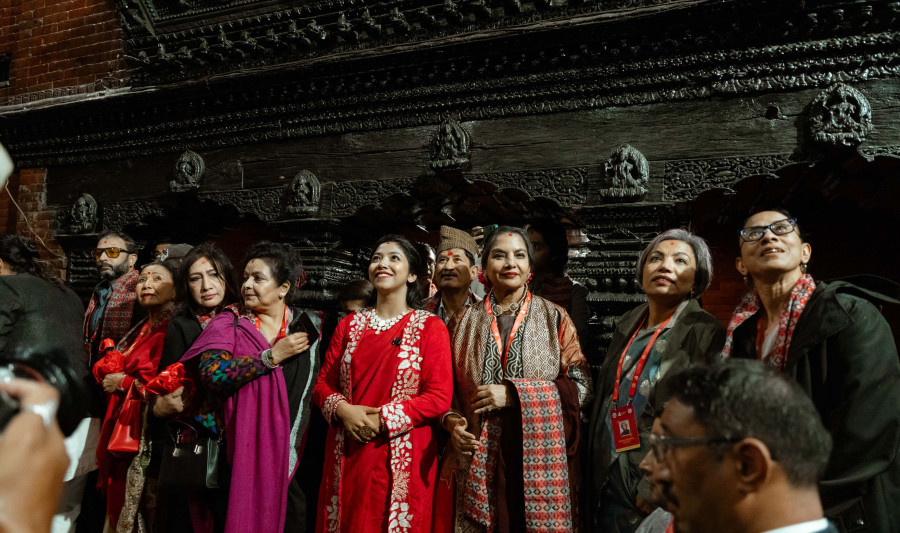
The festival screened new titles and restored classics, and brought together filmmakers to discuss the industry’s evolution, creative challenges and its future. Kathmandu Metropolitan City Acting Mayor Sunita Dangol (centre left) and Indian actor Shabana Azmi (centre right), among other dignitaries, pictured at the Kathmandu Film Festival on Friday. Photo: Courtesy of Ridish Maharjan
From celluloid filmmaking to digital productions that are putting Nepal on the world cinema map, the Nepali film industry has come a long way. Nepali films are winning awards in international film festivals. The number of films the industry is producing has risen drastically as well. And so has the revenues these films generate. Where does the industry go from here?
The three-day Kathmandu Film Festival saw discussions around this and other pertinent subjects. Alongside screening new titles, from Nepal and around the world, and restored classics, the festival, which concluded on Sunday, brought together a diverse set of stakeholders to discuss the shifting landscape of Nepali cinema.
The festival made room for both nostalgia—it screened such classics of Nepali cinema as ‘Ke Ghar Ke Dera’ (1985) and ‘Kumari’ (1977)—and curiosity about what lies ahead for the industry.
The festival featured conversations and masterclasses that helped advance dialogues about filmmaking. It included ‘Film, Festivals and a Life Well Lived’, a conversation between renowned Indian actor Shabana Azmi and Nepali actor Swastima Khadka, which explored women’s representation in cinema and the social responsibility of artists. “We must tell stories that compel society to question itself,” Azmi said, highlighting cinema’s role in challenging patriarchal attitudes.
The festival also hosted a masterclass by an Italian film critic and festival curator Marco Müller, titled ‘The Importance of Film Aesthetics from the Global South and the International Festival Circuit’. Along with that, two panel discussions—‘Nurturing Creative Cities through Films and Festivals’ and ‘Nepal’s Film Industry: Past, Present and Future’—also drew receptive audiences.
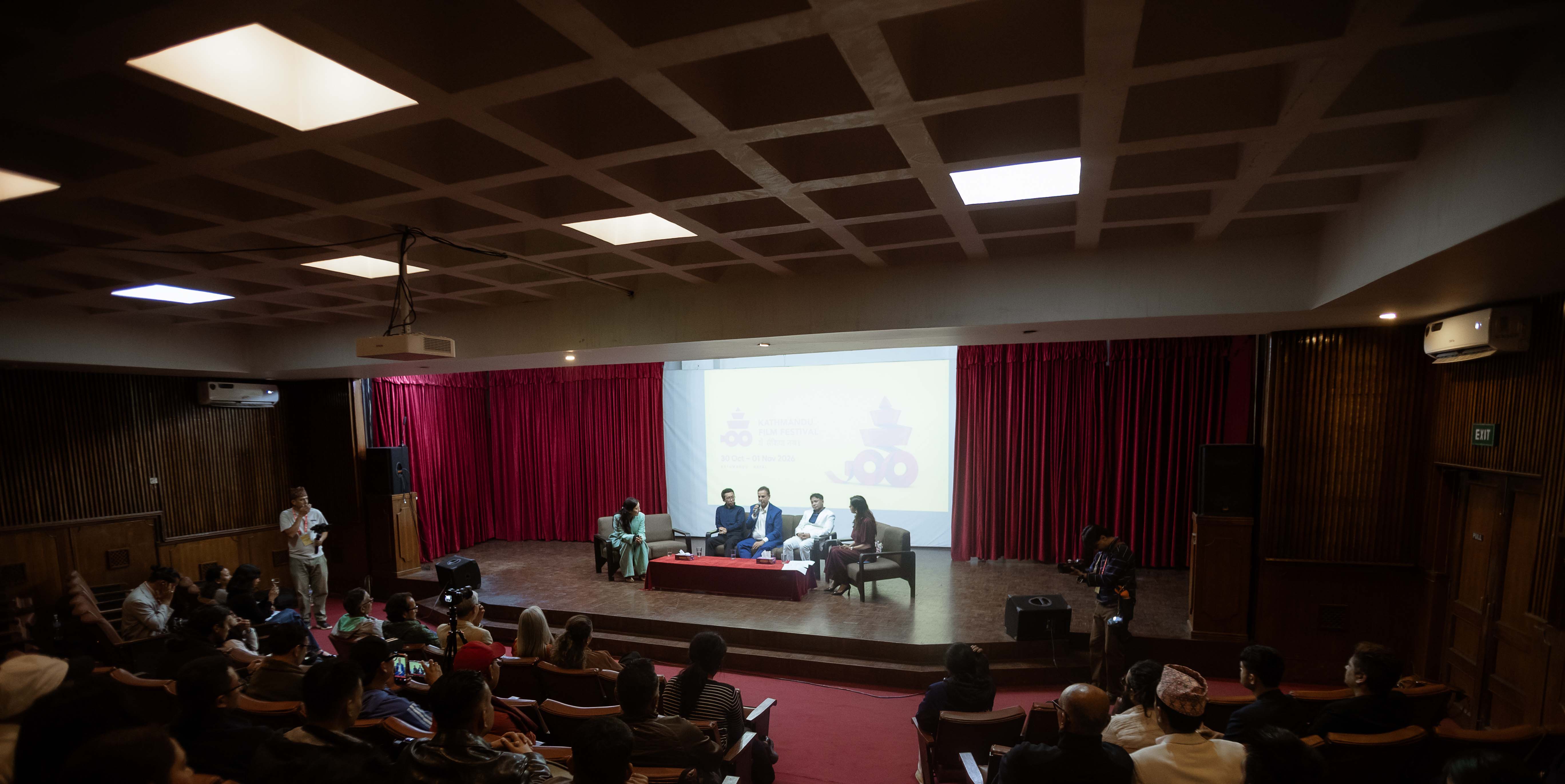
The latter of the panel discussion was held before the closing ceremony. And it provided an opportunity for a wholesale reflection on the Nepali film industry—what it was, what it is and what it will be. The discussion brought together veteran actor Hari Bansha Acharya, filmmaker and educator Ngima Gelu Sherpa, actress Thinley Lhamo and filmmaker-producer Prachanda Man Shrestha. The session was moderated by media personality Sugarika KC.
As Nepali cinema expands in film production, box-office earnings and cinema exhibitions, the panelists were asked whether its creative and institutional foundations had developed at the same pace.
Reflecting on the industry’s past, Hari Bansha Acharya, the legendary actor who debuted in Lobhi Papi (1990), recalled that earlier film productions were limited in number and relied on celluloid and 16mm formats.
“Earlier, there used to be one film in five years,” he said. “Now, we see almost 100 films per year on average.” Acharya also emphasised the importance of Nepali films in preserving the country’s cultural identity. “Nepal should be recognised and remembered not by its flag but by its films,” he said.
Production of Nepali films is rising. The arthouse-oriented titles are increasingly making their mark in the international stages and the box-office earnings are also on the rise. Does that mean the industry has a rosy future?
Panellists speak at the session ‘Nepal’s Film Industry: Past, Present and Future’. Photo: Courtesy of Prashna Maharjan
Prachanda Man Shrestha, co-producer of Nepal’s Cannes hit ‘Elephants In the Fog’ (2026), argued that increased production and box-office earnings alone can not secure the industry’s future. He said that the industry might lose more audiences in the future if it continues making films that seek to reproduce earlier hits and not seek “creative excellence”.
“In 2-3 years, the film industry will definitely fall further down if the same patterns continue without its creative excellence” said Shrestha.
Meanwhile, the rise of artificial intelligence has added another dimension. AI is gradually finding applications in Nepali filmmaking in various ways. Director Basanta Niraula, for instance, used AI during the pre-production of ‘Paanch Pandav’ to visualise a scene, while director Deepa Shree Niraula used the technology in ‘Chhakka Panja 5’ to make actor Deepak Raj Giri appear younger in a scene. However, documentary filmmaker and educator Sherpa cautioned against relying on AI simply to speed up the filmmaking process.
“As filmmakers, we should follow every step of filmmaking rather than rely on AI for faster results,” said Sherpa, whose documentary short ‘Home’ (2021) received a Special Mention at the International Short Film Festival Oberhausen.
When asked about the challenges faced by young filmmakers, Sherpa, who is 33, said finding their own voice and maintaining originality remained quite difficult.
The themes Nepali films of today revolve around also found a way into the discussion. Thinley Lhamo, the actress from Min Bahadur Bham’s ‘Shambhala’, spoke of the need for more authentic representation of Himalayan and Indigenous communities through original stories. Recalling her early experience in the industry, she said casting decisions had sometimes been based largely on appearance, gender and language.
“The criteria of working for my first film was only Mongolian girl, face, and language,” she said. Lhamo drew a comparison of Nepal’s filmmaking processes with those of international films. The scriptwriting process for ‘Tenzing’ had taken nearly 18 years, she said, citing an example of the time and research required to develop a strong, original film.
Looking ahead, Acharya drew on his experience of taking on serious roles in films such as ‘Balidan’ (1997) and ‘Bhuthan’ (2025) to encourage young filmmakers and actors to step out of their comfort zones. “I should not always remain in my mother’s lap,” he said.
Shrestha expressed optimism about the potential of Nepali cinema, arguing that a stronger focus on ‘creative excellence’—a phrase that recurred in his talk—could help the industry expand its domestic and international reach. “If we do best in creative excellence, the film industry will be at a minimum of 100 crore (1 billion) and international revenue will be 50 crore (500 million),” he said.
The festival’s closing event took place at Taragaon Next Museum in Baudha and saw the screening of filmmaker Deepak Rauniyar’s 18-minute film ‘Private Property’ (2026). Set in a US gas station, the Nepal-US-France-Australia production explores questions of race, prejudice, entitlement and belonging.
The inaugural Kathmandu Film Festival, organised by Kathmandu Metropolitan City, revisited the classics and debated AI and creative excellence. In doing so, it offered a glimpse of an industry negotiating its past while trying to define its future. The future of the Nepali film industry, the discussions suggested, will depend not just on how many films it makes or how much they earn—but on the originality, ambition and creative rigour of the stories it tells.




 13.72°C Kathmandu