Shabana Azmi on acting, equality and power of cinema
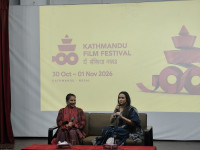
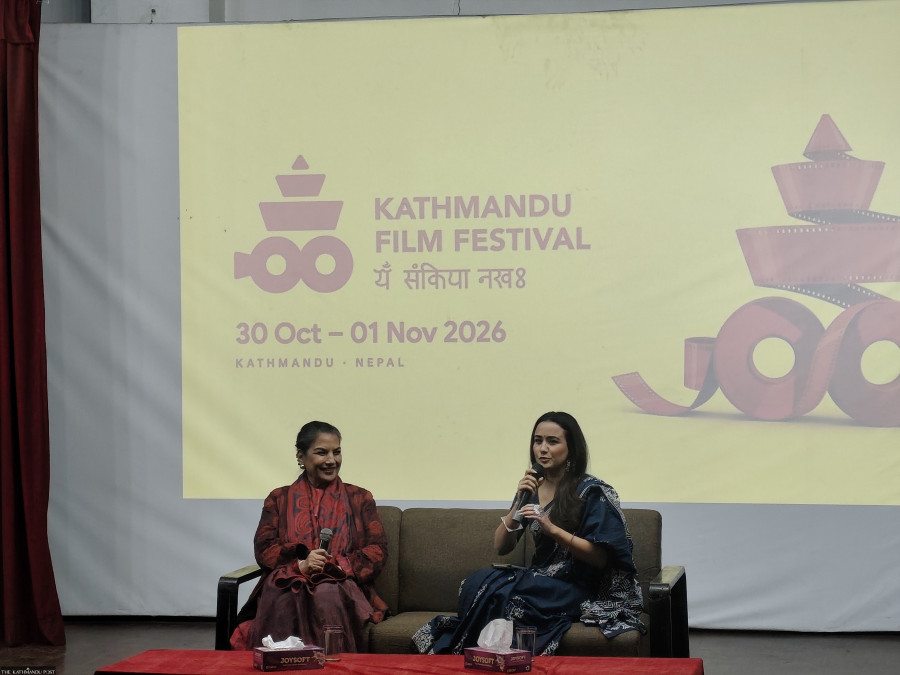
In a conversation with Swastima Khadka at the Kathmandu Film Festival, the veteran Indian actor reflected on her journey from ‘Ankur’ to mainstream hits, her marriage to Javed Akhtar and the responsibility of women artists. Although they come from different countries and generations, Azmi and Khadka share several similarities in their film careers. Post Photo
Sitting in a hall at Nepal Tourism Board in Bhrikutimandap, Kathmandu on a rainy Saturday, Indian actor Shabana Azmi revisited her career, childhood and relationships to an eager crowd that had braved the weather to hear her speak.
Sharing the stage with Nepali actor Swastima Khadka, Azmi also talked about the place of women in cinema.
The conversation was part of a film festival organised by Kathmandu Metropolitan City. Nepal is no stranger to renowned Indian actor Azmi. She has visited the country several times, accepting invitations to festivals celebrating cinema and the arts.
Khadka began by asking how acting first entered Azmi’s life. Azmi said that her mother, the celebrated theatre actor Shaukat Kaifi, used to take her to rehearsals when she was just six months old. Her childhood, however, was marked by financial hardship.
“We lived in a small room of around 180 to 200 square feet, and eight families shared a single bathroom,” Azmi said. “My father gave all the money he earned to the Communist Party, and our family received only IRs40 to run the household. In those circumstances, I began making up imaginary stories.”
When she decided to join the Film and Television Institute of India, she asked her father Kaifi Azmi, who is also a noted poet, whether he would support her choice. “Whatever path you choose, I will support you,” she recalled him saying. “Even if tomorrow you want to become a cobbler, I will support you—but you must be the best in that profession.”
Khadka asked whether the political awareness, gender equality and literary influences in her family had shaped her as an actor. Azmi spoke of a poem her father had written about 75 years ago, urging women to walk shoulder to shoulder with men rather than behind them.
“I grew up thinking equality was the natural order of life,” she said. “But when I was 19, I realised that equality was actually an exception in society.”
Azmi said she remains proud that many of her films engaged with social questions and left an impact on audiences. “There comes a time in an artist’s life when you cannot act as if it is just a nine-to-five job,” she said. “You cannot remain silent about serious issues such as exploitation, oppression and human rights.”
Although they come from different countries and generations, Azmi and Khadka share several similarities in their film careers. Azmi, who made her debut in Shyam Benegal’s ‘Ankur’, went on to establish herself in both the mainstream cineman and the arthouse. Khadka, meanwhile, began her acting career in commercial films, but ‘Bulbul’ marked a turning point. Since then, she has made her creative mark not only in mainstream cinema but also in arthouse films. Both actresses have built careers around stories of women's empowerment.
Azmi was conferred the National Film Award for Best Actress for her performance in ‘Ankur’ in 1974. She later earned acclaim for ‘Arth’ (1982), ‘Masoom’ (1983), ‘Paar’ (1984) and Deepa Mehta’s ‘Fire’ (1996), while also appearing in popular films such as ‘Amar Akbar Anthony’ and ‘Parvarish’ (both 1977), and ‘Avtaar’ (1983).
Azmi said she had often heard that an actor associated with arthouse films could not succeed in commercial cinema. “For an artist, the medium is less important than the story and the honesty with which it is told,” she said. “Commercial films made me financially secure, while art films gave me spiritual satisfaction.”
The discussion then turned to Azmi’s marriage to lyricist, screenwriter and poet Javed Akhtar. Khadka asked how two people with strong but different personalities made room for each other. Azmi said friendship was the foundation of their relationship.
“He is my best friend, and I am his best friend,” she said, describing herself as a minimalist and Akhtar as a maximalist. They respect each other’s space, she added. When an argument threatens to escalate, they use a simple phrase: “Drop it.”
“That phrase immediately ends the tension between us,” she said. “When both of us are calm, we return to the subject and discuss it. In love, the most important thing is to accept each other’s weaknesses and strengths.”
At Azmi’s request, Khadka spoke about her own marriage to filmmaker Nischal Basnet. She described them as very different in temperament: he is introverted, while she is extroverted. People wonder how the relationship works, but their basic values and outlook are similar.
“Although our habits and personalities are different, our fundamental values and thinking are very much alike,” Khadka said. “We share the same approach to life and the same sense of honesty, and that has strengthened our relationship.”
Asked how women could confront patriarchy both on and off screen, Azmi compared the roles written for women in the past with those being created today. Mainstream films once portrayed women as weak or as figures living in men’s shadows, she said, but that has gradually changed.
“Artists have a major role in this struggle for change,” she said. “We must tell stories that compel society to question itself.” She credited directors for offering her strong and meaningful roles that could influence audiences positively, and urged younger women actors to remain honest in their work and raise their voice without fear.
As the conversation between the two actors drew to a close, the floor was opened to the audience. A fan stood up and said that he had grown up watching her films and that he could hardly believe Shabana Azmi was sitting in front of him. Azmi appeared genuinely moved. “Thank you,” she said, and got ready for the next take.




 15.13°C Kathmandu