Chief ministers unite to press federal government on devolution
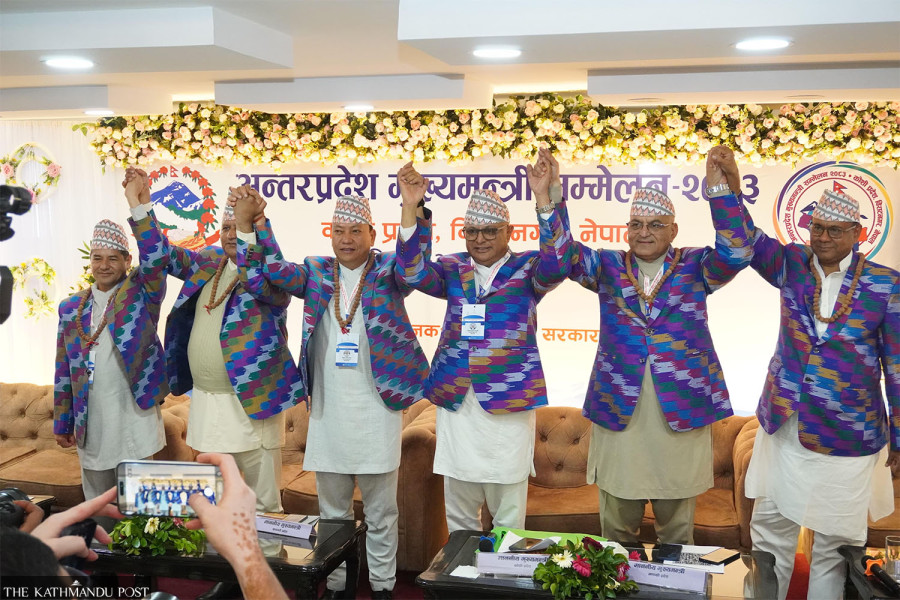
Their two-day meeting ended Wednesday with an agreement to form a joint forum to push for greater provincial powers, fiscal autonomy, and a clearer division of responsibilities with the centre. In the Koshi Declaration-2026 issued at the end of the conference on Wednesday, the chief ministers identified incomplete devolution of powers, limited provincial fiscal autonomy, and delays in transferring administrative structures as major obstacles to the effective implementation of federalism. Partbat Portel/TKP
Chief ministers of all seven provinces have agreed to form a joint forum to pursue shared concerns and press the federal government to implement constitutional provisions on federalism.
The decision was taken at a two-day interprovincial chief ministers’ conference organised by the Koshi provincial government in Biratnagar on Tuesday and Wednesday. The proposed Interprovincial Chief Ministers’ Partnership Forum will bring together all seven chief ministers to oversee the implementation of their joint commitments, monitor progress, and promote cooperation on development projects. The conference also agreed to hold chief minister-level meetings or conferences at least once a year to review progress.
In the Koshi Declaration-2026 issued at the end of the conference on Wednesday, the chief ministers identified incomplete devolution of powers, limited provincial fiscal autonomy, and delays in transferring administrative structures as major obstacles to the effective implementation of federalism.
They said unclear divisions of responsibility, delays in legislation, difficulties managing civil servants, and inadequate financial resources continued to undermine provincial governments’ ability to exercise their constitutional powers.
The chief ministers pledged to press the federal government to fully implement constitutional provisions, establish provincial police services, and ensure a fair distribution of financial resources.
A key demand concerns police adjustment. Although policing and public security fall under provincial governments’ exclusive powers under Schedule 6 of the constitution, the chief ministers said the necessary federal laws and institutional arrangements remained incomplete.
They called for the transfer of police personnel, infrastructure, property, records, and equipment to provincial governments, arguing that provinces needed these resources to maintain law and order effectively.
The declaration also urges the federal government to enact and implement the Federal Civil Service Act in a way that respects provincial constitutional powers and addresses their concerns. The chief ministers called for an end to uncertainty over the management of provincial chief secretaries, secretaries, and chief administrative officers in local governments.
Fiscal autonomy emerged as another major concern. The provinces want the federal government to release equalisation grants in full and refrain from reducing allocations midway through or towards the end of a fiscal year.
They also called for larger equalisation grants based on provincial expenditure needs and revenue capacity, alongside a gradual reduction in conditional grants. Such changes, they argued, would give provinces greater freedom to allocate resources according to local priorities.
The declaration calls on the federal government to stop using conditional grants to fund federal projects that overlap with investments in areas under provincial jurisdiction. It also demands adequate funding to complete projects transferred from the federal government but left unfinished because of budget shortages.
The chief ministers further asked the federal government to establish legal and institutional arrangements needed to allow provinces to approve investments exceeding Rs6 billion in sectors under their exclusive jurisdiction.
They also called for a fair and transparent distribution of revenue and royalties generated from hydropower, forests, mines and minerals, river-based materials and forest products. Their proposal is to account for provincial and local governments’ contributions to natural resource conservation and management, as well as the needs of communities affected by extraction.
The provinces also committed to pursuing joint projects involving roads and economic corridors, air connectivity, agricultural production and exports, tourism, energy, river basins, and disaster management.
They pledged to work towards removing unnecessary taxes and administrative barriers that hinder interprovincial trade and investment.
The agreement marks an attempt to give provincial coordination a more permanent structure rather than relying on occasional meetings. Its effectiveness, however, will depend on whether the joint demands lead to concrete actions by the federal government.
The chief ministers’ declaration sets out a common agenda, but progress on police adjustment, civil service management, and predictable fiscal transfers will ultimately depend on legislation, administrative action, and funding.




 18.78°C Kathmandu