From palace gossip to Gen Z protest report leak, Jana Aastha lays it bare
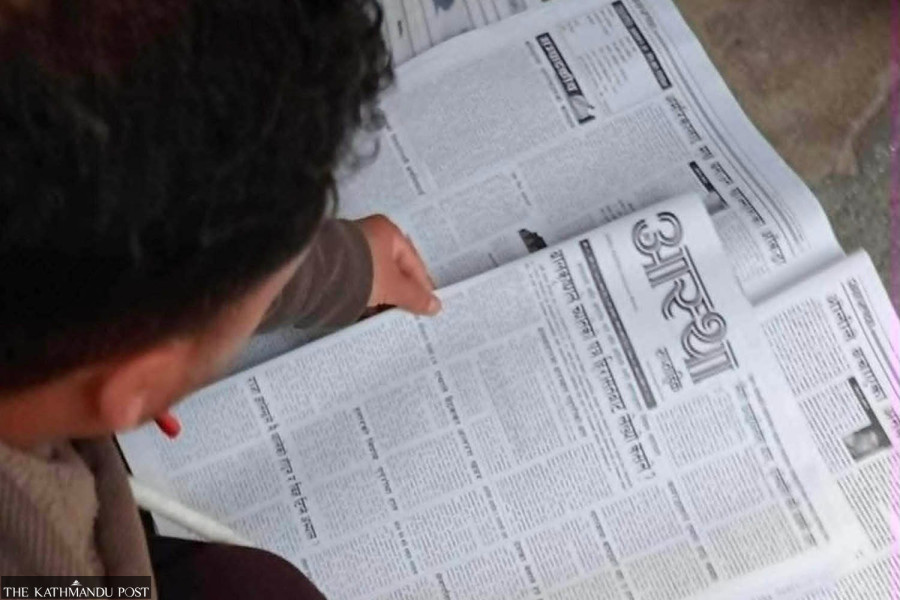
Following the leak of the report on protest inquiry, government has decided to ‘release’ it. A man leafs through Jana Aastha. At times, this tabloid has faced criticism for sensationalist reporting. Post photo
By leaking the report on the Gen Z killings and atrocities that the authorities had been sitting on for a fortnight, the weekly has once again cemented its decades-long reputation for breaking classified information and challenging the establishment.
In the early 1990s, as Nepal basked in the new light of multi-party democracy following an end of the party-less Panchayat system, weekly newspapers were the undisputed mainstream. Before the rise of broadsheet dailies, weeklies were the primary vehicles for political analysis and public information.
One of the most influential at the time was Drishti, operated as a ‘mission journalism’ project and widely regarded as the mouthpiece of the CPN-UML. At its peak, Drishti reportedly printed nearly 50,000 copies, with a young, aggressive journalist named Kishor Shrestha at the helm of its reporting team.
However, a rift soon developed between Shrestha’s team and the party leadership over the issue of editorial independence and professional ownership. In a recent interview with the Nayapage news website, Shrestha recalled his confrontation with the then-heavyweight UML leader Bamdev Gautam. Shrestha had demanded that the magazine be institutionalised and that ownership be shared with the journalists who built it. Gautam refused. Following the disagreement, Shrestha and his entire team walked out with nothing but their reputations.
“Except for the publisher Shambu Shrestha and Agni Shikha, almost the entire management and editorial staff joined me to start Jana Aastha,” says Shrestha. The team included figures like Khagendra Thapa Magar, Harish Phuyal and Bhikshu Ashwaghosh. Driven by the desire to practice independent and critical journalism free from party dictates, they launched their new venture on 8 March 1995, coinciding with International Women’s Day. They chose Wednesday as their publication day—the same day Drishti hit the stands then—to directly challenge their former employer.
The startup was funded by small contributions of Rs10,000 each from friends and Kathmandu local ward chairs, including Subhan Kumar Shrestha, Balkrishna Prajapati, Kalyan Bandhu Aryal, Dharma Ratna Tuladhar. With a total capital of Rs250,000, they opened an office in the Nepal Red Cross Society’s building at Bagbazar. Shrestha recalls that the cover story of their first issue was a 100-day review of the government, featuring congratulatory messages from veteran leaders such as Ganesh Man Singh and Jhalanath Khanal.
According to veteran journalist Sitaram Baral, the era was defined by partisan journalism. “Most weeklies were tied to a political party and served their specific interests. When the flood of daily newspapers arrived later, weeklies shifted their focus from news to ‘views’—sitting at a table to dissect or attack individuals based on ideology,” says Baral. “However, at Jana Aastha, we made factual, investigative news our foundation.”
Unmasking the palace
Jana Aastha quickly carved out a niche by exposing the inner workings of the Royal Palace, the Royal Nepali Army, and other opaque power centres. During a time when the monarchy was largely beyond reproach in the mainstream press, the weekly used disgruntled insiders to bring sensitive information to the public. Baral explains that those who lacked access to traditional power used the weekly as a reliable medium to voice their grievances.
One of the most significant cases they pursued was the Namita-Sunita murder mystery. On May 31, 1981, sisters Namita Bhandari and Sunita Bhandari from Kathmandu, along with their relative Neera Parajuli, went missing during a trip to Pokhara. The bodies of the sisters were later found raped and murdered by the Seti river, while Neera remains missing to this day. Thiscase became a symbol of Panchayat-era brutality, with allegations that high-ranking royals were involved and that the investigation was deliberately sabotaged. Shrestha had spent six months investigating this for Drishti in 1991, and he continued to use Jana Aastha to keep the pressure on the palace for similar atrocities.
In 2000, Jana Aastha broke the story of the death of musician Prabin Gurung, who was killed in a hit-and-run involving a vehicle driven by the then Prince Paras Shah. While the state attempted to suppress the news, Jana Aastha led a campaign to collect 500,000 signatures to demand justice, delivering them directly to the palace gates. It was taken as a rare moment of mass resistance against royal impunity.
The weekly also exposed the staggering disconnect between the ruling elite and the suffering of the masses during the Maoist insurgency. On the night of February 16, 2002, Maoist rebels attacked Mangalsen, the district headquarters of Achham, killing 129 people. While the nation mourned, Jana Aastha published a scathing report on February 20 detailing how political leaders in Kathmandu were busy attending lavish feasts and engaging in factional infighting that very night. The report, titled for its aggressive tone, exposed the "bone-crunching" luxury of the political elite while the rural population bled, creating a political firestorm.
Arun Baral, editor-in-chief of Jus Nepal online portal and a former staffer, remembers the weekly's peak years. “In our time, palace news broke every week. From the personal lives of the royals to their internal secrets, everything came out,” he says. But these scoops came at a price. Shrestha claims he received direct death threats from then Prince Paras and the army chief Prajjwal Shamsher Rana. “Prajjwal’s son Prabhas was reportedly roaming the streets with two pistols looking for me,” says Shrestha.
The threats were not empty. On Martyrs' Day in 2002, Shrestha was arrested from his office following the Achham report. Later, during the royal coup of February 1, 2005, a military squad of 21 soldiers led by a colonel occupied the Jana Aastha office for three weeks, censoring every word before publication. Arun Baral, who witnessed the occupation, recalls Shrestha’s defiance. “Even when the army tried to block content, Kishor Dai stood his ground and argued with the generals. While the rest of us were terrified, he remained unfazed, even publishing satirical cartoons to mock the censorship.”
The scandal crossing the line
Despite its reputation for bravery, Jana Aastha has often been accused of crossing ethical boundaries into sensationalism. The most tragic example remains the suicide of actress Srisha Karki. On October 9, 2002, the weekly published a front-page story titled “The Colourful Nights of Film City,” which included a Karki’s nude photograph. Four days later, the actress died by suicide.
This incident triggered intense debates over media ethics and the right to privacy. Journalists Bishwamani Subedi and Yadav Prasad Pandey, who reported the news story, were arrested in January, 2003. Although the Attorney General later dropped the charges, the stigma remained.
Jana Aastha has faced recurring criticism over the years as a direct result of this report. “I was forced to go underground for two years,” Shrestha recalls. “However, there is no evidence to suggest that the suicide was a consequence of that specific news story. Nevertheless, I am repeatedly castigated for it.” Shrestha has consistently defended himself against these allegations, maintaining that the post-mortem report provided no link between the publication and the tragic death.
The ‘factory’ of producing journalists
Amidst the praises and controversies, Jana Aastha served as an unconventional but effective school for a generation of journalists who now lead Nepal’s mainstream media. In its early days, the weekly was supported by intellectual heavyweights like the late Kamal Koirala, Ramesh Bikal, Bhikshu Ashwaghosh and Suresh Manandhar. Their involvement transformed the newspaper into an intellectual forum as much as a tabloid.
The list of former journalists from Jana Aastha reads like a ‘Who’s Who’ of Nepali journalism. Sudheer Sharma, former editor-in-chief of Kantipur; Gunaraj Luitel, editor-in-chief of Nagarik; and Rajaram Gautam, former editor of Annapurna Post, all began their professional journeys there. Others include Matrika Paudel, Parshuram Kafle, Sitaram Bhattarai, Chudamani Bhattarai, Tikaram Rai, Madhav Dhungel and Binod Dhungel. The aggressive, fact-driven ‘schooling’ they received under Shrestha’s leadership helped shape the investigative rigour of the dailies they would later lead.
Mob psychology and digital frontier
Despite its various triumphs and tribulations, Jana Aastha remains a paper in high demand—a publication where suppressed and sensational news continues to find its way to the light. According to Chairman Shrestha, the weekly currently employs 19 journalists in Kathmandu alone. However, the nature of the challenges has shifted with the times. In Shrestha’s view, “In the past, the establishment lived in fear; today, it is the mob that dominates.”
Shrestha points to the ‘mob psychology’ fostered by social media, where a single incident can lead to an individual being permanently branded as guilty in the court of public opinion. He maintains that ‘trust’ is journalism's most vital asset—a currency that must be meticulously preserved for the sake of both sources and readers.
By making the findings of the Gen Z movement report public, Jana Aastha appears to be leveraging the Right to Information to enforce state transparency while simultaneously re-establishing its own editorial influence. Shrestha asserts that the weekly obtained this classified information solely through the credibility it holds with its deep-rooted sources. Yet, this disclosure has also resurrected long-standing questions regarding the reliability of such sources, the strategic timing of these leaks, and the inevitable political ripples they create.




 19.43°C Kathmandu