Nepal-India relations in uncertain territory as new government charts assertive course
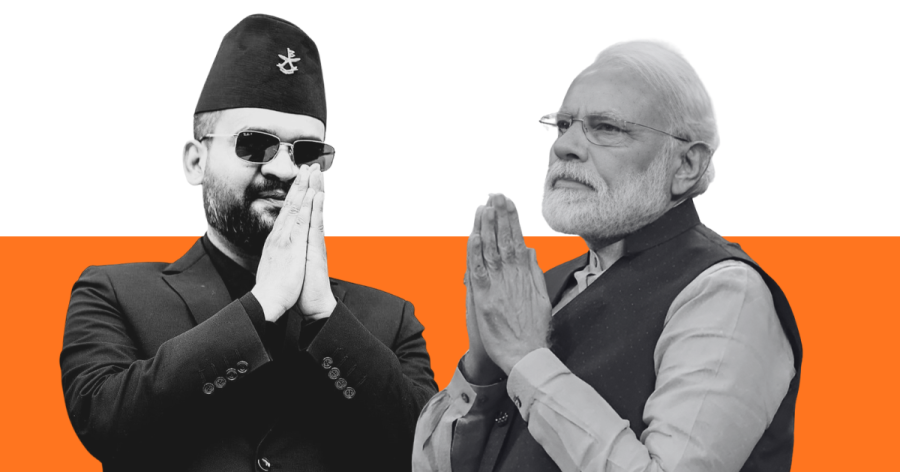
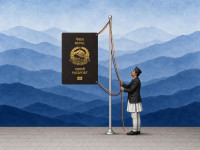
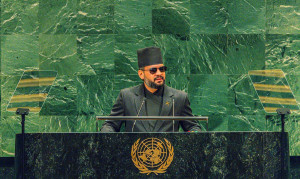
Prime Minister Balendra Shah’s break from Nepal’s tradition of diplomatic deference has unsettled New Delhi and raised a question his government cannot yet answer: is this a foreign policy or just a posture? Post Illustration
In the first six weeks of his government, Prime Minister Balendra Shah has declined to meet India’s ambassador. He has refused a request from the special envoy of the United States president. He has imposed customs duties that disrupted the daily commerce of millions of people living along the Nepal-India border. And he sent a formal diplomatic protest to both New Delhi and Beijing over a Himalayan pilgrimage route that his country claims as its own sovereign territory — a protest that landed just days before India’s foreign secretary was due to arrive in Kathmandu, and that helped prompt the visit’s postponement.
The cumulative signal has been unmistakable to the diplomats, analysts and foreign policy observers who watch the relationship between Nepal and India: the new government in Kathmandu intends to do things differently. What remains unclear is whether the approach reflects a coherent foreign policy doctrine or the early missteps of an inexperienced administration navigating the weight of office for the first time.
“Diplomats and officials from both sides admit that Shah not meeting the Indian ambassador in person, the imposition of customs duties, the prime minister’s refusal to meet the Indian foreign secretary, the revival of boundary disputes and the postponement of the foreign secretary’s visit — all happening within 45 days — signals a nationalist posture,” said one foreign policy analyst who studies the bilateral relationship, and who spoke on condition of anonymity, fearing his comments would provoke retribution.
The Post spoke with more than a dozen sources for this article, including current and former Indian diplomats, bilateral relations analysts, foreign policy experts, academics and officials within Nepal’s foreign ministry and the Rastriya Swatantra Party government. Almost all of them asked not to be named, citing diplomatic protocols and fear of retribution.
The RSP’s rise has been meteoric by any measure. The party was established only in June 2022, and in its first national elections that November, it won 21 seats in the House of Representatives. Shah himself had entered elected politics as an independent candidate, winning the Kathmandu mayoralty in May 2022. In the March 5 elections this year, the RSP won 182 of 275 seats in the House of Representatives, taking 125 directly and 57 through proportional representation. It was a mandate without precedent for a party so young, and it carried with it expectations — in Kathmandu and in New Delhi alike — that it would usher in a new era in Nepal’s foreign relations.
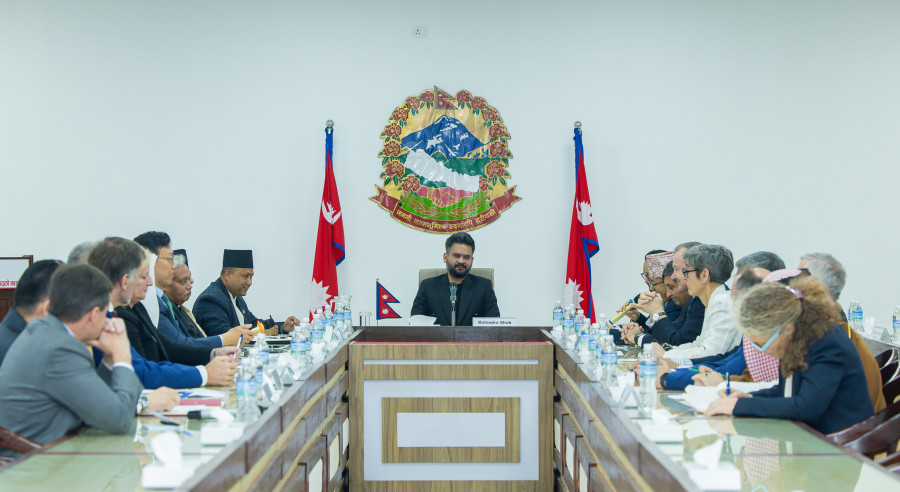
Prime Minister Balendra Shah held a joint courtesy meeting with 17 Kathmandu-based ambassadors at Singhadurbar on April 8—breaking with a long tradition of individual, unstructured meetings with foreign envoys. File Photo: Courtesy of Prime Minister's Secretariat
Those relations had long been defined by what critics called “surrender diplomacy” — a pattern, under the Nepali Congress, the CPN-UML and the Maoists, in which prime ministers received foreign ambassadors within hours of taking office, sometimes without foreign ministry officials present, and met junior officials from powerful countries without apparent regard for protocol or reciprocity. India, given its size and Nepal’s near-total economic dependence on it, had been the primary beneficiary of that deference.
“In the past, Congress, UML and the Maoists had totally surrendered the protocol of the high office,” said Kamal Thapa, a former foreign and home minister who watched the pattern play out across decades of Nepali politics. The expectation in New Delhi was that the RSP, whatever its nationalist rhetoric, would ultimately behave as its predecessors had.
That expectation took shape against the backdrop of the Gen Z Revolution of September 2025 — the uprising in which young Nepalis took to the streets after the government banned social media platforms, eventually forcing then-Prime Minister KP Sharma Oli to flee his official residence by helicopter as crowds set fire to the homes of senior political figures, the parliament building, the Supreme Court and parts of the main government administrative complex. Seventy-eight people were killed and many more were injured in two days of violence that produced one of the most dramatic political transformations in Nepal's recent history. The interim government that followed, led by Sushila Karki, guided the country to elections. That India had stayed out of the upheaval was noted appreciatively on both sides; it indicated, some analysts said, a maturity in the relationship that augured well.
Modi reached out personally to Shah and RSP president Rabi Lamichhane after the March 5 result, congratulating them on their decisive win and reaffirming India’s commitment to working with Nepal. The goodwill was genuine, but it did not last long.
Following Shah’s entry into national politics in early January, Indian diplomats in Kathmandu and figures connected to the Bharatiya Janata Party and its affiliate, the Hindu Swayamsevak Sangh — the overseas wing of India’s Rashtriya Swayamsevak Sangh — made repeated efforts to meet him. Some reached his close confidants. But despite sustained effort, according to two sources affiliated with the Hindu Swayamsevak Sangh who spoke to the Post, Indian diplomats were unable to secure a direct meeting with Shah before or after the election. Those who knew him hoped the dynamic would change once he was sworn in. It did not.
Unlike his predecessors, Shah showed little interest in meeting foreign envoys individually. According to two Nepali government officials familiar with the matter, India applied significant pressure through formal and informal channels, urging him to meet Indian Ambassador Naveen Srivastava after taking the oath of office. Shah declined.
The refusal was part of a new policy in the new administration. Two RSP leaders told the Post that the decision not to meet foreign officials below the rank of head of government or minister had been agreed upon during the weeks of transition between the election and Shah’s swearing-in on March 27. Foreign ministry officials who spoke to the Post describe it as a blanket stance: Shah has not held an on-record bilateral meeting with any ambassador since taking office. His senior aides have been instructed to seek prior clearance from their supervisors at the Prime Minister’s Office before meeting foreigners.
Finance Minister Swarnim Wagle and Foreign Minister Shisir Khanal both pushed back. Knowledgeable officials told the Post that Khanal and Wagle had spoken to the prime minister directly about the need to engage with senior officials from India, China and the United States. “The prime minister politely refused,” officials familiar with the development said. Shah, a man of few words, indicated he intended to hold the line.
Anurag Acharya, a foreign policy analyst who heads the think tank PEI, argued that the problem is not the existence of a protocol but its inflexibility. “These protocols must be measured and flexible, to reflect our own interests and priorities,” he said. “International experience shows that government heads have broken established protocols when it comes to their national interests — we have seen powerful presidents and prime ministers receive and see off their counterparts at the airport, against protocol, as a diplomatic gesture to create a conducive environment for bilateral negotiations.”
The question, Acharya said, is not whether Nepal should have a protocol. “We should, but they must facilitate rather than create unnecessary friction in our external engagements,” he told the Post. “If an important trade partner or a powerful neighbour has sent a special envoy, the prime minister does not have to get hooked on the protocols, especially if the meeting can open avenues for deeper bilateral cooperation.”
That overcorrection, former foreign minister Thapa argued, carries its own risks. “The prime minister should also not go to the other extreme, which will also be counterproductive for the country. We cannot put all external actors in one basket,” he said. “We should proactively engage with our immediate neighbours and major powers by fixing our priorities — we have to deal with them on an issue basis and based on our needs. As Nepal stands to lose more if relations with them are strained, the onus lies on us.”
It was against this backdrop that Foreign Minister Khanal travelled to Mauritius on April 9, having received an invitation from India Foundation — a think tank with close ties to the ruling BJP — to attend the ninth Indian Ocean Conference, co-organised by India’s Ministry of External Affairs. The meeting with his Indian counterpart, S. Jaishankar, on April 10 produced the clearest signal yet that both sides wanted to stabilise the relationship. Khanal told journalists afterwards that Shah had accepted Modi’s invitation to visit India, though the trip would not happen immediately.
Both sides agreed to activate bilateral mechanisms and explore new areas of cooperation before scheduling high-level visits. Jaishankar committed to sending Foreign Secretary Vikram Misri to Kathmandu for a third visit — he had first come in August last year — a traditional gesture of engagement extended by New Delhi to incoming Nepali governments. In 2018, after the Nepal Communist Party’s landslide, India had sent then-Foreign Minister Sushma Swaraj.
The Mauritius understanding was encouraging. In the weeks that followed, in rapid succession, it began to unravel.
Nepal decided to strictly enforce a customs duty on goods valued at more than Rs 100 — less than a dollar — brought across the border from India, citing the need to increase revenue and curb smuggling. The provision itself was not new: Shyam Prasad Bhandari, director general of the Department of Customs, noted that it had existed in customs directives since the mid-1990s. But the strict enforcement was novel, and the practical effects were immediate. Families on both sides of the border share deep cultural, social and economic ties; border residents who routinely crossed for household goods found themselves stopped and taxed. Madhesh-based parties, whose constituents live in the affected districts, quickly opposed the decision.
Surendra Jha of the Janata Samajbadi Party, whose party had fought the provision for decades, said the enforcement exposed a fundamental hypocrisy in how Nepal polices its border. “There are cases of big-time smuggling taking place at the border at night in collusion with security agencies, which doesn’t come under surveillance,” he said. “But people buying small goods are being scrutinised. That is deplorable.”
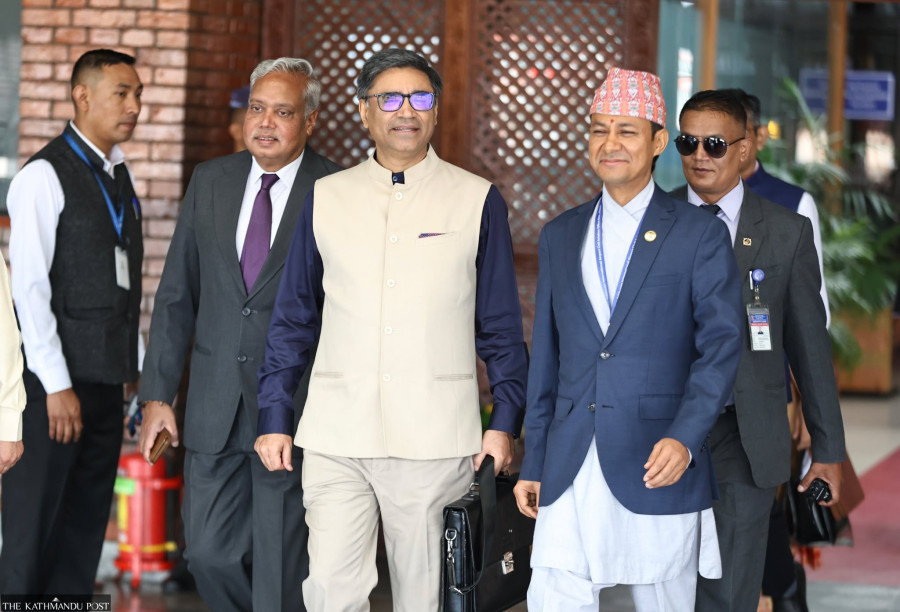
Indian Foreign Secretary Vikram Misri (third from the left) during his visit to Nepal on August 17, 2025. Post File Photo
India’s Ministry of External Affairs was measured but pointed, confirming it remained “engaged on the developments,” a diplomatic language that signalled concern without confrontation.
Chandra Dev Bhatta, an author and geopolitical commentator, said the enforcement exposed a broader confusion about what the policy was meant to achieve. Discouraging small cross-border purchases would not build economic self-sufficiency, he argued — markets matter as much as local production. “Imposing high taxes on goods with values over 100 will not achieve self-sufficiency — it risks giving the impression that we are acting as a rentier state,” he told the Post. “Nepalese tea export to India was facing difficulties, and a harder stance from India could create long-term problems.” This week, India said it was relaxing the mandatory testing requirement imposed on imported tea, easing concerns among Nepali tea producers.
Then the Lipulekh dispute exploded into the open.
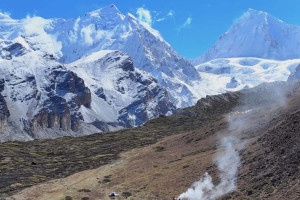
On April 30, India’s Ministry of External Affairs announced that the 2026 Kailash Mansarovar Yatra — the Hindu pilgrimage to Mount Kailash and Lake Mansarovar in Tibet — would take place between June and August, coordinated with China. Pilgrims would travel in batches of 50, with one route passing through Lipulekh Pass in Uttarakhand, a high-altitude crossing at 17,000 feet that Nepal claims as its own sovereign territory. Nepal said it was neither consulted nor informed before the route was announced.
Nepal's Ministry of Foreign Affairs issued a formal diplomatic protest on May 3, stating that Limpiyadhura, Lipulekh and Kalapani, east of the Mahakali River, are “integral parts of Nepal since the Sugauli Treaty of 1816,” and urging both India and China not to conduct road construction, border trade or pilgrimage in the area. The RSP, which had staked out a firm position on the boundary dispute while in opposition, could not stay silent. India’s MEA rejected Nepal’s claim as “neither justified nor based on historical facts and evidence,” describing Nepal’s territorial assertions as “untenable,” while reiterating willingness to resolve boundary disputes through dialogue.
Speaking to the parliamentary committee on Wednesday, Khanal offered the government’s most detailed public account yet of where the dispute stands. He said both countries are moving toward resolving border issues, including Lipulekh, through dialogue — and that India’s response to Nepal’s diplomatic note had itself signalled a willingness to negotiate. “We naturally sent a note asserting our own claims. They also had their own claims regarding the border issue. But their position is that it should be resolved through diplomatic efforts, and that is the response we received,” he said. He noted that technical committees from both countries have been actively working on boundary demarcation — work that pauses during the monsoon season but has been ongoing since last year, after a long hiatus. “I think that, after a long time, Nepal and India are gradually moving toward resolving the border issues diplomatically and through dialogue,” Khanal told the committee.
The combination of the live territorial dispute and the protocol standoff — Shah had already refused to meet Samir Paul Kapur, the American assistant secretary of state, when he visited on April 20 — made proceeding diplomatically untenable. Misri’s visit, tentatively scheduled for May 11, was postponed. The two sides have since offered different accounts of why.
On Wednesday, Khanal said Nepal had received communication from India that the visit was postponed due to important internal meetings in New Delhi. “Due to some internal and various other important meetings recently held in India, the visit was postponed, and this information has been received by the Ministry of Foreign Affairs,” he said, adding that the postponement had not affected Nepal-India dialogue in any way. That framing — placing the reason squarely on India’s schedule rather than on the diplomatic friction — stands in contrast to accounts from multiple diplomats and analysts, who described the Lipulekh protest note and the protocol standoff as the primary drivers.
“Anxieties ran high in India’s Ministry of External Affairs over the possibility of Shah repeating the same protocol with Misri,” said one Nepali diplomat with knowledge of the internal conversations. “Considering Nepal’s special ties with India, New Delhi had initially expected Shah to avoid the protocol issue with Misri.”
The Indian Embassy did not respond to the Post’s request for comment.
Behind the diplomatic friction lies a structural reality that no amount of nationalist posturing can easily alter. India accounts for more than 60 percent of Nepal’s total trade, with bilateral trade reaching over $8 billion in the fiscal year 2023-24. It is Nepal’s largest source of foreign direct investment and provides transit for almost the entirety of Nepal’s third-country trade. India supplies close to 100 percent of Nepal’s petroleum products. Shankar Sharma, the outgoing Nepali ambassador to India, recently recalled by the Shah government, was emphatic on returning to Kathmandu. “From petroleum products to fertiliser to essential goods like medicine to energy trading, we depend on India. No other country can replace India’s position in our external engagements,” he said.
The dependency has grown more acute in recent weeks. With fuel prices rising globally amid the Iran-US conflict, Nepal has requested India to supply fertiliser to cover the planting season. Foreign Minister Khanal confirmed on Wednesday that Nepal is purchasing 80,000 metric tons of chemical fertiliser from India under a government-to-government arrangement.
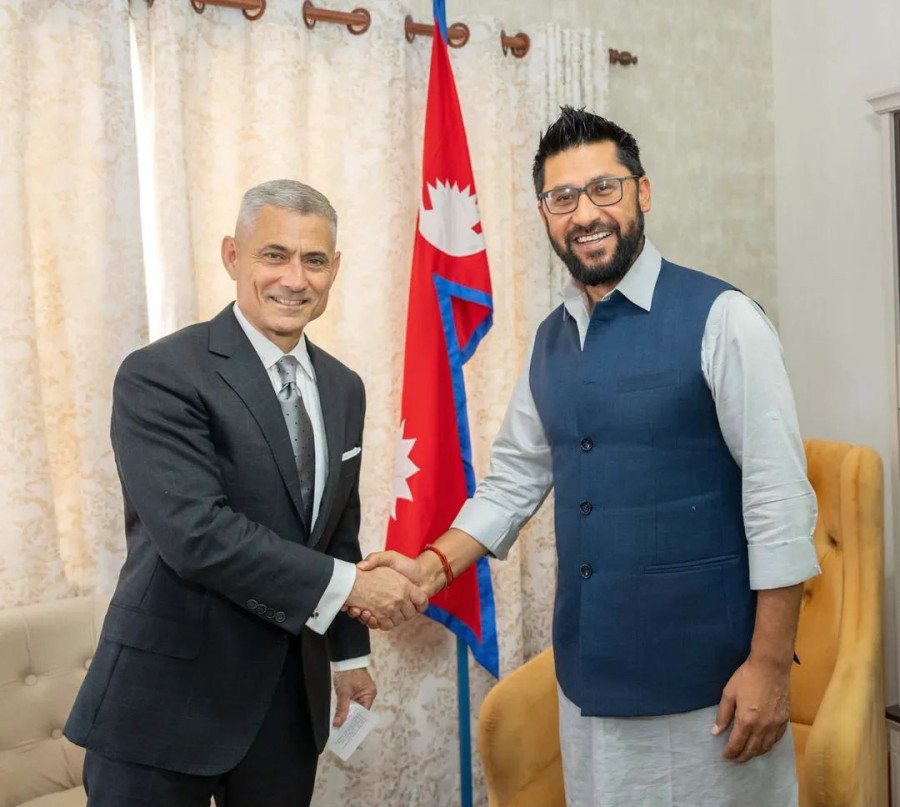
The US Assistant Secretary of State for South and Central Asian Affairs Samir Paul Kapur (left), with the ruling Rastriya Swatantra Party chair Rabi Lamichhane during his visit to Nepal on April 21. File Photo
On the substantive agenda for any future high-level engagement, priorities have been identified on both sides. The new government wants to resolve the long-standing air route dispute, complete stalled India-funded infrastructure projects, and revisit the terms of Gurkha recruitment following India’s 2022 introduction of the Agnipath scheme, which dramatically changed service terms for soldiers from Nepal, retaining only 25 percent of recruits after a four-year tour and releasing the rest without pension. Foreign Minister Khanal also wants to revive the Pancheswar Multipurpose Project, a massive hydropower initiative envisioned under the 1996 Mahakali Treaty that has languished without visible progress for nearly three decades. There are also items the RSP is consciously setting aside: two RSP leaders told the Post that the new administration has little interest in taking up the report of the Eminent Persons Group on Nepal-India relations.
The Indian response to all of this, in public and in private, has been to absorb the friction without escalating — betting that the relationship’s structural weight will ultimately pull Kathmandu back toward engagement. Pankaj Saran, a former Indian ambassador who later served as Deputy National Security Adviser, urged patience. “The stakes are too high for both countries to allow individual incidents to derail the promise of a new relationship based on mutual respect and advantage,” he said. “The sentiment in New Delhi is to welcome the emergence of a new generation of leaders in Nepal and be ready to take the bilateral relationship to newer heights. These are still early days.”
Professor Mahendra P. Lama, who served on the Indian side of the Eminent Persons Group, offered the most analytically pointed diagnosis. The RSP government, he argued, has so far pursued only cosmetic changes in foreign policy — the collective envoy meetings, the one-year foreign travel moratorium, the customs enforcement, the Lipulekh note — while the more substantive questions remain unaddressed: the terms of electricity export, the infrastructure financing pipeline, and the possibility of transforming Nepal from what it has historically been, a buffer state, into what the RSP’s manifesto envisions, a bridge between India and China enabling trilateral economic cooperation.
More significantly, Lama argued, the traditional architecture of Indian influence inside Nepal’s political system has been disrupted. “The traditional constituencies of influence, channels through which their cultivated ambitions flowed, and their overt and covert instruments of action within the government of Nepal are, for the time being, fragile, difficult to identify, and under close internal scrutiny,” he said. “Therefore, India and other countries have no option other than to closely watch and patiently wait.”
On the larger question of where the relationship is heading, Bhatta, the geopolitical commentator, said the accumulation of frictions reflects a diplomatic failure on both sides, though more so on Nepal’s. The Lipulekh dispute, handled through confrontation rather than negotiation, closes doors without resolving anything.
“By closing doors to negotiation, we limit our options — but at the same time, we cannot, and should not, negotiate away our own territory,” he said. “A middle-path approach could have offered a solution, but it requires diplomatic acumen rather than activism.” The deeper risk, Bhatta argued, is one of drift — of a relationship with centuries of historical weight being pulled into currents neither side fully controls.
“The key question is whether Nepal-India relations will become trapped in a geopolitical vortex, or whether we can navigate them for the genuine interests of both countries,” he said. “Everything depends on our own actions — a prudent approach can safeguard relations, while a haphazard one could jeopardise ties that run far deeper than any single government.”
Acharya, for his part, argued that Shah possesses an asset he has not yet deployed. His Madhesi identity and his international popularity have earned him genuine regard not just among India’s foreign policy establishment but among Indian society more broadly — a reservoir of goodwill that few Nepali prime ministers have enjoyed. “Shah has a historic opportunity to use his image and popularity to bridge the differences that have haunted bilateral relations for over a decade,” he said. “Whether he chooses to use his popularity to rise like a statesman, or pander to his nationalist base, is his decision.”
For now, the two sides appear to be looking for a way back to each other. Khanal is due to travel to New Delhi by the end of the month to attend the first summit of the International Big Cat Alliance, where he is expected to meet Jaishankar. Nepal’s foreign ministry says it expects the Indian foreign minister’s visit to Kathmandu to follow on a reciprocal basis. The more consequential marker will be whether Misri’s visit can be rescheduled — and whether, when he arrives, he will be received by the prime minister himself. The answer to that question will say more about the trajectory of Nepal-India relations than any diplomatic note or missed meeting so far.
“This is not the time to stand on protocol issues for both countries,” said Suhasini Haidar, diplomatic affairs editor of The Hindu, noting that the Iran-US conflict and its reverberations across South Asia make the current distance between the two capitals particularly ill-timed. “They should schedule early visits to Nepal by Foreign Secretary Misri and to India by Prime Minister Shah and his ministers.”
Anil Giri is a Chief Sub Editor covering diplomacy, international relations and national politics for The Kathmandu Post. Giri has been working as a journalist for more than two decades, contributing to numerous national and international media outlets.




 14.46°C Kathmandu