Enrolment is rising in Nepal’s gurukuls and Sanskrit universities. But is it a genuine revival or a reinvention driven by ritual economics, Hindu nationalism, and the lure of free room and board? Students waiting to enter the entrance examination Hall at Harihar Sannyas Ashram, Devghat Photo: Acharya Tribhuvan Neupane/Facebook
Once dismissed as a “dead language,” Sanskrit is witnessing a quiet but noticeable resurgence in Nepal. Across traditional institutions, student enrolment is rising after decades of decline, raising an important question: is this a genuine revival, or simply a reinvention shaped by new social, political, and economic realities?
In the Devghat area spanning Tanahun and Chitwan districts, around 1,000 students are currently studying Sanskrit at institutions such as Mahesh Sanskrit Gurukul, Paramananda Sanskrit Gurukul (run by Harihar Sannyas Ashram), and Gargi Kanya Gurukul. (A gurukul is an ancient residential system of learning.)
Professor Guru Prasad Subedi of Nepal Sanskrit University in Dang recalls a different reality from his student days. Following the restoration of democracy in 1990, he says, it was once difficult to find students willing to pursue Sanskrit.
Today, that picture has changed significantly. At Harihar Sannyas Ashram, around 300 students sat for an entrance examination on April 18 for just 25 available seats in grades 6–12. For Subedi, this signals growing interest among students and parents alike.
A similar experience is reported by Achyut Prasad Lamichhane, chair of Balmeeki Campus in Kathmandu, affiliated with Nepal Sanskrit University. “There were hardly 300–400 students at our campus two decades back,” he said. “Now the number has risen significantly, to the point where some faculties are forced to turn students away due to limited quotas.”
Balmeeki Campus currently has 1,088 students enrolled across various faculties — more than it can accommodate given its budget constraints.
According to the Ministry of Education, the government allocated Rs 1.40 billion in the last fiscal year for the university’s 12 constituent and 19 affiliated campuses, out of a total education budget of Rs 211.17 billion for fiscal year 2025/26.
Ambika Adhikari, who oversees accounts at Nepal Sanskrit University, says that the budget is constrained because the university has to pay pensions to former staff from its budget. “The university has to bear almost Rs 18 million in pension payments annually,” he said.
At Gargi Kanya Gurukul in Devghat, Bharatpur-1, Chitwan, principal Goda Subedi says enrolment has risen steadily in recent years. The gurukul, which teaches girls from Brahmin, Dalit, and Indigenous communities, previously enrolled around 70–75 students. For the new academic session it set a target of 100, and more than 43 students sat the April 20 entrance examination.
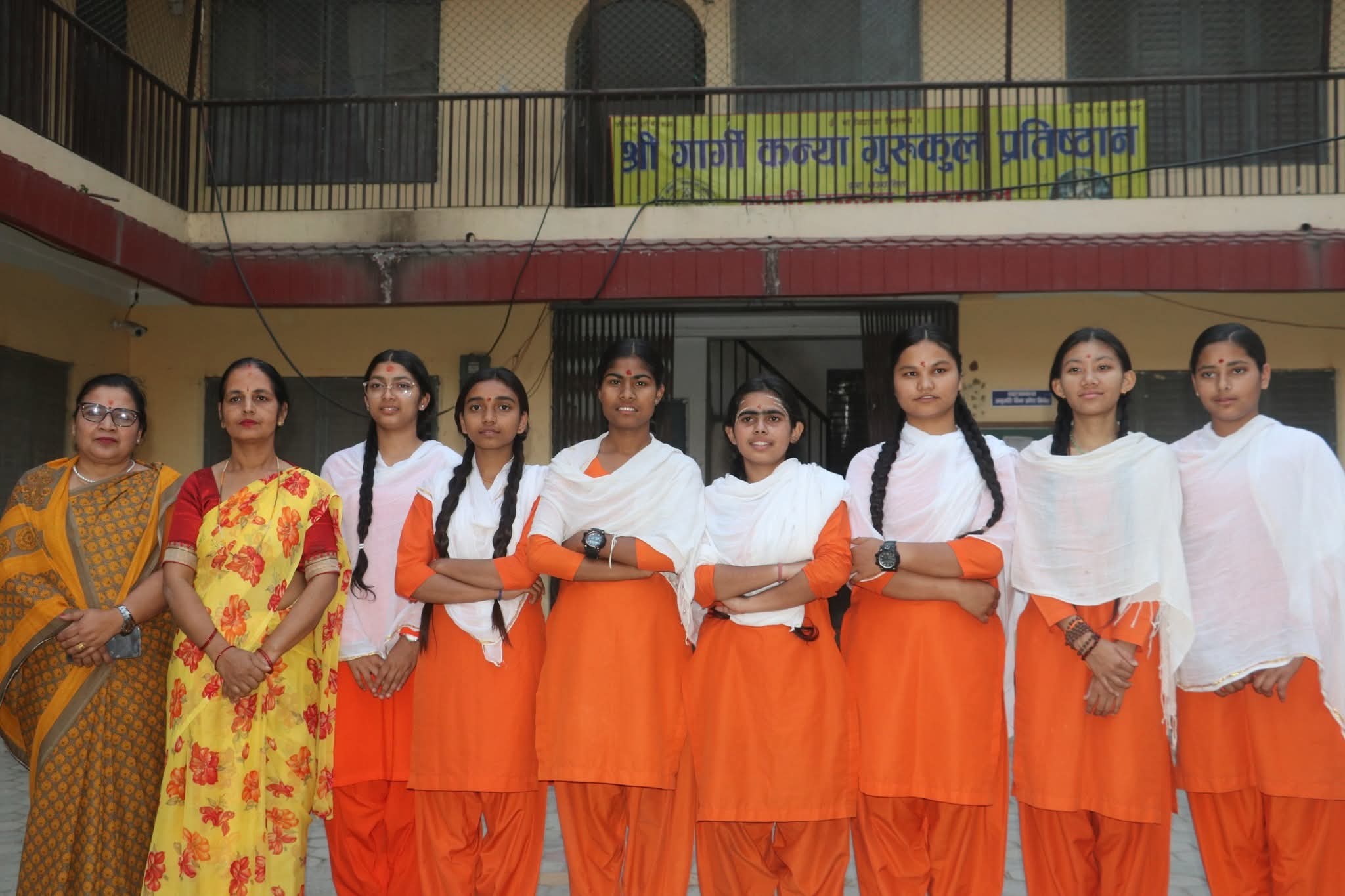
Students of Gargi Kanya Gurukul, Devghat Photo: Courtesy of School Management Committee
Mahesh Sanskrit Gurukul enrolled 33 students — out of 200 — for the new academic session. Subedi, the principal of Gargi Kanya Gurukul, said her school admitted 21 of 43 students who sat the entrance exam.
Nationwide, Professor Subedi estimates around 25,000 students are currently studying Sanskrit. Some 500 gurukuls operate across the country — about 300 registered and 200 unregistered — enrolling an estimated 15,000–20,000 students. Nepal Sanskrit University’s constituent and affiliated colleges account for a further 4,943 students at the Shastri (bachelor’s) and Acharya (master’s) levels, according to Giriraj Sharma, the university's administrative chief.
According to Ghanashyam Sigdel, a deputy administrator of Balmeeki Campus, the renewed appeal lies largely in Sanskrit’s growing link to livelihoods. Those trained in yoga can find work in their own communities, while demand abroad has grown — particularly for individuals skilled in karmakanda, the branch of Sanskrit dealing with ritual practice.
The profile of learners is diversifying as a result. Alongside young students, retirees from government and private sectors are turning to Sanskrit, drawn partly by karmakanda’s practical portability. “With most of their children living abroad, they often travel to visit them,” Sigdel explains. “Knowing Sanskrit rituals means they do not have to remain idle while overseas.” Campus data shows 142 students enrolled in introductory-level karmakanda courses this year alone.
Not everyone agrees with this framing. Nabin Pokharel, 23, enrolled at the Acharya (master’s) level, says Sanskrit is connected to culture and personal discipline. “I come from a priest’s family — that’s how I came to the subject, and I’ve chosen to continue,” he said.
While Rusbin Adhikari cites his family’s financial hardship as the reason for studying Sanskrit at the Harirar Sanyas Ashram, Devghat, Somat Chalise says he was drawn by Eastern philosophy and its career prospects. Chalise is pursuing a bachelor’s degree in philosophy at Balmeeki Campus.
Likewise, Buddhi Kumal, who completed Acharya degree in Sanskrit grammar and is now working as a lecturer, says growing interest in Sanskrit studies among indigenous communities is largely driven by the opportunity to study a range of subjects alongside Sanskrit, as well as the provision of free education, accommodation and meals.
Kumal adds that alcohol consumption is relatively common in many indigenous communities, often increasing the likelihood of disputes and conflict. “I saw that students of Sanskrit tend to lead more disciplined lives, which was one reason I chose to pursue the subject,” he said.
Yogi Dayanath Magar, another indigenous person studying Sanskrit, says employment was the main reason behind his decision to study Sanskrit. For Magar, while working at the Yogi Naraharinath Library in the Pashupati area in Kathmandu, knowledge of Sanskrit became essential for managing and cataloguing the library’s large collection of Sanskrit texts. This practical need, he says, led him to pursue formal study of the subject. Magar is currently pursuing an Acharya in Sanskrit literature at Tribhuvan University.
This resurgence of Sanskrit comes after a long period of contraction. The turning point is often traced to the Jayatu Sanskritam (May Sanskrit triumph) movement — Nepal's first organised student protest — which began on June 15, 1947. Initiated by students of the Teendhara Sanskrit Hostel in Kathmandu, the movement challenged the autocratic Rana regime and demanded access to modern subjects — English, science, mathematics, geography — alongside traditional Sanskrit learning.
The Rana regime, which lasted 104 years before ending in 1950, had largely denied ordinary citizens' children access to modern education. The Jayatu Sanskritam movement, though not anti-Sanskrit in intent, contributed over time to a reordering of educational priorities. Sanskrit began its slow retreat.
Sanskrit scholar Nirmala Mani Adhikary, head of the Department of Languages and Mass Communication at Kathmandu University, argues that the National Education System Plan (NESP) introduced in 1971, during the Panchayat era, accelerated this decline. "The plan didn't abolish Sanskrit outright, but by redefining education's purpose around modern state needs, it gradually pushed Sanskrit from the centre to the margins," he said.
NESP prioritised science, technology, and vocational training. Students who had enrolled in Sanskrit institutions — often supported by government provisions including food and accommodation — increasingly migrated to modern education streams, deepening the decline.
The 1990 People's Movement, which ended the Panchayat system, brought no relief. The rise of identity politics, and then the Maoist insurgency in 1996, further marginalised Sanskrit. The subject became associated with Brahminism, and as identity-based narratives targeted that association, its academic standing weakened. Adhikary recalls that during the conflict, Sanskrit teachers were at times attacked and examinations disrupted.
In a striking reversal, however, in 2020, under then-education minister Giriraj Mani Pokharel of the Maoist Centre, the government decided to introduce Sanskrit at the school level from grade one. The move sparked controversy, with education campaigners arguing it placed unnecessary burden on young children. Before 2000, Sanskrit had been a compulsory subject for students in grades six to eight.
Krishna Pokharel, an officer at the Education Ministry’s school education department, says that Sanskrit has been incorporated as an optional subject in school curricula since 2020.
Historian Mahesh Raj Pant of the Samsodhan Mandal, an independent scholarly institution, points to a further structural factor behind Sanskrit's long decline: the absence of sustainable income opportunities. "While Sanskrit graduates may not have been entirely unemployed, many struggled to secure even a basic livelihood," he said, noting this discouraged new students from entering the field.
Pant also argues that a language cannot gain widespread acceptance unless adopted by those in power. Historically, Sanskrit dominated the subcontinent until around the 11th and 12th centuries, after which Persian gained prominence under the Mughal rule, followed by English from the 18th century.
Although recent growth in Sanskrit studies appears partly driven by practical considerations, Lamichhane, the Balmeeki Campus chair, argues that a more decisive factor has been political developments in India. He points to the rise of the BJP under Narendra Modi — who came to power with a clear majority in 2014 — as a key influence, with the decade since marked by renewed emphasis on Hindu religious identity and a parallel resurgence of Sanskrit.
“We believe that alongside Modi, Yogi Adityanath, the chief minister of Uttar Pradesh, has emerged as a prominent advocate for Hindu traditions and the study of Sanskrit,” Lamichhane said.
Nabraj Kattel, member secretary of Jayatu Sanskritim, an organisation working for the revival of Sanskrit in Nepal, agrees. “It is a hard reality that the BJP’s rise in power in India has fuelled the interest in Sanskrit in Nepal,” he said.
In Nepal, following the March 5 elections, Balendra Shah — parliamentary party leader of the Rastriya Swatantra Party and newly appointed prime minister — took his oath of office on March 27 in a Vedic ceremony featuring sacred chants and attended by 108 young Sanskrit students (batuks) as well as Buddhist monks. On Nepali New Year (April 14), Prime Minister Shah extended greetings through a Sanskrit shlok.
Some political analysts drew parallels between the ceremony and BJP traditions, though Santosh Giri from the Prime Minister’s Secretariat pushed back: “The prime minister was simply following the cultural practices he personally believes in.”
At the swearing-in of parliamentarians on March 26, Khushbu Oli, elected under proportional representation for the Rastriya Prajatantra Party — which advocates for Nepal as a Hindu state — also took her oath in Sanskrit. Oli, who studied Sanskrit at school, said her goal was to encourage the preservation of the language. “There was no need to attach political meaning to the decision,” she said.
Some saw Prime Minister Shah’s oath-taking under Vedic rites as undermining the constitution’s secular principles.
Political analyst Geja Sharma Wagle disagrees.
Religion is a private concern, and so the state should not interfere with it, says Wagle.
“A state has no religion but individuals are free to practice their religion and culture. It is the state’s duty to respect, promote and protect those individual beliefs,” he said.
Wagle says religion, Sanskrit language and culture are distinct things and should not be conflated.
Sanskrit is drawing interest from abroad as well. At Balmeeki Campus, teacher Prakash Sapkota reports growing traction among foreign students: 23 students from China, the United States, Russia, Thailand, and other countries are currently enrolled, with intakes in March and September.
Sapkota attributes this partly to the global spread of yoga and partly to a spiritual pull. “Many Western learners come to Sanskrit after achieving material comfort, seeking deeper inner well-being,” he said.
Sapkota says that foreigners’ interest in Sanskrit is more a matter of cultural investment rather than a financial calculation. He notes that due to the growing acceptance of yoga and naturopathy as legitimate means of treatment in the West, their practitioners are also interested in Sanskrit.
Nirajan Kafle, associate professor of Sanskrit at Ashoka University in India, urges a more measured reading. “Interest certainly exists, but it should be understood in realistic terms,” he said. “Within the general population, only a limited number actively study Sanskrit. It is not a mass interest comparable to widely spoken modern languages.” Beyond language study, he notes, Sanskrit also draws those interested in South Asian history, philosophy, ritual, literature, and religion.
As enrolment rises, a noticeable trend has emerged: a larger proportion of students come from remote areas and economically disadvantaged families, drawn in part by free education and residential facilities. "In some cases, students enrol without fully understanding the significance of Sanskrit, drawn instead by the absence of financial burden," said principal Subedi of Gargi Kanya Gurukul. Many parents, she added, aspire to educate their children in cities but cannot afford it; gurukuls, which provide both education and accommodation free of cost, offer an alternative.
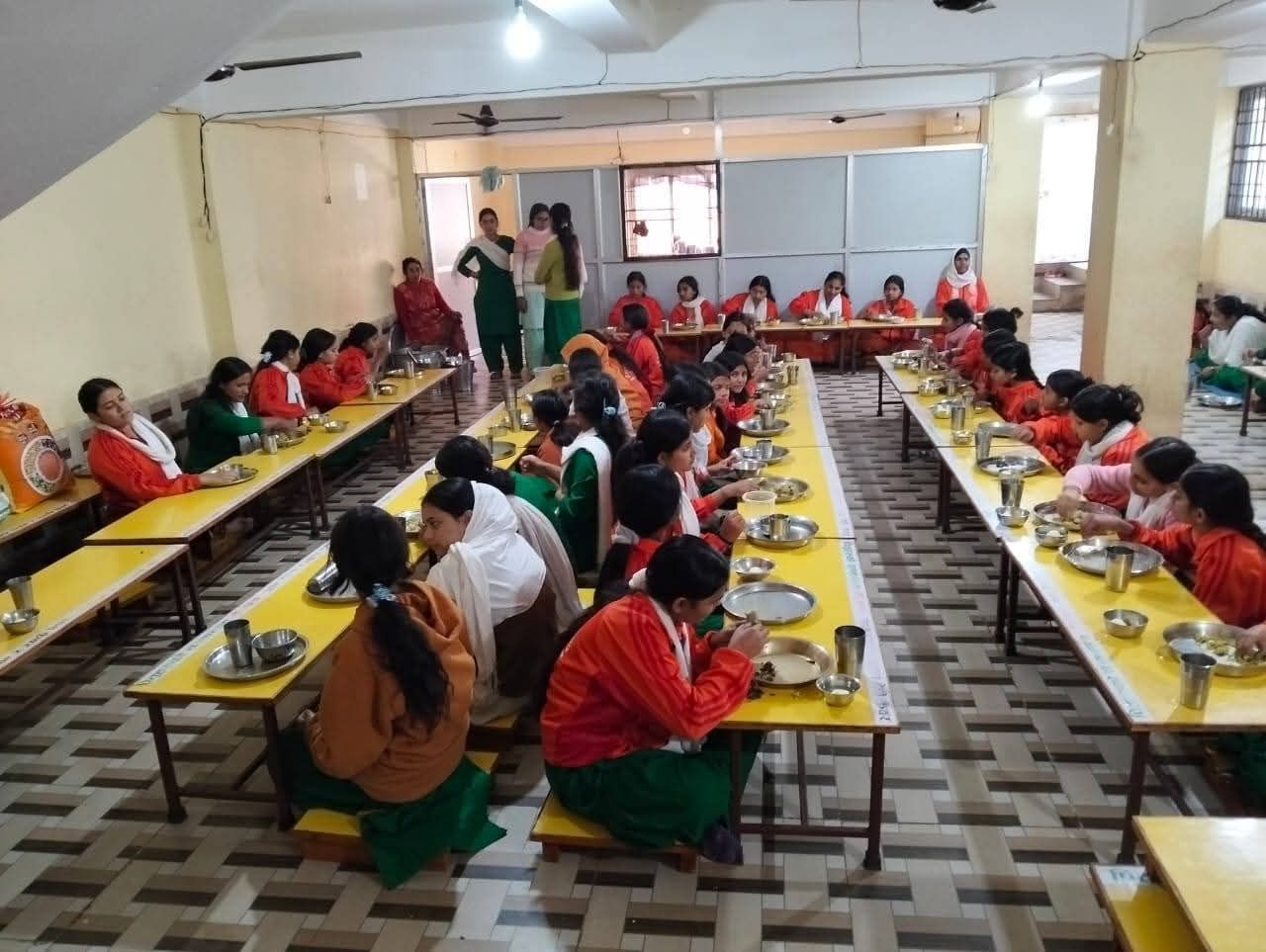
Students of Gargi Kanya Gurukul taking food at the Gurukul's mess. Photo: Courtesy of School Management Committee
Most Sanskrit educational centres in Devghat are largely funded by donations from patrons and claim no government investment — a claim that Krishna Pokharel, an official at the Ministry of Education overseeing school education, disputes. He argues that some gurukuls, initially established as self-funded institutions, later begin to pressure the government for budget allocations. “Gurukuls operating under the Ministry of Education are provided government support of up to around Rs 500,000 [per year], depending on the number of students,” he said.
This accessibility, however, coexists with entrenched exclusion. Acharya Krishna Damai, a Katha Bachak [scriptural narrator, mainly the Bhagavat puran] who has openly identified his caste, says discrimination continues within gurukul systems. “Even today, it is difficult for individuals to openly declare their caste and pursue ritual-based Sanskrit studies in gurukuls,” he said.
Damai pursued his studies in Dang with support of various individuals and went on to complete his Acharya-level degree. He works now as a Katha Bachak, but says discrimination has followed him. Greater opportunities to specialise in different branches of Sanskrit, he argued, could have opened pathways to teaching or academia. “In their absence, becoming a storyteller remained the highest attainable position within my stream.”
At the Yogi Naraharinath Sanskrit Gurukul in Bageshwari, Chitwan, principal Imanath Chalise says around 35 students, including those from Dalit and Indigenous backgrounds, are currently studying Sanskrit.
Chalise explains that while Dalit students were previously taught karmakanda, the subject’s limited practical utility has led the institution to shift its focus towards subjects such as ethics and astrology.
“It is not enough for us to teach; society itself must be willing to accept ritual and ceremonial practices performed by Dalit practitioners,” Chalise said. Students, too, must have a practical pathway to earn a livelihood, he added.
“For this reason, we have not been teaching karmakanda to non-Brahmin students for the past few years,” he stated.
Yogi Dayanath Magar says his understanding is that it is still difficult for people outside Brahmin communities to study Karmakanda in Sanskrit. He notes that, until fairly recently, even members of the Chhetri community had to struggle for access to study Karmakanda, reflecting a history of exclusion within the discipline.
Sanskrit education in Nepal has long been largely confined to ritual practice — a limitation that has curtailed its wider intellectual reach. Historian Pant argues that any meaningful revival must reckon with this history. It must avoid the mistake of reducing Sanskrit to karmakanda, he says, and it requires a dedicated academic framework: Sanskrit taught as a distinct field with its own curriculum and scholarly tradition, not loosely integrated into modern disciplines.
Nabaraj Kattel, member secretary of the Jayatu Sanskritam, partially agrees. He credits karmakanda with keeping Sanskrit alive through its most difficult period — "the possibility of earning a livelihood through ritual services helped sustain interest" — but concurs that Sanskrit has historically been a vast medium of knowledge production, spanning philosophy, mathematics, astronomy, linguistics, medicine, and political thought. Failing to reconnect with that heritage, he warns, risks reducing Sanskrit to something narrow and functionally limited.
Kattel also raises concerns about quality. The Katha Bachak has emerged as perhaps the most prominent role available to Sanskrit graduates today — but he questions whether the rigour of interpretation is always adequate. “Detailed exposition of Vedanta philosophy is rare, and interpretations can sometimes remain at a surface level,” he said.
Dev Mani Bhattarai, head of the Department of Religious Studies at Balmeeki Campus, backs Kattel’s argument. Classifying Katha Bachak into three categories, Bhattarai says there are very few in the top tier, while those in the second and third often misinterpret the core tenets of religion during their recitation.
“This happens due to the superficial understanding of religious philosophy,” Bhattarai adds.
For the revival to endure, observers broadly agree that a shift is needed: encouraging research, critical inquiry, and original writing in Sanskrit, rather than relying on memorisation and ritual training. That, they say, might be the key to repositioning the language as a living intellectual tradition rather than a purely ceremonial one.




 22.68°C Kathmandu