Panel proposes Rs24,000 minimum monthly allowance for medical interns
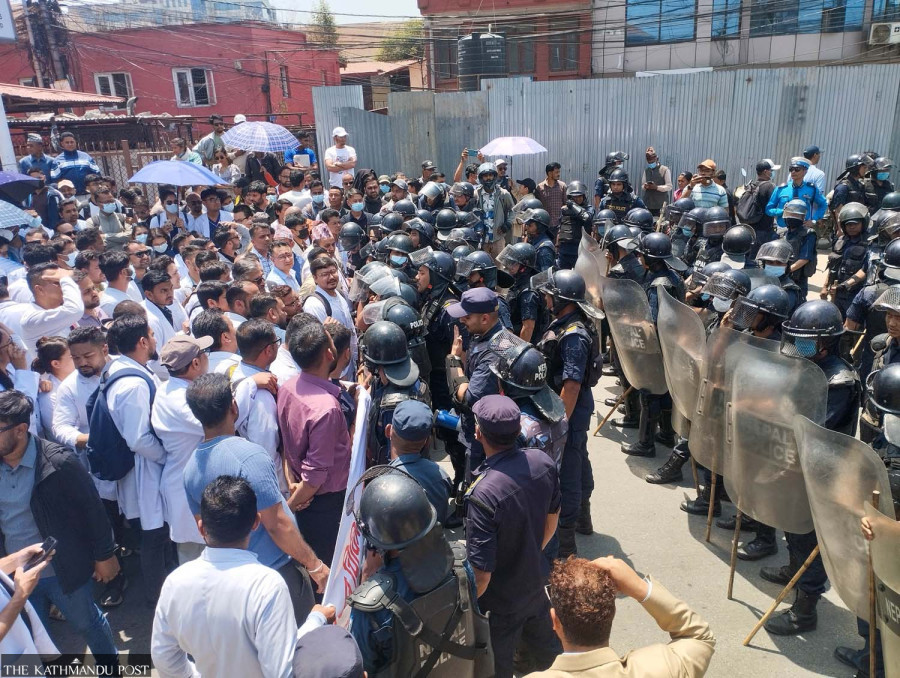
Recommendation also extends to other one-year internship-based programmes. Resident doctors pursuing MD/MS degrees in private medical colleges clash with police at Maitighar Mandala in Kathmandu in April last year. They were demanding stipends on par with their counterparts in public colleges. Post file photo
A government task force has recommended a minimum monthly subsistence allowance of Rs24,000 for MBBS and BDS interns. The move is aimed at standardising payments across public and private medical colleges.
The recommendation comes amid growing complaints from intern doctors that allowances vary widely between institutions, despite students carrying out similar clinical duties during their compulsory internship year.
The task force, led by joint secretary Chandra Kanta Bhusal at the Ministry of Education, has proposed that intern doctors be paid 50 percent of the starting salary of an eighth-level government health worker, whose basic pay is around Rs48,000 a month.
According to the report, private medical colleges currently provide around Rs13,000 a month to interns, while some government colleges provide up to Rs23,000. Intern doctors have long argued that the disparity is unfair, particularly because they work night shifts and remain directly involved in patient care.
“The government appears positive about implementing equal allowances for intern doctors,” said Dilli Harijan, an MBBS student at Kathmandu University. “The decision should be enforced through the Medical Education Commission from this year itself.”
Harijan said students had already raised the issue with Prime Minister Balendra Shah, Education Minister Sasmit Pokharel, Health Minister Nisha Mehta and acting vice-chairman of the commission Shree Krishna Giri.
The recommendation follows months of lobbying by the MBBS and the BDS students, who launched campaigns demanding equal internship allowances in all medical colleges. The task force has also suggested extending the same provision to students of other medical programmes that require a one-year internship.
“The internship period is an inseparable part of bedside teaching and learning in medical education. Considering the workload, night duties and compulsory hospital service, it is reasonable to ensure minimum requirements including housing, food, transport and other basic facilities,” reads the report.
Bhusal said the panel believed intern doctors should receive half the allowance currently provided to postgraduate resident doctors studying MD and MS courses.
Last year, disputes over allowances for postgraduate resident doctors had triggered protests across the country. Following pressure from doctors’ associations and repeated demonstrations, the government decided that resident doctors studying in both government and private colleges should receive a monthly allowance equivalent to the salary of an eighth-level government officer. The Medical Education Commission has been implementing that decision.
Around 2,500 students enroll annually in MBBS and BDS programmes in Nepal. The final year of the course requires compulsory internship service in hospitals.
The recommendation also follows an earlier agreement between the government and the Safe Workplace Struggle Committee for Health Workers, which had called for uniform allowances for intern doctors. A separate committee led by former additional secretary Tanka Prasad Barakoti at the Ministry of Health had also recommended providing interns with 50 percent of the eighth-level salary scale.
Meanwhile, the Nepal Medical Council has instructed teaching hospitals and medical academies not to force resident doctors to work continuous shifts lasting 24 to 36 hours.
The council said it had received complaints that some hospitals were assigning excessive workloads to resident doctors in MD, MS and MDS programmes, leading to severe physical exhaustion, mental stress and depression.
In a directive issued by acting registrar Dr Dipendra Pandey, the council reminded institutions that the ‘PG Medical Education Regulation-2017’, approved by the government, allows resident doctors to work 24-hour shifts only twice a week under normal circumstances.
The council warned that prolonged duty hours without adequate rest could weaken doctors’ judgement and increase the risk of serious mistakes during treatment, directly affecting patient safety.
It has also asked all teaching institutions to revise their duty rosters in line with existing rules and ensure mandatory rest periods after 24-hour shifts.




 12.97°C Kathmandu