
Inside the strange,
disciplined,
unreachable world of Nepal’s
Prime Minister
Balendra Shah has 4.7 million Facebook followers, a James Bond video game on his phone, and almost no interest in explaining himself to anyone. One hundred days in, Nepal is still trying to figure out the person running the country.
On the morning of May 11, Prime Minister Balendra Shah arrived at the federal parliament building wearing his now-familiar uniform: a black coat, his signature sunglasses, and a pair of white Goldstar sneakers. He handed President Ramchandra Paudel a folder containing his government’s first policies and programmes — the roadmap by which his administration would be judged. Then, forty-five minutes into the President’s address to a joint session of federal parliament, the Prime Minister got up and left.
He did not leave the building. Shah walked into a chamber set up for the prime minister inside the parliament complex, and he stayed there — while, just beyond the wall, the head of state read out the policies of Shah’s own government to the assembled members of the House of Representives and National Assembly. Shah remained in the chamber, alongside his chief personal secretary, Subash Sharma, for more than half an hour, mostly looking at his phone.
Later that evening, one of his advisers posted on social media that the prime minister left the parliament meeting because he felt uneasy about his health. But minutes later, the post was deleted.
The episode became a hot topic for days, as questions were raised both inside parliament and on social media about why Shah would walk out of a joint session where his own government’s agenda was being presented. It was not the first time, and it would not be the last, that Shah’s government found itself explaining — or declining to explain — what the prime minister had just done.
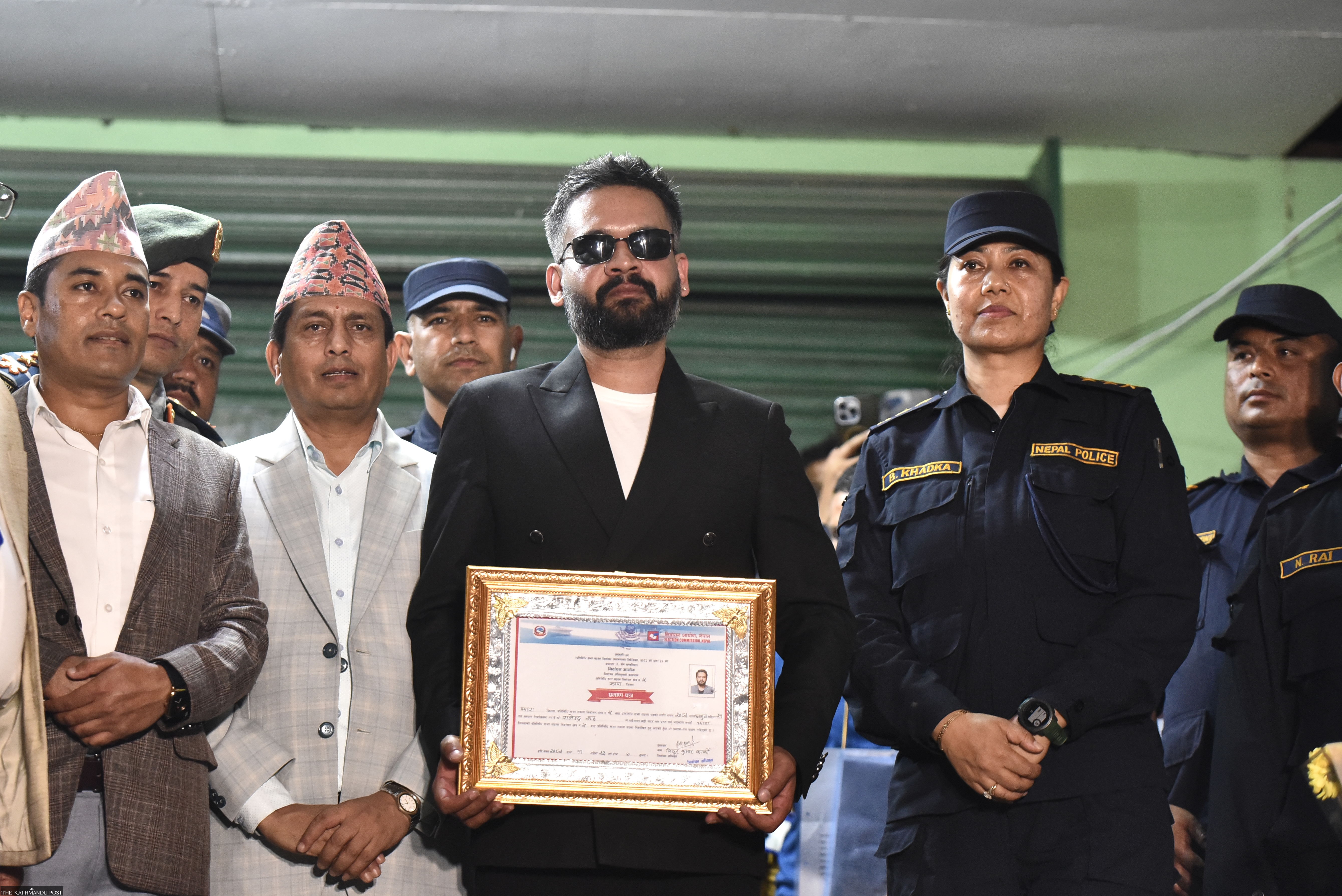
Since Balendra Shah took the oath of office, a pattern has become visible to anyone who has watched the footage closely enough: the prime minister of Nepal has rules, and the rules are about visibility.
He wears his sunglasses in parliament. He wears them at public ceremonies, at military parades, in group photographs with foreign ambassadors. He does not wear them in cabinet meetings, in private conversations, or during joint meetings — he has not held a single one-on-one meeting with any ambassador — with diplomats. Yet, a striking pattern is quite visible: during photo-ops with ambassadors, he appears with his signature black shades. And he rarely steps out in public without them.
The pattern repeats with his attention. On April 5, when his party’s candidate, DP Aryal, was elected Speaker of the lower house unopposed, ministers and lawmakers rose to offer their congratulations. Shah did not. He stood up and left. This particular incident, however, went largely unnoticed.
On May 31, after weeks of opposition demands that the prime minister submit to the monthly questioning that parliamentary rules require, Shah appeared — and upended the format entirely. He stood, asked the Speaker for time, walked to the rostrum, and announced that MPs had waited long enough. Opposition MPs objected that they had not been given the preparation the rules promised them.
But that was exactly the plan: to surprise everyone. Shah’s advisers had told the Post that, unlike his predecessors, he would not answer pre-submitted questions or rely on prepared notes. Instead, he would go to parliament, stand at the rostrum, invite lawmakers to ask questions on the spot, and surprise them.
When the Post asked Aryal on June 1 whether he had been informed in advance about the prime minister’s question-and-answer session, he responded with a question of his own: “How did it look to you?”
When told that it appeared he hadn’t been informed beforehand, Aryal replied, “You can figure that out yourselves,” declining to answer directly.
Nevertheless, that was his first address to parliament since assuming office, and by then, a narrative was already taking shape that he had an aversion to parliament — or parliamentary proceedings, for that matter. Though largely expected, Shah had conveniently skipped the first meeting of the newly elected parliament on April 2.
To understand the rules, it helps to understand the man who set them — and for that, there is essentially one door into Balendra Shah’s life: Kumar Byanjankar, known to everyone as Kumar Ben, the prime minister’s adviser, architect, and closest friend of more than a decade.
On a Friday evening in mid-June, Ben had just finished dinner at his home in Jwagal in Lalitpur when a reporter arrived. He was in the middle of a conversation with the prime minister — not about state affairs, but about a video game. Shah, Ben said, had eaten his own dinner and was now playing 007 First Light, the 2026 James Bond title from IO Interactive. Ben pulled up a screenshot Shah had sent him and showed it off.
“Along with me, the prime minister also takes dinner early,” Ben said. “He is not a foodie. He loves simple Nepali dal-bhat-tarkari. But he loves watching movies, listening to songs, and playing video games.”
The portrait Ben paints is almost defiantly ordinary. Shah wakes early and works out in a gym inside his official residence. He eats his lunch early — around 8:30 in the morning. It’s dal-bhat again, or vegetable momo if it’s available, or fried rice if it’s not. His secretariat describes a prime minister who arrives in his office by 9:30, no later than 10:30, and leaves by 5:30, both uncommon and new routine for a Singha Durbar where cabinet meetings once ran for hours and ministers came and went from the residence at all times of night.
He avoids sweet, sour, oily, and spicy food, drinks four to five liters of water a day, and is asleep by 9:30 at night, and gets eight or nine hours of sleep.
He does not read much, Ben said, but he reads social media constantly — by his aides’ account, three to four hundred comments a day — and has played through Persona 5, the critically acclaimed Japanese role-playing game that follows a group of teenagers who use magical powers to confront corruption and injustice. “One of the reasons why the prime minister is so sharp and intelligent is because he plays the game,” Ben said, appearing genuinely impressed by Shah’s gaming habit. If he is not playing the game, he writes songs — something he grew up doing.
Ben described a friendship with Shah that predates politics: the two have traveled together to France, Brazil, Indonesia, and Sri Lanka, including a trip to the Cannes Film Festival in May 2024 when Shah was still mayor of Kathmandu. When the food abroad doesn’t suit them, Ben said, they cook for themselves — sometimes carrying daal, pickle, and gundruk from Kathmandu, sometimes buying ingredients locally. Sunil Lamsal, now the Minister for Physical Infrastructure and Transportation, is “a good cook,” Ben said, and does the cooking when the three travel together.
Asked about one of the more persistent rumors about the prime minister’s drinking, Ben said: “I want to make it clear that the prime minister hardly drinks alcohol. Out of twelve months, he takes alcohol for only two months in total. For the remaining ten months, he does not touch it.”
Driving is another of his hobbies.
He still drives himself, sometimes arriving unannounced at Ben’s residence in Jwagal, Lalitpur, and staying for hours. It was at Ben’s house, after his father’s death in December 2025, that Shah first discussed entering politics.
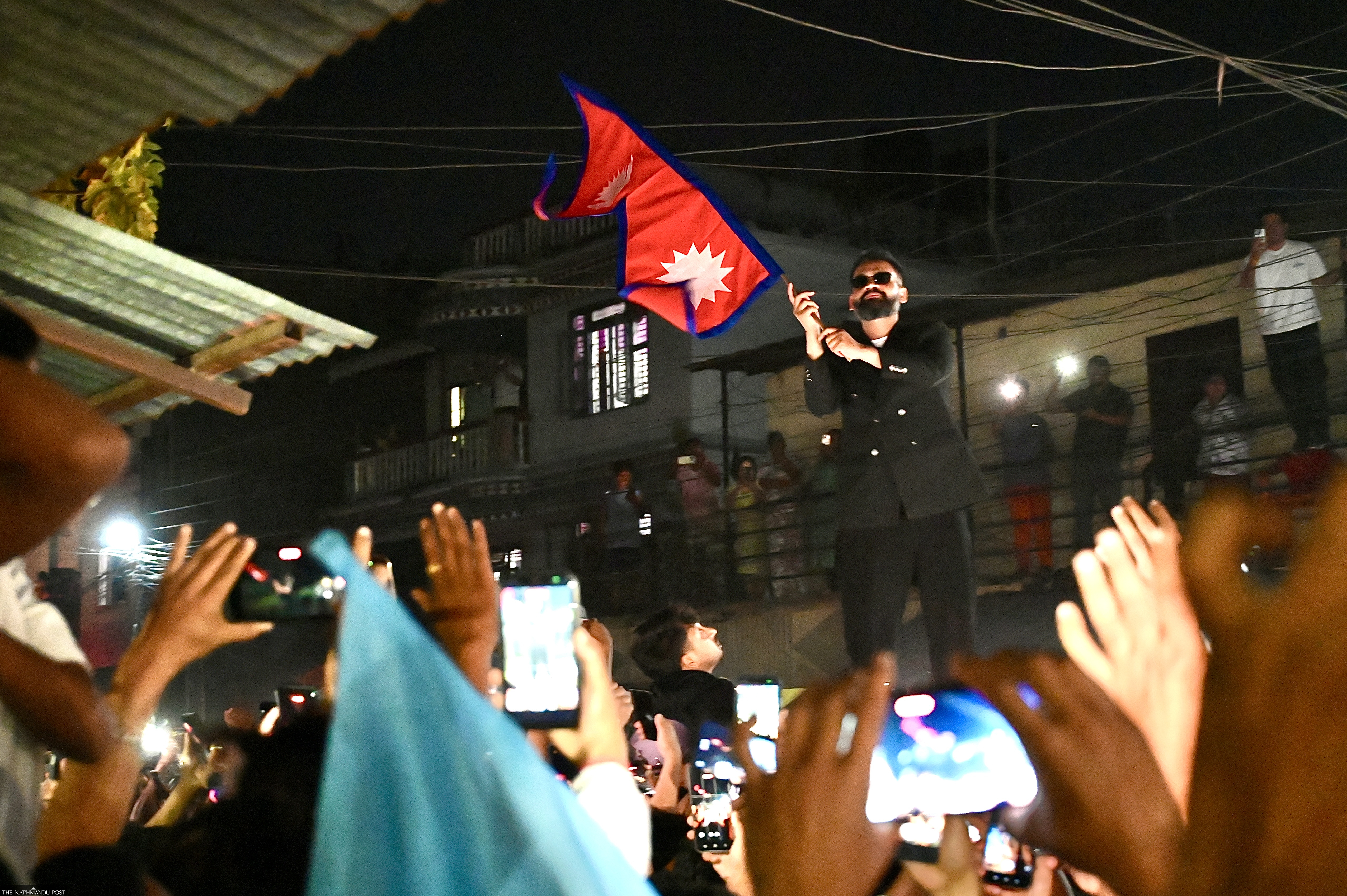
Shah, however, did not speak much during the campaign. His speeches at various rallies totalled just 27 minutes — across 40 days and 11,000 kilometers of road. He won anyway, by a significant margin, which told its own story about what Nepali voters were looking for, and what they were willing to accept in its place.
If there is one place Balendra Shah does speak — reliably, frequently, on his own terms — it is on Facebook.
He posts often, and the posts are reposted automatically to his social media accounts. On Saturday, June 6, at 10:15 pm, he posted a single line on Facebook: “I also want to become an ambassador. If anyone has the prime minister’s number, could you please share it?”
It appeared to be a dig at a government secretary who had texted the prime minister, seeking an ambassadorial appointment.
Within hours, his political adviser Asim Shah replied with laughing emojis and “I will tell the PM,” Education Minister and government spokesperson Sasmit Pokharel offered to message him, lawmaker Tika Sangraula joked that she had his number but wouldn’t share it, and another MP Ranju Darshana told him to pick one job or the other.
To Shah’s supporters, this is simply who he is — a head of government willing to be human, to joke around with colleagues in public. To a wide range of critics, including within the Gen Z movement that helped elect him, the timing is the point.
The pattern, as critics have assembled it, runs like this. On April 27, the cabinet abruptly postponed a parliamentary session Shah’s government had itself requested, in order to push through ordinances on the Constitutional Council and cooperative fraud management. As criticism mounted, Shah posted a stylised portrait on Facebook on May 9 — seated with his legs folded in a white linen button-down shirt and beige pinstripe trousers — an image that went viral and spawned a wave of AI-generated imitations across Nepali social media, displacing the ordinance story from public conversation.
A week later, on May 16, with the government under fire over conditions for displaced families in temporary holding centers, Shah posted another photo in the same outfit — this time holding a piece of cheese, captioned “Say cheese, DDC’s cheese,” noting that DDC (Dairy Development Corporation) belongs to the government of Nepal. The post drove a roughly 30 percent jump in demand for yak cheese — the state dairy corporation’s marketing chief Sanjeev Jha told the Post they were receiving calls from supermarkets asking for additional supplies.
Not everyone was smiling. Social activist Sushma Barali wrote that she had just watched a video of a postpartum mother in a displacement centre with no access to proper nutrition for herself or her newborn. “Meanwhile, the head of our government posts playful pictures telling everyone to 'say cheese’,” she wrote.
Then, on a more recent weekend, after a photo of Shah with two fellow ministers captioned them as “nation builders,” he posted again — this time a photo of himself at a local tea shop.
Critics have a name for the strategy: In an interview with Kantipur, Gen Z activist Amit Urja said Shah understands digital algorithms and knows how to capture public attention. “He is highly skilled at introducing populist themes to ensure that no single political controversy lingers in the public imagination for too long. However, this approach prioritises spectacles over solutions, undermining the rule of law while offering the public temporary entertainment,” he said.
Another youth activist Arnab Chaudhary noted that former Prime Minister KP Sharma Oli was once praised for using proverbs and sarcasm to disarm critics. “While humour has its place, we must question when, where, and who is delivering these jokes. The current leadership claims to represent a new political era, yet they employ the exact same tactics to obscure core issues and avoid accountability,” he told Kantipur.
Shah’s response to all of this criticism appears to be disarmingly plain. “After a week of work, I like fooling around on weekends, this is not a problem,” he posted on Facebook on June 15. “You should be sad on the day I stop fooling around.”
The kind of posts shared by Shah, on its face, is an ordinary thing for anyone to say. The issue is that Shah is not anyone. He is the prime minister of a country of 30 million people who voted for him in record numbers, and who are waiting — many of them increasingly impatiently — to hear how he plans to think about their future. Whether his weekends are his business, in other words, depends a great deal on what happens to the country during his weekdays — and that is precisely the part of his government that remains hardest to see.
If Shah’s personal life is described by those close to him as small and self-contained, his prime ministership has been built the same way.
Since taking office, Shah has effectively imposed what several RSP leaders describe as a moratorium — not formally announced, but understood — on meetings with foreign diplomats, senior bureaucrats, party leaders, lawmakers, security chiefs, business leaders, and journalists. He has met the full diplomatic corps jointly exactly twice, on April 8 and May 25. Both meetings, according to one diplomat present, followed the same choreography: ambassadors introduced themselves, and Shah read a statement prepared in advance by the Foreign Ministry. “He listened to our opinion quietly but did not ask many questions,” said the diplomat, who asked to stay anonymous so they can share details from the meeting.
The format struck at least two diplomats as unusual. Meetings with a new head of government are typically an early priority for embassies — a chance to establish rapport and signal the tenor of a bilateral relationship. Shah’s government has instead handled the diplomatic corps collectively, twice, in sessions that two diplomats described as scripted on both sides. “It is different from what we are used to,” a diplomat from Asia told the Post. “Whether that is by design or simply how this government works, it is too early to say.”
The moratorium has not only been observed by outsiders — it has been enforced. An incident involving Krishna Hari Pushkar is a case in point. According to officials familiar with the matter, when Pushkar on June 5 attempted to reach the prime minister directly by text message seeking an open ambassadorial role, police picked him up from his home later that and took him to the Valley Crime Investigation Office in Teku for questioning, following orders from the Prime Minister’s Office.
A day later, Pushkar told the Post that he decided to send the text after his attempts to meet the prime minister had failed. A Home Ministry official said he was detained for reaching out to the prime minister directly, breaching "the chain of command" while seeking personal favors. According to the police, he was released after questioning, as there were insufficient grounds to press any charges against him. The move was criticized by former bureaucrats as an authoritarian overreach with no precedent in the civil service.
The PMO then swiftly transferred him from the Vice President’s Office to the reserve pool.
Bureaucrats have been told to route matters through Chief Secretary Suman Raj Aryal rather than approach the PMO directly, though, officials note, Shah does still summon and meet senior officials privately when he judges it necessary.
The rhythm of government itself has changed. Cabinet meetings, which under previous governments rotated between the PMO in Singha Durbar and the official residence in Baluwatar — and which ran on a fixed Monday-and-Thursday schedule — now happen only in Singha Durbar, on no fixed schedule, and rarely run longer than thirty minutes. The official residence, once jokingly called the “party palace” for the political meetings that filled it, now hosts none of Shah’s government business.
“He hardly interacts and intervenes, but he does not prefer discussion either,” said one minister. “That is why our cabinet meetings are short.”
But that account is contested — and not only by Shah’s allies in the abstract. Pratibha Rawal, the minister for Land Management, Cooperatives, Federal Affairs and General Administration, pushed back directly. “The public narrative that the prime minister does not speak or engage in discussions is not accurate,” she said. “For policy matters of the government, ministers go to meet the Prime Minister. Even on matters requiring party positions, we meet him, and time is always available.” Rawal said Shah examines proposals “from multiple angles,” listens to the proposing minister without imposing decisions, and at the end of cabinet meetings asks ministers, “Do you have anything to add?” He also, she said, personally tells ministers when they are doing good work.
RSP lawmaker KP Khanal, who has worked with Shah since his time as Kathmandu mayor, described a similarly functional — if minimal — relationship. “We do not go to Baluwatar,” " Khanal said. “If we need to meet the prime minister, we go to his office in Singha Durbar. Last time we met in Parliament, he asked how the sanitation campaign was going.”
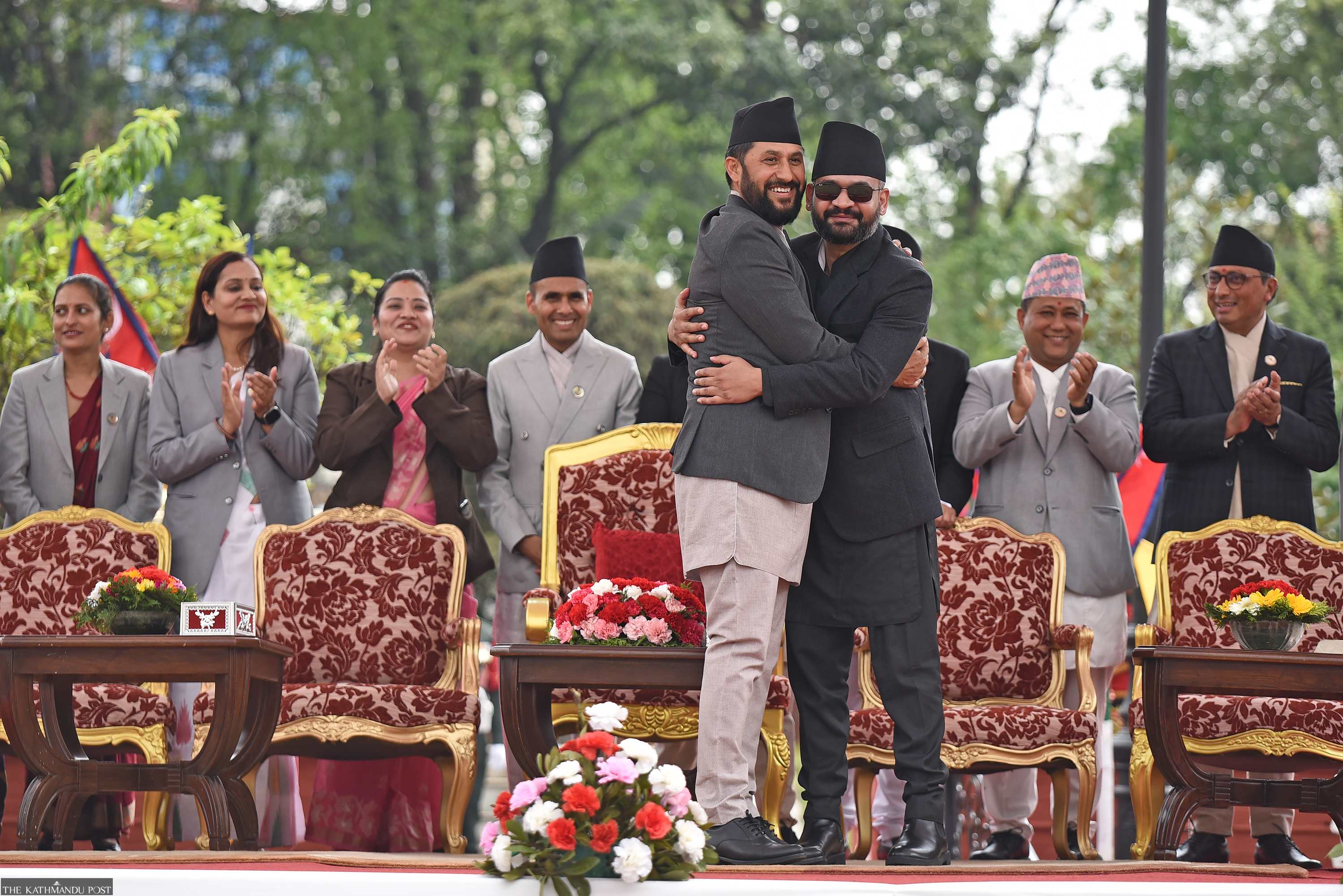
RSP leaders privately acknowledged unease over Shah’s tendency to govern from within a tight circle of old friends rather than party structures, though publicly the party has dismissed any suggestion of a gap. “Party matters are sent to the prime minister through chairperson Rabi Lamichhane, while government matters are communicated to the party through the prime minister in the same way,” said Ganesh Parajuli, the RSP’s parliamentary party deputy leader.
But outside the party, observers have begun drawing their own conclusions. Bhaskar Gautam, who teaches international relations and diplomacy at Tribhuvan University, argues that Nepal's weak political institutions have historically allowed powerful individuals to reshape the state around themselves rather than the other way around — and that Shah is no exception. “The prime minister has resorted to selective actions that reinforce a culture of impunity and fail to uphold the spirit of rule of law,” Gautam said. “He is not focused on institution-building or ensuring the equitable and just distribution of state resources among citizens.” Whether that judgment proves correct will depend largely on what the next hundred days look like — and how much of Shah’s government remains visible enough to assess.
For a prime minister who avoids almost everyone, Shah’s government has moved with unusual speed on paper. Eight ordinances have been issued since March 27. Law Minister Sobita Gautam, who led the drafting effort working out of the PMO, said Shah gave direction on what the ordinances should cover — public procurement law, the Constitutional Council, the removal of political appointees, the abolition of employee trade unions — but left the drafting itself to her team, which included senior secretaries and Sudip Dhakal, the head of the prime minister’s administration.
People who worked with Shah during his time as mayor say this is consistent with how he has always operated. “He has always spent full time in the office,” one longtime associate said. “Whether mayor or prime minister, department heads or ministers do not say that work is stalled because he is busy. A file that reaches his desk is either approved immediately or rejected and returned.”
The clearest demonstration of how Shah makes up his mind came not in Parliament, but in a smaller room: the Constitutional Council, the six-member body responsible for recommending the country’s most powerful appointments, including the chief justice of the Supreme Court.
On May 7, Shah convened his first meeting of the council as its chair. The expectation, inside and outside the room, was that the council would recommend Acting Chief Justice Sapana Pradhan Malla — the senior-most justice on the Supreme Court, and the candidate most other members favored. Shah proposed someone else: Justice Manoj Sharma, bypassing seniority entirely. Any potential opposition had already been preempted — the Constitutional Council Act had been amended through an ordinance, giving the prime minister, as council chair, the upper hand.
Council members told Kantipur that Shah had wanted someone without any obvious political links — a reference to the fact that Malla was once a member of the Constituent Assembly appointed under the CPN-UML quota, though she has repeatedly distanced herself from the party. An analysis of Sharma’s judicial record by the Post found he was more often a signatory than the principal author of precedent-setting Supreme Court judgments. Leader of the opposition Bhishmaraj Angdembe and National Assembly chair Narayan Dahal filed written dissents. Shah's proposal was endorsed by the three RSP-aligned members of the council.
The meeting was also, by multiple accounts, the first formal interaction between Shah and the leader of the opposition since he took office — a break from the customary consultations that predecessors had maintained before major appointments. Two days later, Malla warned publicly of the executive’s growing shadow over the judiciary. A parliamentary hearing subsequently endorsed Sharma's appointment. Malla went on leave for twenty days. The controversy subsided.
For a prime minister whose admirers describe his decision-making in binary terms — a file is either approved or returned — the Sharma nomination was that instinct applied to the most consequential personnel decision of his young government. The institution absorbed the disruption and moved on.
On May 29, after Finance Minister Swarnim Wagle delivered the budget speech, something shifted. Shah — by most accounts withdrawn in Parliament, rarely lingering, often the first to leave — stayed. He was, several lawmakers said, visibly cheerful. He shook hands with members across party lines, smiling as he greeted Mahabir Pun, who he recently appointed as the new Minister for Science, Technology and Innovation.
On his way out of the chamber, Shah stopped at Vidushi Rana — the owner of Goldstar, the shoe brand whose white sneakers Shah has worn to Parliament for weeks, and now an RSP member of parliament herself. He showed her his shoes. By multiple accounts, he spoke with her longer than he did with almost anyone else that day.
In an interview on Kantipur TV’s Fireside programme, Rana recalled that she had once spoken about Goldstar shoes during Shah’s tenure as mayor.
“I didn’t think he’d paid such close attention to it,” she said.
Asked whether the prime minister was promoting a particular brand, Rana described the entire episode as a chance encounter. “It was purely a coincidence that I met the prime minister in the corridors of Parliament as I was leaving,” she said. “As soon as I greeted him, he said, ‘See, I’m wearing Goldstar shoes.’”
His one-way communication with the public remained firmly in place. Twelve weeks into his tenure, Shah was yet to deliver a public address, a point critics continued to cite as both a failure to acknowledge the voters who put him in office and a symptom of a broader communication style they argued was at odds with democratic accountability.
On June 21, he finally spoke, addressing the first general convention of the Rastriya Swatantra Party. It was his first and only public address since assuming office.
He spent much of his speech responding to lingering criticism. On the surface, the address was about party consolidation, governance priorities and political direction. But beneath the structure of a convention speech, it functioned largely as a sequence of replies — and responses often appeared less like acknowledgements of criticism than rejections of the premises behind them.
Earlier in the day, UML leader Pradeep Gyawali had urged the RSP to exercise its mandate with caution, warning that democratic institutions could be weakened if the balance between acceleration and restraint. Comparing state power to a vehicle, he said the brakes matter as much as the engine.
Shah returned to the metaphor almost immediately.
“Such concern may apply to vehicles on local roads,” he said. “But our vehicle is not on a local road, it is on an expressway. We only need brakes once we reach the destination.”