Prime Minister Balendra Shah resets Nepal’s diplomatic posture in a single day
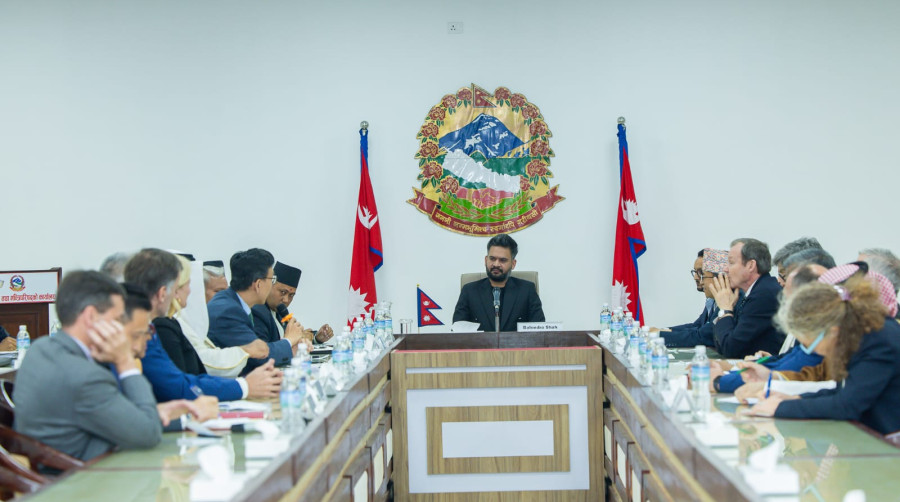
In a break from years of ad hoc diplomacy, Shah met 17 ambassadors jointly and briefed ministers on protocol, signalling a more deliberate, state-led foreign policy. Photo: Courtesy of Prime Minister’s Secretariat
Prime Minister Balendra Shah held a joint courtesy meeting with 17 Kathmandu-based ambassadors at Singhadurbar on Wednesday—breaking with a long tradition of individual, unstructured meetings with foreign envoys. On the same day, the Ministry of Foreign Affairs separately briefed all Cabinet ministers on Nepal’s diplomatic code of conduct for the first time since its enforcement in 2011.
Together, these back-to-back moves amount to the most deliberate reset of Nepal’s diplomatic posture in years, foreign policy observers said, a signal that the new government intends to consolidate foreign policy authority, reduce mixed messaging, and move from personality-driven engagement with the international community towards a more coherent, state-led approach.
“This is not a routine courtesy—it is closer to a strategic diplomatic reset briefing,” said former Nepali Army Major General Binoj Basnyat. “Nepal is trying to move from reactive, personality- and party-driven diplomacy to a more coherent, state-led approach.”
The shift is a direct departure from post-2006 practice, when successive prime ministers routinely met ambassadors individually, often without Foreign Ministry officials present for briefings, note-taking, or debriefs. Foreign policy, critics long argued, had become an extension of whichever political personality held power.
On Wednesday, that began to change. At the prime minister’s joint meeting, Foreign Secretary Amrit Bahadur Rai opened by welcoming the ambassadors and briefing them on government priorities, a procedural detail that, in practice, reasserts the ministry’s institutional role.
Shah himself spoke for roughly five minutes, outlining his government’s priorities: the safety and security of Nepali migrant workers and the diaspora, good governance, economic development, and Nepal’s longstanding policy of balanced relations with its neighbours and partners.
“Peace must remain our shared priority,” Shah told the envoys, according to the Foreign Ministry.
Present were ambassadors and heads of mission from India, China, the United States, the United Kingdom, Japan, France, Germany, Saudi Arabia, Qatar, Israel, Pakistan, Bangladesh, Sri Lanka, South Korea, Switzerland, Egypt, and the United Nations. Eleven additional Kathmandu-based ambassadors are scheduled for a follow-up meeting.
Almost all envoys expressed support for the new government. Some indicated their countries were developing new cooperation plans, though details were not disclosed. “We found an air of optimism in the meeting,” said one official who attended, speaking on condition of anonymity. “The international community sits on our side. The only thing is how we capitalise that goodwill in this difficult time.”
Separately, ahead of the prime ministerial meeting, Foreign Secretary Rai briefed all Cabinet ministers on Nepal’s foreign policy landscape and the diplomatic code of conduct—a protocol document that has existed since 2011 but has rarely been systematically enforced. The briefing covered diplomatic etiquette, limitations on ministerial conduct in foreign policy, and technical norms governing meetings with foreign dignitaries.
Former ambassador Shambhu Ram Simkhada, Nepal’s former permanent representative to the United Nations in Geneva, welcomed both steps. He said past governments had allowed leaders to meet ambassadors casually and frequently, bypassing the Foreign Ministry, which he argued eroded Nepal’s international standing.
“There was a kind of recklessness,” Simkhada said. “No one seemed responsible.”
But he also issued a challenge to the new government. The Rastriya Swatantra Party’s manifesto pledges a “balanced and dynamic” foreign policy. While the meaning of balanced is broadly understood, Simkhada said the government still needs to define what dynamic means in practice.
“Dynamic policy demands continuity and change,” he said. “The new government that has been installed through big change needs to define what changes it wants to inject in foreign policy conduct.”
Basnyat agreed that the format of Wednesday’s joint meeting carried its own strategic message. Meeting all ambassadors together, rather than in a sequence that might suggest a hierarchy of relationships, sends a signal of neutrality at a moment of intensifying great-power competition in the region.
“Calling all ambassadors together is not routine — it’s a signal at a time of rising competition between India, China, and the US and the West,” he said. “The format matters because meeting everyone together means no visible tilt.”
Whether the symbolism translates into sustained policy, he added, remains the real test.
Anil Giri is a Chief Sub Editor covering diplomacy, international relations and national politics for The Kathmandu Post. Giri has been working as a journalist for more than two decades, contributing to numerous national and international media outlets.




 14.2°C Kathmandu