Tourists flock to watch cliff honey hunting in Lamjung
In recent years, this centuries-old adventurous practice in villages such as Bhujung, Ghanpokhara, Taghring, Mipra, Taapgaun, Chyamche, Ghermu, Dudhpokhari and Ghalegaun has attracted global media attention. Aash Gurung/TKP
Towering cliffs in Lamjung stand like they are touching the blue sky. At their base, streams hiss through the terrain, and waterfalls blur the eyes of onlookers.
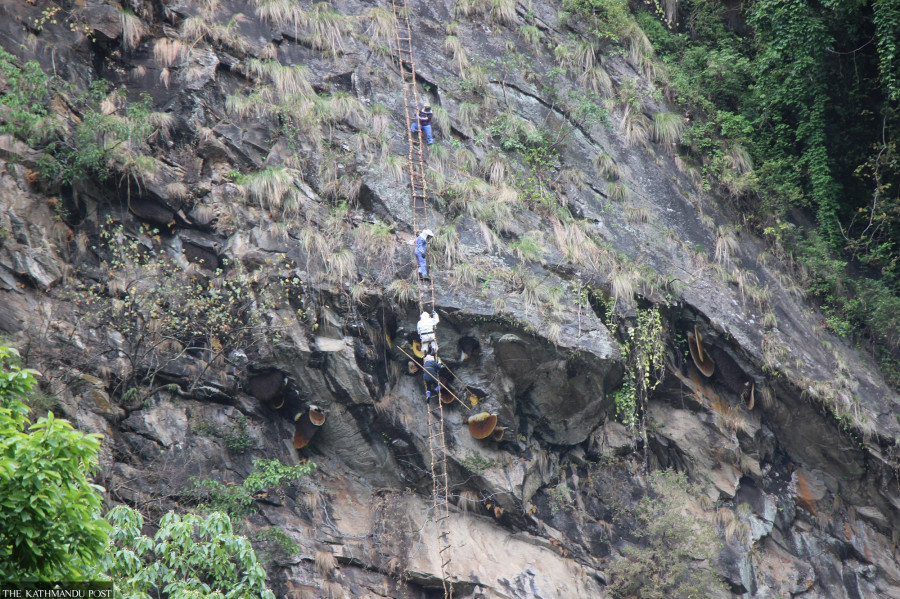
From the top of these dangerous cliffs, a ladder called pro in the Gurung language (a ladder made of ropes and bamboo) is suspended. People tie ropes around their waists and descend using this ladder. To drive the bees away from hives, they use smouldering bundles of leaves to create thick smoke. Soon the cliff is clouded in smoke as the bees swirl in a storm-like frenzy.
A large number of foreign tourists are now drawn to Lamjung’s rural identity and the centuries-old Gurung tradition of cliff honey hunting. During the season, when honey is collected from the Himalayan cliff bee (Apis laboriosa), tourists from abroad as well as domestic visitors from Kathmandu, Pokhara and Chitwan travel to different sites where the practice takes place.
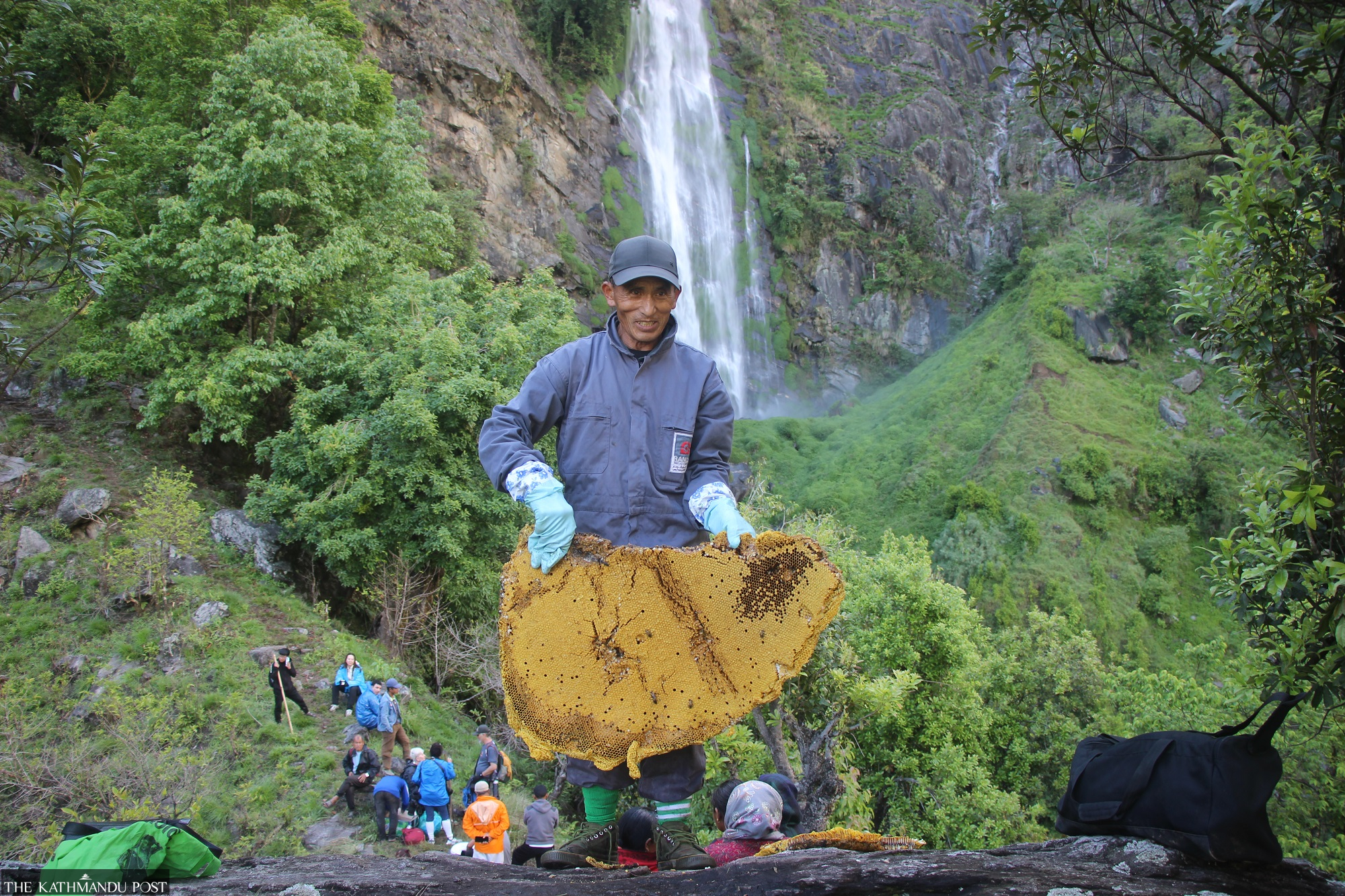
While hanging from cliffs, honey hunters are surrounded by swarms of bees. They wear protective gear to avoid stings. Below them lies a deep gorge. Using long bamboo poles, they pierce the honeycomb. A basket or container is placed beneath the comb. The honeycomb is then detached from the rock using a sharp tool tied to another bamboo pole. In some places, honey is dropped directly to the ground, while in others it is pulled up using ropes.
In recent years, this traditional and adventurous practice in villages such as Bhujung, Ghanpokhara, Taghring, Mipra, Taapgaun, Chyamche, Ghermu, Dudhpokhari and Ghalegaun has attracted global media attention. Large crowds of tourists now gather on cliff edges to witness the activity.
A few years ago, when honey was collected at Ghimche cliff and Kanyu waterfall in ward 4 of Kwholasothar Rural Municipality turned festive. A group of around 200 people, including celebrities, doctors, pilots and security officials from Kathmandu, visited to witness the event. According to Tul Bahadur Gurung, chair of the Tourism Management Committee in Bhujung, foreign tourists have shown strong interest in this traditional practice. “Tourists now ask about the season and come specifically to see cliff honey hunting in the villages,” he said.
The fascination is not limited to Nepalis. Just a week ago, during honey collection at Chopli cliff in Mipra in ward 4 of Marsyangdi Rural Municipality, 13 tourists from Turkey and five from Italy spent the entire day filming and photographing the activity from the cliff.
“We had only seen it on YouTube. The reality is far more dangerous and extraordinary,” said Francesco Santino from Italy.
At Chopli cliff, a team including 55-year-old Raj Kumar Gurung, 42-year-old Kum Bahadur Gurung, 34-year-old Jamir Gurung, 52-year-old Tara Kumar Gurung, 40-year-old Baisa Bahadur Gurung and 67-year-old Daan Bahadur Gurung carried out the honey hunting. Local youth Pradip Gurung said foreign visitors were deeply engaged, capturing photos and videos throughout the process.
Cliff honey hunting has also been documented by world-renowned filmmaker Eric Valli. International media outlets such as BBC, CNN, Reuters and AFP have produced documentaries and visual features on the practice. Filmmakers from India, Europe and the US continue to visit Lamjung to document it.
According to Purna Bahadur Gurung, who has long been involved in honey hunting near Gurung settlements in Bhujung, said only villagers used to come to watch earlier. “Now people from cities and even from abroad visit to witness the risky process of extracting honey,” he said.
The relationship between the bees and the Gurung community goes beyond livelihood or adventure. It also has deep historical and cultural significance. Gurung priests say their ancient scripture describes the historical connection between bees and the Gurung people. Writer Tirtha Gurung has also highlighted this relationship in his book Aapa Kwharpa.
Before collecting honey, rituals are performed to worship Sime Bhume (forest deities), a compulsory tradition in rural areas. Locals believe that climbing the cliff without the ritual can bring misfortune and increase bee aggression. Because of this long-standing practice, villagers say no major accidents involving falls have been recorded so far.
Chandra Singh Gurung, 61, of Tapgaun in ward 8 of Dordi Rural Municipality, said that climbing cliffs for honey has always been done after proper rituals.
Marsyangdi Rural Municipality chair Arjun Gurung said foreigners’ interest in the traditional honey hunting practice has increased in recent years. Visitors film documentaries and capture photographs for international media. “Foreign journalists and filmmakers continue to come here. Their work has also helped promote tourism,” he said.
He added that the practice is being linked with tourism development. “Honey hunting sites like Syange, Naiche, Kapre and Siurung are contributing to the promotion of the Annapurna trekking route,” he said.
Dordi Rural Municipality chair Yubaraj Adhikari said foreign visitors arrive every year to observe cliff honey hunting. “International media outlets have lately focused on this tradition. With foreign arrivals, local income has also increased,” he said.
According to Adhikari, villagers continue the practice as before, and it is gradually becoming globally recognised. The municipality has also introduced insurance coverage for honey hunters.
According to Umal Bahadur BK, secretary for the Tourism Management Committee in Ghalegaun, special honey hunting events targeting foreign tourists are being organised. Foreign tourists are scheduled to arrive on Wednesday, with a honey hunting event set for Thursday. Ghalegaun lies within the Annapurna Conservation Area Project, where foreign nationals, except SAARC citizens, are required to pay Rs3,000 to ACAP.
A package has been set at Rs10,850 per person, including food and accommodation, along with access to observe the honey hunting process. He said tourists will not only observe honey hunting but also experience Gurung culture, village life and homestay hospitality. A similar event has also been planned at Kapre cliff in ward 7 of Marsyangdi Rural Municipality.
Cliff honey is usually collected during April-May and October-November. Locals say honey collected in October-November is slightly toxic due to mixed plant nectar during the wild flowering season, though it is also believed to have medicinal value. Honey collected in this season is softer in texture. Excess consumption, however, can cause discomfort, according to experienced honey hunters.
Cliff honey is traditionally believed to help with joint pain, cold-related illnesses and insomnia, and is also associated with boosting strength.
Aash Gurung/TKP
Marsyangdi Rural Municipality chair Arjun Gurung said foreign interest in the traditional honey hunting practice has increased in recent years. Visitors film documentaries and capture photographs for international media. “Foreign journalists and filmmakers continue to come here. Their work has also helped promote tourism,” he said.
He added that the practice is being linked with tourism development. “Honey hunting sites like Syange, Naiche, Kapre and Siurung are contributing to the promotion of the Annapurna trekking route,” he said.
Dordi Rural Municipality Chair Yubaraj Adhikari said foreign visitors arrive every year to observe cliff honey hunting in rural cliffs. “International media have recently focused on this tradition. With foreign arrivals, local income has also increased,” he said. According to him, villagers continue the practice as before, and it is gradually becoming globally recognised. The municipality has also introduced insurance coverage for honey hunters.
According to Umal Bahadur BK, secretary of the Tourism Management Committee in Ghalegaun, special honey hunting programmes targeting foreign tourists are being organised. Foreign tourists are scheduled to arrive on Wednesday, with the honey hunting event taking place on Thursday. Ghalegaun lies within the Annapurna Conservation Area Project (ACAP), where foreign nationals, except SAARC citizens, are required to pay Rs3,000 to ACAP.
A package has been set at Rs10,850 per person, including food and accommodation, along with access to observe the honey hunting process. He said tourists will not only observe honey hunting but also experience Gurung culture, village life and homestay hospitality. A similar programme is also planned at Kapre cliff in ward 7 of Marsyangdi Rural Municipality.
Cliff honey is usually collected during April–May and October–November. Locals say honey collected in October–November is slightly toxic due to mixed plant nectar during the flowering season, though it is also believed to have medicinal value. Honey collected in this season is softer in texture. Excess consumption, however, can cause discomfort, according to experienced honey hunters.
Cliff honey is traditionally believed to help with joint pain, cold-related illnesses and insomnia, and is also associated with boosting strength.




 14.5°C Kathmandu
.jpg)